
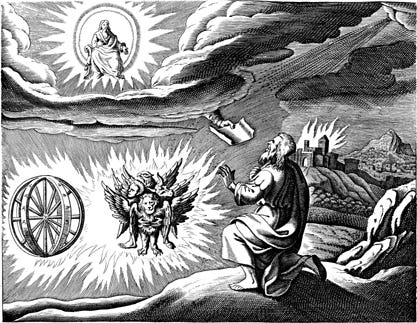
Ezekiel’s vision
One of the most neglected areas of contemporary Catholic theology is the subject known as angelology. This branch of theological study considers the Angels, their role in God’s Creation, and their role in the Salvation which He prepared across history. If we look closely at the Gospels, we find the Angels appearing regularly, often at the most important moments of the narrative. Perhaps the most obvious episode is when the Archangel Gabriel appears to the Virgin Mary, proclaiming the mystery of the Incarnation. Other such episodes abound. The Lord Jesus Christ receives some comfort from an Angel in Gethsemane, two Angels appear at the empty tomb once He has risen, and two Angels (we might wonder whether these two are the same) appear just after His Ascension into Heaven. They are also referred to at many points in Christ’s ministry. We are told that it was an Angel who stirred the waters of Siloam, so that the first person to enter the waters might be cured of their ailment. We find the Angels again referred to during Christ’s time in the wilderness, when the devil dares to try and tempt Him. Angels appear equally in the Book of Acts, freeing St. Peter from prison, and they are very present in the Book of the Apocalypse. All of this does suggest that they have quite a fundamental importance for any serious Christian theology. They can’t be ignored without ignoring the Scriptures themselves, nor can they be explained away as window-dressing.
Angelology has some unexpected facets, and it might seem strange at first glance, even incredible. Indeed, for anyone reading the Scriptures for the first time, the God of Israel can seem quite strange in His own right. In the first instance, Christian theology teaches with some authority that there are nine choirs of angelic beings. That is to say, there are nine distinct types or species of Angel, each praising God in its own way, and each having its own role in the Divine economy. These nine Orders of Heavenly Spirits can be subdivided into three spheres. In the highest sphere, that which is closest to God, we have the Seraphim, the Cherubim and the Ophanim (the Ophanim are also known as Thrones). These spirits are so close to God, to the Heavenly Throne, that they are quite difficult to describe. They are not anthropomorphic, as most of the other angels appear to be. In fact, these Angels are often represented in zoomorphic terms, sometimes as hybrids. This is conveyed in the Prophet Ezekiel, and also in Christian Icons, where the four Evangelists are often associated with these “Living Creatures”, with a human, an eagle, a lion, and an ox. Their power and their otherness is conveyed by the Eucharistic Prayer of St. John Chrysostom, which we may quote:
“It is proper and right to hymn You, to bless You, to praise You, to give thanks to You, and to worship You in every place of Your dominion. For You, O God, are ineffable, inconceivable, invisible, incomprehensible, existing forever, forever the same, You and Your only-begotten Son and Your Holy Spirit. You brought us out of nothing into being, and when we had fallen away, You raised us up again. You left nothing undone until you had led us up to heaven and granted us Your Kingdom, which is to come. For all these things, we thank You and Your only-begotten Son and Your Holy Spirit: for all things we know and do not know, for blessings manifest and hidden that have been bestowed on us. We thank You also for this Liturgy, which You have deigned to receive from our hands, even though thousands of archangels and tens of thousands of angels stand around You, the Cherubim and Seraphim, six-winged, many-eyed, soaring aloft upon their wings...”
Seraph
The Cherubim first appear in Genesis, after the Fall of humanity from the Garden of Eden. They guard the gates to the Garden, preventing any forced return, with rotating swords of flame. Two of them appear again seated atop the Ark of the Covenant, facing one another, with their wings touching. The symbolism of these two Cherubim runs deep: they symbolise the unity of the two natures of Christ in one Divine Person, they also represent the unity of the two Testaments in one Revelation, and in a final sense they represent the dynamic tension of the relationship between God and His People Israel. It is in the meeting of their wings that a Theophany becomes possible, an unveiling of God’s Omnipotence, a sense of the Mystery.
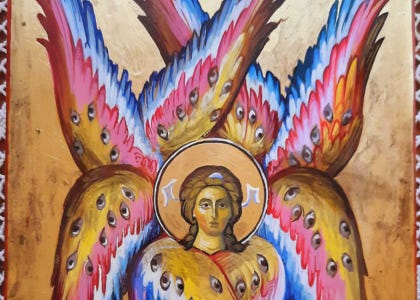
The Seraphim (it is thought that the devil was originally from this choir of Angels) are referred to in Isaiah, when the Prophet has a vision of the Heavenly Temple. He is unable to envisage the full splendour of God’s Majesty, and so his attention turns to the created beings surrounding it, in this case the Seraphim, who fly around the Throne, incessantly praising the Lord: “Holy, Holy, Holy, ...” It has been remarked elsewhere that this prayer reflects the tension between transcendence and immanence, the complete otherness of God, yet His engagement with humanity at the same time. The Seraphim are completely absorbed in praises of God, yet one of them descends to purify the lips of Isaiah with a burning coal. They have six wings: two of these wings are used to veil their faces, as the Glory of God is too much to bear without them. On this subject of veiling, we have some spiritual traces of a justification for the hijab, as found in Islamic doctrine.
The Ophanim are perhaps the most exotic of the angelic choirs. They are rarely mentioned in liturgical contexts, and they rarely appear in Holy Scripture. They are portrayed as living wheels, the wheels of God’s Chariot, which appears to simply be His Throne in movement. They appear as spheres, with innumerable eyes. In some sense, we have the impression that they are almost all-seeing, participating in God’s Omniscience to a high degree. All of this attests to their principal virtue: humility. Knowledge can be humbling. They are those Angels who bear the Divine Chariot, with all of its Glory, in humble service to the One who rides upon it. Wherever it goes, they follow in submission.
This first Order of Heavenly Spirits relates us to the heights of metaphysics. We have already mentioned elements like the Garden of Eden, God’s Throne, the Heavenly Temple, His Chariot, His Glory, and His Omniscience. There are many other such elements which we might describe, but that would constitute a study of categories, which might seek to describe each of these elements analogically, and to relate them to the fundamental contents of Christian theology. In fact, such a categorical study would ultimately seek after an understanding of the Divine Attributes. At this point, the questions become very profound. Is God’s Glory a created thing? Or is it uncreated? Is God’s Omniscience contingent on the created order? In any case, such metaphysical objects or realities are mostly invisible to us, and they mostly transcend our understanding. Humility is essential, and any enlightenment on Christian metaphysics ultimately comes from the prayerful work of contemplation. It is therefore usually the mystics who come to appreciate what some of this really means.
By Anthony MacIsaac