
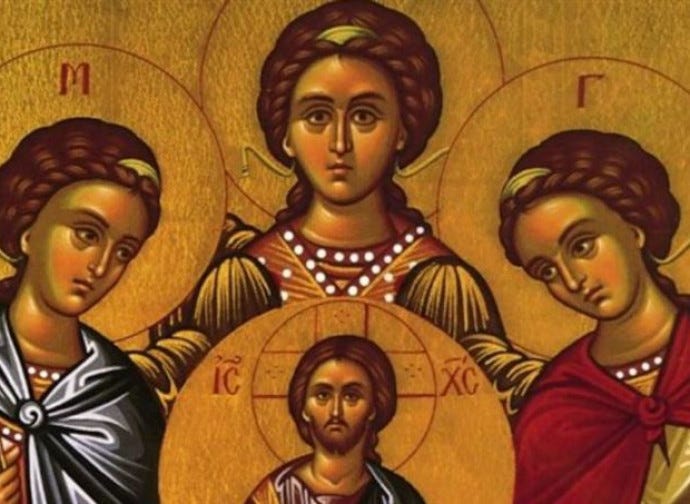
Archangels Michael, Gabriel and Raphael
Some of what we have said in the first instalment of Angelology is reflected in an excellent Patristic text, entitled The Noetic Paradise. The original Greek text may have been written in the 8th century, in one of the Palestinian Monasteries. The only surviving copy is a translation into Arabic. The document speaks of two Paradises, two Gardens of Eden. One is the traditional Garden, with all its physicality. The other is a Garden of the mind, or the Nous, and which formed a constitutive part of the original human condition. In this Noetic space, Adam and Eve were able to participate in the angelic communion, possibly to experience their angelic life to some degree. With the Fall, both the body and the mind were affected, and the Noetic Paradise was likewise closed off by a Cherub. Henceforth, the human mind struggles with the passions, with intrusive thoughts, and temptations on all sides. However, with contemplation, the Christian might purify their mind, so that eventually the angelic communion isn’t such a strange idea. In contemporary discourse, we often hear of mindfulness, of the connection between mental health and physical health. The Noetic Paradise is on the same theme, in that the purification of our mind goes in tandem with the purification of our body. As one Paradise opens up for us, at the end of our earthly life, so too does the other.
We come here to a truth of eschatology, one which often seems to go unnoticed. When all is said and done, when all who have died rise from their graves, and when the world is made anew as Christ comes in Glory at the Parousia, nothing can quite be the same as before. The very physics of creation will probably be reconfigured, and the hidden realities of metaphysics become visible. The angelic choirs, in all their splendour, will come into new communion with the ranks of Saints. Each person will finally be able to meet, if not to touch, their Guardian Angel. Since all things configure to Christ, we might look to Him to better understand some of the implications of these ideas.
In ancient Christianity, the Lord was often referred to by the title Christos Angelos, that is Christ the Angel. St. Paul hints at this in Galatians 4:14. Of course, the Church clearly defines the two natures of Christ as human and Divine. Perhaps the fact that the angelic nature isn’t explicitly mentioned suggests the relative inferiority of the angelic beings to the human. It nevertheless seems plausible that Christ incorporates all angelic reality into Himself. Indeed, He created the Angels in the first place. His Blessed Mother, the Virgin Mary, is dignified as Queen of the Angels. We might wonder how His Resurrection affected the angelic order, and how the eschatological accomplishment will be enjoyed by the Angels, what will it mean for their own experience? All we know is that there will be a communion with them, in the Body of Christ.
Much more could be said about all of this, and these are just some reflections on possible areas of theological study relating to angelology. We haven’t yet spoken much about the second and third spheres of the angelic choirs. One of the greatest Patristic authorities on the subject is Pseudo-Dionysius, who wrote The Celestial Hierarchy, and a companion piece entitled The Ecclesiastical Hierarchy - the two reflecting each other, in some ideal sense. The author was thought to be St. Dionysius the Areopagite, but we now know that the attribution is pseudepigraphal. Since the Church nevertheless received his writings under the appellation of St. Dionysius, there does seem to be a sense of authentic tradition. As with the authorship of Moses, regarding the Pentateuch, or the authorship of the Epistle to the Hebrews attributed to St. Paul, we have the idea of a living tradition somehow imbued with the spirit of these figures. In this sense, Moses is indeed the author of the Pentateuch, but not in a literal way. Likewise, the writings of Pseudo-Dionysius may well carry some of the spiritual inspiration of St. Dionysius, an Athenian disciple of St. Paul, and a Martyr. What we do know, in any case, is that the developed Angelology expressed in this work has roots in ancient Jewish Theology, and is inspired by the categories of Neoplatonist philosophy.
In The Celestial Hierarchy, all three spheres of angelic beings are described in some detail. The second Order comprises the Dominations, the Virtues and the Powers. The third Order includes the Principalities, Archangels and the Angels. Pseudo-Dionysius does admit that there may be other ranks of Heavenly Spirits beyond the nine choirs, and that the subject can’t be exhausted. Jewish theology often includes a tenth species of Angel, and it is difficult to fully draw equivalences between the second and third spheres of angelic beings in Christian theology, and the classes presented in Jewish tradition. Sometimes the Angels are referred to as Elohim, as “Godlike beings”, and contemporary theology might wonder whether some of the divinities in non-Christian religions are ultimately angelic in nature? In any case, the Dominions and Virtues are presented as those Angels most involved with the natural world – they are concerned with the Divine ordering of Creation, even on the level of planets and stars, and with the operation of miracles. The Powers are primarily charged with the restraining of evil, notably of demonic forces, and were invoked regularly by St. Teresa of Avila, to take one example. The final sphere of the angelic hierarchy is the most immanent, the closest to human concern. Principalities are thought to govern kingdoms, nations and institutions, with a view to inspiring greater reverence and love for God. The Archangels are involved in missions of special significance, and in communicating the Good News. Angels are messengers in a more general sense, and mediators of prayer and Grace, they are the most intimately associated with human beings.
Different authors after Pseudo-Dionysius have written about all of this. Within the French School of Spirituality, one of the most prolific was Ven. Henri Marie Boudon (1624-1702), Archdeacon of the Diocese of Evreux. His interest was primarily devotional, and his sources referred back to the Patristic writers. He notes, throughout his work entitled Devotion to the Nine Choirs of Holy Angels, that we are obliged in charity to express some devotion to the angelic spirits since they are continually concerned with our Salvation and are continually engaged in helping us. If we show lack of interest in their help, and if we fail to invoke their intercession before Christ, and before Our Blessed Mother as Queen of the Angels, we lose so many graces that might otherwise have come to us. Among the most obvious of these graces is protection from the evil spirits, the demons and their temptations. Whatever power God might allow the demons to exercise, the Angels always have more, and are powerful warriors against the onslaught of evil. It isn’t therefore surprising that the Angels are also highly significant at the hour of death, when they help assure the Christian of the grace of final perseverance.
The Mass intention for each day of the Novena would correspond to each of the angelic choirs: the first day in honour of the Holy Seraphim, through to the ninth day in honour of the Holy Angels. Such a Novena was offered in Scotland, in 2017, but in a private capacity. It suffices simply to register the Mass intentions with one or more Priests, and to attend the Masses for each choir.
St. Michael the Archangel has often been represented as the Angel of Death, charged with the weighing of souls at the Judgement. This is a motif which goes all the way back to ancient Egypt, in which we find the tradition of Anubis weighing the human heart against a feather. Regarding St. Michael, there is a sense that he might influence the balance in the soul’s favour, just as the demons attempt to influence it in the opposite direction. Hence why devotion to his care is recommended. Boudon suggests that sincere devotion to the Angels’ intercession is a “Mark of High Predestination”. Various prayers already exist, and perhaps the most famous today is the prayer composed by Pope Leo XIII, invoking the protection of St. Michael. Boudon offers us other possibilities too, the most interesting of which might be a Novena of Masses. The Mass intention for each day of the Novena would correspond to each of the angelic choirs: the first day in honour of the Holy Seraphim, through to the ninth day in honour of the Holy Angels. Such a Novena was offered in Scotland, in 2017, but in a private capacity. It suffices simply to register the Mass intentions with one or more Priests, and to attend the Masses for each choir.
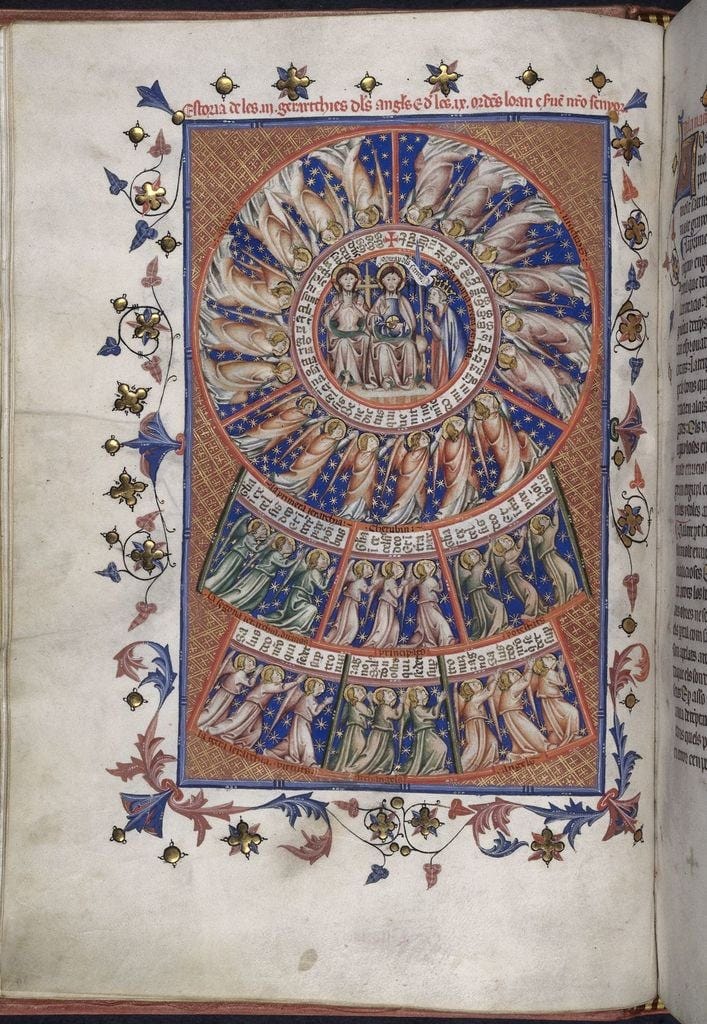
Image from f. 40v of Breviari d'Amor (Catalan prose version)
Alongside St. Michael, there are six other Archangels who occupy a special position in the Heavenly Order. These are the “Seven Angels who stand before the Throne”, and Boudon refers us to the idea that they participate in distributing the seven Gifts of the Holy Spirit, and in protecting us against the seven deadly sins. In some sense, they stand outside of the Nine Choirs, in a special relationship with God, although all appear to be Archangels. It is interesting to note that despite being of the second-lowest Choir, they were selected for a mission of the utmost significance. The singularity of these seven Angels is also reflected in other religious traditions, perhaps most notably in the Amesha Spenta of Zoroastrianism, who stand apart from the much more numerous class of Yazatas, and who seem to participate in a deeper way with the reality of God (Ahura Mazda), distributing His Grace.
St. Gabriel the Archangel is perhaps the other Angel best known to the Christian tradition, who we mentioned briefly at the outset of this article. He is principally found as a messenger, bringing good news to Daniel, and latterly to Our Blessed Mother. The Annunciation is forever associated with the ministry of St. Gabriel the Archangel - it is he who poses the question of the Incarnation to the Virgin Mary, precipitating her Fiat, and we continue to pray in the words of St. Gabriel as we say the Ave Maria. We are in communion with him each and every time we pray the Holy Rosary, or the Angelus. St. Raphael the Archangel is lesser known, but is likewise invoked in mainstream Catholic devotion. He appears in the Book of Tobit, appearing in the form of a man, aiding Tobit on his adventure, and curing his father Tobias of blindness. Along the way, he acts as matchmaker for Tobit, finding him his wife Sarah. In devotion he is therefore a patron of good meetings, and of healing.
The other four of these seven special Archangels aren’t well known, and appear only in apocryphal texts, if at all. Their names are venerated within Eastern Christianity, including the Eastern Catholic Churches. Theologically speaking, this means that they can be venerated, even if their names may not be completely accurate. While differing names can be found in different apocrypha, the rule of Lex Orandi, Lex Credenti helps us discern what names should be used in veneration. Perhaps the best known of these four is St. Uriel the Archangel. Paradoxically, he is identified with the Cherub guarding Eden, in some sources. He is also identified as the Archangel who helps the Holy Family in their flight to Egypt. He is a patron of the arts and the sciences. The remaining three Archangels include St. Barachiel, St. Jehudiel and St. Selatiel. The first is a patron of family life, of Mercy, of Blessings. The second is a patron over leadership, royalty, and spiritual endeavour. He is associated with reward and punishment. Finally, St. Selatiel is a patron of prayer, and is recounted as one of the Angels who helped redeem Adam and Eve, after their deaths. Sometimes, an Archangel associated with the name St. Jeremiel is also venerated, and he is associated with the “lifting up to God”. St. Raguel is likewise recognised in the Melkite Greek Catholic Church. Beyond these seven Angels, the only other Angel with a specific cultus appears to be the Angel of Portugal, associated with the events surrounding Fatima. In tradition, he is one of the Principalities, watching over the country of Portugal, although his name is unknown.
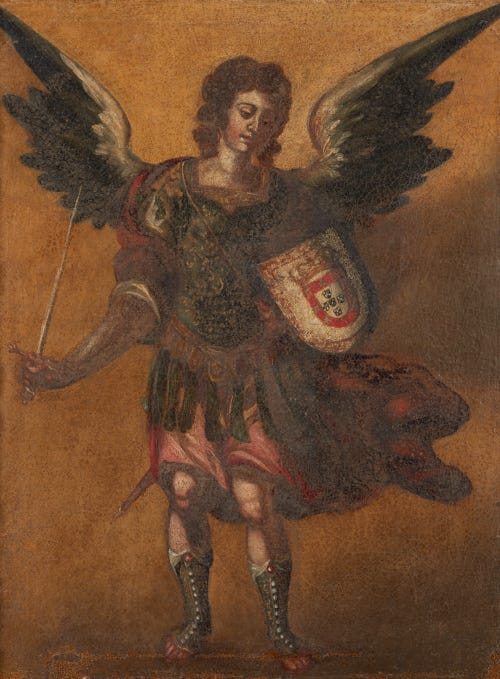
The Angel of Portugal
We might conclude our survey with a cursory glance at the Guardian Angels. Generally speaking, authors such as Boudon argue that almost all of the Guardian Angels are from the lowest Heavenly Choir. They are those Angels who assist us in the greatest way, and to whom we owe the greatest gratitude. They know us perhaps better than we know ourselves, and are consistently watching over us, even when we sin. Some traditions, such as one promoted in Opus Dei, suggest that we should silently salute the Guardian Angels of our friends, family and enemies. They are powerful intercessors.
By Anthony MacIsaac
In 2016, he became a devotional Knight of St. Michael the Archangel. Part of the spiritual responsibility associated with this devotion is to pray the Chaplet of St. Michael the Archangel daily, and to encourage greater devotion to the Angels.
Fascinating article!
"And Jesus answering, saith to them: Do ye not therefore err, because you know not the scriptures, nor the power of God? For when they shall rise again from the dead, they shall neither marry, nor be married, but are as the angels in heaven." -- Matthew 12:24-25