
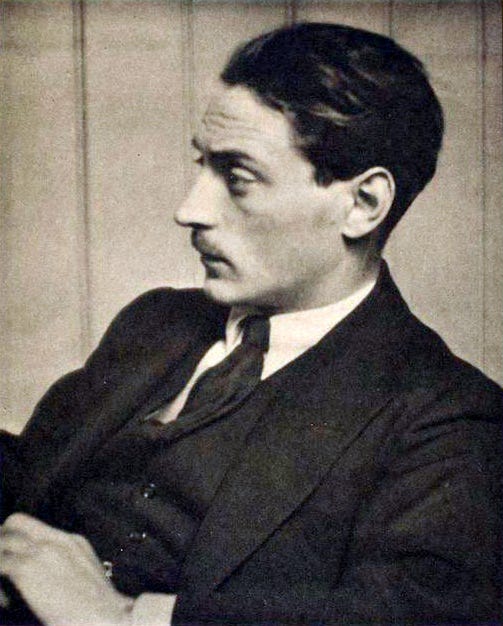
In addition to being a best-selling novelist, Compton Mackenzie was a Roman Catholic convert, a master-spy, a buyer of islands and a proud Scottish nationalist. His life was eventful and far from mysterious. Available sources include ten volumes of autobiography, four of war memoirs, a dozen works of non-fiction on various subjects and seven of miscellaneous recollections; in all a total of over three million words of self-description. In addition, he wrote some romans à clef which are all built closely upon events in his own life and upon emotions connected with those events so that their male protagonist often appear as shadows of their author rather than simply creations of his imagination. As a result, his personal papers, which are housed by the Humanities Resources Center at the University of Texas, offer little more than the published works in the realm of self-revelation.
Edward Montague Compton Mackenzie, known simply as Monty to family and friends, was born on 17 January 1883 in West Hartlepool, England. He was gifted with an exceptional memory and his constant lack of money forced him to write incessantly. He remained restless until his death, on 30 November 1972, resulting in a substantial bibliography of over a hundred works, including novels, essays, short stories, articles, poems, guidebooks, plays and screenplays. Nonetheless, quantity is not synonymous with quality, and if today Mackenzie is not celebrated among the greatest authors of British literature of the last century it is precisely because the outcome of his efforts did not always live up to expectations. After all, writing under pressure is never easy, and among his books, some of which are truly sublime, the potboilers are numerous.
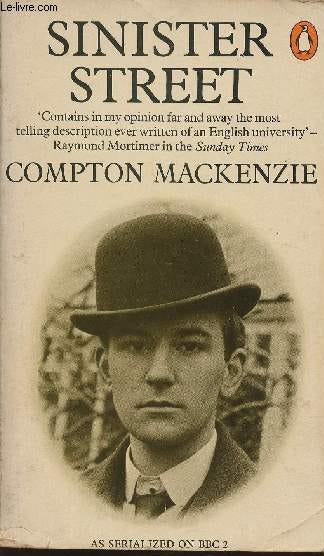
His debut, indeed, was remarkable. The novel Sinister Street, published in two volumes between 1913 and 1914, bluntly recounted the squalid moral lives of public school students. It was a succès de scandale that demonstrated the author’s unconventional and intelligently provocative approach. Young readers such as Evelyn Waugh, Scott Fitzgerald, Cyril Connolly and his schoolmate, the future George Orwell, appreciated it; Henry James went so far as to call the author “by far the most promising novelist of his generation.” Over time, however, the originality of his early work gradually faded; public and critical enthusiasm waned, and book sales also suffered a severe setback. Today, Mackenzie is remembered above all for two humorous novels set in the Hebrides, Monarch of the Glen (1941) and Whisky Galore (1947), which were adapted into a TV miniseries and two successful films, respectively. Almost all of his other work lies completely forgotten. The captivating hexology The Four Winds of Love (1937–1945), which constitutes a major fictional chronicle of the first forty years of the twentieth century, is no exception. The main protagonist is John Ogilvie and his story of passion, love and redemption has many points in common with Mackenzie’s life.
Since his father was the owner of a theatre company, constantly engaged in long tours throughout England, he was accustomed, from an early age, to a vagrant existence. The family was originally from Cromarty, in northern Scotland, and already in his schooldays Mackenzie took the Jacobite cause seriously to heart. Although raised to be a perfect subject of the Empire – in religious matters, for example, he was such a devout Anglican that he even toyed with the idea of taking orders – he sensed the atavistic call of the Highlands, even more so after his conversion to Catholicism in 1914. His book Catholicism and Scotland (1936), besides being a phenomenal indictment of Knox and the Puritan reformers, is the testimony of a man deeply in love with the Gaelic language, his homeland, and the Stuart monarchs (he also wrote in 1932 a biography titled Prince Charlie about Bonnie Prince Charlie).
Although Mackenzie was not Scottish by birth, his heart truly belonged to that land, and in 1928 he was among the founders of the National Party of Scotland, the predecessor of the current Scottish National Party. The NPS was the first Scottish nationalist political party, and the first to campaign for the country’s self-determination. Unlike the majority of his members, he was unwilling to compromise with London and desired full independence for Scotland. Furthermore, from 1931 to 1934, he served as Lord Rector of the University of Glasgow: the first Catholic since the Reformation to do so.
Despite his passion, opinions about him differed: some, like Hugh MacDiarmid, cited him as a nationalist who understood the essence of Scotland, others, including another leader of the Scottish Renaissance, Lewis Grassic, claimed that he could not even consider himself Scots.
However, for Mackenzie, Scotland was, in a certain sense, a parenthesis. His restless spirit, longing for contemplative solitude but also for noisy joviality, led him to travel extensively. He loved the islands, those secluded places that, especially in the first half of the twentieth century, were often frequented by false nobles, petty thieves and fugitives. With Faith Stone, the first of his three wives, he lived for some time in Capri, at Villa Solitaria, and dedicated two entertaining novels to the island, Vestal Fire (1927) and Extraordinary Women (1928). In the early 1920s he purchased the small islands of Herm and Jethou, in the English Channel; finally, he built a house on the island of Barra, in the Outer Hebrides, where his tomb is located. His friend D. H. Lawrence seems to have drawn inspiration from him for the protagonist of his The Man Who Loved Islands.
Towards the end of his life, when Scottish nationalism was no longer driven by idealists like himself but by those he perceived as cowardly politicians, Mackenzie devoted himself to defending the Greek cause during the Cold War. Greece was a country he knew well because during the First World War he was drafted into the British secret service operating in the Eastern Mediterranean, and one of its operational centres was in Athens. There he was the head of the counter-espionage and his prime task was to keep track of enemy agents and informers. He must have been a highly skilled spy if Mansfield Cumming, founder of MI6, wanted to appoint him his successor.
Scotland and Faith are therefore the poles between which Mackenzie’s best books moved: they deserve to be dusted off and read again.
In these last years the idea that also occupied him was the hatred of regimentation, whether by bureaucrats, colonialists or animal owners. He disliked almost equally the town planners, cars and popular culture. He joined the Campaign for Nuclear Disarmament, and became a founder member of the Committee of 100, an anti-war group.
Religion was another important issue in Mackenzie’s life. His decision to join the Church of Rome was, he stressed, “not to be regarded as a conversion but a submission, a logical surrender to an inevitable recognition of the fact that Jesus Chirst had founded his Church upon the rock of Peter”. And during his lifetime, the ecclesiastical hierarchy held him in the highest esteem. In May 1944, for example, with Hilaire Belloc mentally ill, he was the senior Catholic writer, and as such was asked to propose to toast to Cardinal Griffin, Archbishop of Westminster, at a dinner of Catholic writers.
On the other hand, his public image masked a less than transparent private life: his second wife, Christina MacSween, whom he married after Faith’s death, had been Mackenzie’s mistress for several years, and it seems he attended Mass only occasionally. Indeed, when he converted to Catholicism, he made it clear to the priest who instructed him that he could not alter his schoolboy belief that the orders of the Anglican priesthood were genuinely Catholic and in the apostolic succession. He therefore refused to accept them as invalid.
Overall, Mackenzie deserved much credit and gave the Catholic cause a valuable trilogy of novels: The Altar Steps (1922), The Parson’s Progress (1923), and The Heavenly Ladder (1924). They tell the story of Mark Lidderdale, an Anglican prelate who, after long and painful reflection, decides to convert to the true and only Church. Autobiographical elements, such as the protagonist’s difficult childhood, are mixed with an apologetic aim, and some of the themes already present in Sinister Street – modern atheism, sin, and love – are brilliantly reimagined with a new moral meaning.
Finally, he was also a journalist, founder of the music magazine Gramophone, an early radio personality and one of television’s first big names.
Mackenzie, the forgotten writer, was an example to other excellent Scottish Catholic authors, including Bruce Marshall, Muriel Spark, and George MacKay Brown. His witty and light-hearted novels are an extraordinary testimony to a deep-rooted identity, and they tell the story of a people and a religion that modernity has tried in vain to erase. Scotland and Faith are therefore the poles between which Mackenzie’s best books moved: they deserve to be dusted off and read again.
By Luca Fumagalli