
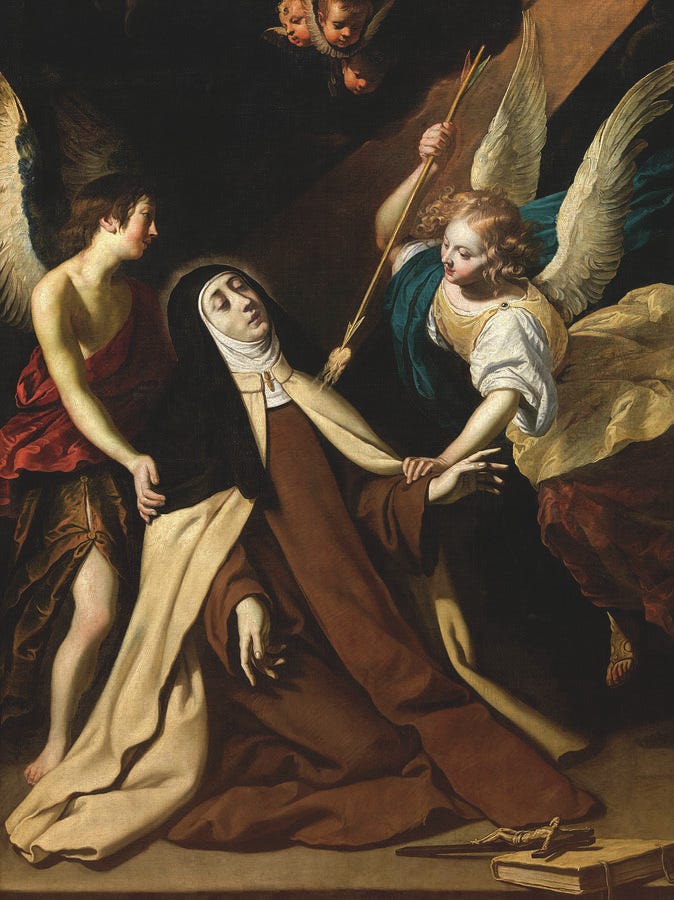
The Catholic Church is replete with miracles like levitation, stigmata, ecstatic trances, visions of Jesus and Mary, bilocation (being in two places at once) and speaking with animals. Saints like St Pio of Petricichino, St Teresa of Avila, St Joseph of Cupertino, St Francis of Assisi and St Phillip Neri to name just a few, all reported such signs - as did their followers and those who in some instances became their enemies. A more recent claim comes in the form of Natuzza Evolo, born in Calabria in 1924 to a poor family, married and had 5 children. In her life-time she spoke with Angels, had communication with Mary who presented herself as thev Immaculate Heart of Mary Refuge of Souls, bilocation, ecstasies and stigmata. Her Cause was opened upon her death in 2018 in Diocese of Mileto-Nicotera-Tropea.
Yet with such a rich tapestry of the miraculous woven into our tradition, both past and present, Scottish Parishes in the main have engineered a faith that appears more sociological, material, and although would carry devotions to the Saints would not necessarily be promoters of their more miraculous feats, let alone teach that it is possible these things can happen today and amongst ordinary folk.The excellent book; They Flew, by Carlos Eire, recounts many of the miraculous stories of Saints seeking to understand the context in which these spiritual experiences could manifest. The book is not so much about proving that St Joseph of Cupertino really did levitate over Pope Urban VIII but that our understanding, and current paradigm of supernatural and natural may not help us explain these events. I would recommend the book to all but it got me thinking about Scotland. Where was the levitating Saints in the convents and monasteries of Scotland? How did the Reformation and subsequent periods of suppression (and renewal) affect the faith in, or appetite for these quite extraordinary events?
As Eire wrote, the early Protestant reformers and the Church would do battle in this realm. Early Protestants took what was is called a cessationist line, in that, the miracles of the New Testament stopped occurring when the last Apostle died – arguing that they were no longer necessary. It was a useful bat to use against the Catholic Church that not only believed in miracles but would promote them as evidence of the Roman Catholic Church being the True Church. But, the enlightenment and this ideological tussle with Protestant apologists would effect how the church investigated and declare the truth of a miracle attributed to someone; with the devil not far away, the Church’s main concern was that neither charlatan nor demonic power could lead its flock astray.
As the modern period dawned and as the reformation took its powerful turn in Scotland, the last reference to any sort of Spiritual experience by a Catholic is of St John Ogilvie – which although does not speak of levitation, does speak of an ecstatic experience. It does not appear we have any other recorded manifestations, which does not mean they did not happen amongst the Catholic communities but as the Monks and Nuns were expelled, the locations in which these sorts of miracles seemed to flourish on the continent disappeared here. Whether in the more far flung communities of the Highland recusants instances of this happened, is unknown to this author. A useful comparison in this regard might be with Spain. It did not suffer from the Reformation greatly and had some of the largest numbers of people claiming these miraculous experiences along with eye-witness accounts. Most experiences seemed to happen in Religious communities so a good starting point at why Scotland seemed to have little known examples of this is that there was no environment in which the sort of devotions, mortifications and holiness that seemed to produce these feats was available. Or indeed for there to be anyone to record such events.
So although it is possible people did indeed levitate, or manifest the Stigmata or have visions we do not appear to have any record of such things happening once Protestantism took root. However, by the 18th century something was happening within Protestantism itself which began to look like a version of these spiritual experiences. The Wesleyan movements (offshoots of the Methodist founders John and Charles Wesley) would begin to see the growth of a Holiness Movement that emphasised Christian Perfection and would hold large meetings in public which would provide testimony of people falling down under the deep weight of sin, weeping uncontrollably and then the joy of forgiveness. There was the idea of a second work of grace that was separate to someone ‘being saved’. This would eventually feed the idea of the Baptism of the Holy Spirit (which we will get into later). Out of these movements, including the Quakers who emphasised hearing and then speaking Gods prophetic word, came the Great Awakening of the American colonies and Britain in the 18th century, followed by more sustained revivals again in America but also Ulster and Scotland in the 19th century. As one paper reported:
‘When John Horner came from the Irish Coleraine revival to preach at the Religious Institution Rooms in Glasgow on 24th July 1859, the congregation began to experience what was happening in Ulster and America. According to The Scottish Guardian scores of people were “in great distress” and “many were seen weeping”.
The miraculous in the form of healing from sickness and speaking in tongues would come to Port Glasgow in 1830. Edward Irving, a Scottish clergymen and eventual founder of the Catholic Apostolic Church (not a Roman Catholic offshoot!) began operating an increasingly successful ministry that in the words of his biographer, Margaret Oliphant, believed:
“...unclaimed and unexercised supernatural endowments, which had died out of use so long, would be restored only at the time of the Second Advent, in the miraculous reign, of which they form a fitting adjunct,” and “that the Holy Ghost ought to be manifested among us all, the same as ever He was in any one of the primitive Churches.
This seemed confirmed when a Port Glasgow woman called Mary Campbell began speaking like the Apostles did after Pentecost. Again Oliphant writing about her:
‘When in the midst of their devotion, the Holy Ghost came with mighty power upon the sick woman as she lay in her weakness, and constrained her to speak at great length, and with superhuman strength, in an unknown tongue, to the astonishment of all who heard, and to her own great edification and enjoyment in God..’
For some this would be the foreshadowing of the Pentecostal movement of the 20th century and subsequent charismatic movement which the Catholic church itself would go onto embrace. What does appear to be common in all the examples of revival, and the manifestation of the gifts of tongues, healing and other gifts as spoken of by St Paul in Corinthians; was the depth and passion of devotion, the amount of prayer, time at religious meetings and in a community of willing believers. They also believed in the possibility of the supernatural and that it was for all.
There appears to be scant evidence of Scottish Catholic experiences in this regard during the same period. There are possible explanations though. All penal laws in Britain had been revoked by the mid-19th century, and the growing numbers of Irish and Highland Catholics filling the urban areas of Scotland brought with it a boom in church building and growth of religious orders and schools.There was however still a mistrust and prejudice of Catholics, especially the Irish. Their poverty, to many Scottish Protestants seemed to confirm the falsity of their religion. For the Irish in Scotland, and other Scottish Catholics a balance would be walked between embracing all that the 19th century British empire could bring to them, with the drive (mostly by the clergy) to ensure they stayed Catholic and retained Catholic devotional life in a land that had industrialised at a faster rate than even England did. I would suggest this more defensive attitude taken, along with the great social need made the priorities focus on just this.
Another aspect however should be highlighted here. The miraculous in Catholic circles was (and still is) seen as an offshoot of a particularly holy life, one that for many Catholics then as now, would seem out of reach of most of us. How many of us for instance really believe God is calling us to be a St Joseph of Cupertino? As mentioned above the clash with protestantism would change how the Catholic Church dealt with these sorts of cases. To prove ones miracles, one had to be holy and above reproach - otherwise it was fake or demonic. In this environment then, is is it a surprise we do not seem to have instances similar to Mary Campbell let alone bilocation or levitation?
By the 1960’s a new protestant miracle movement would take shape with the advent of charismatic churches in the US. It would come to Britain around the same time and eventually would inspire the Catholic Charismatic renewal. Much like the Holiness movements, the new charismatics would operate in varying sizes of public meeting, would emphasise a second experience and a community that accepted and promoted speaking in tongues, prophecy and other miracles. What was different was the emphasis in holiness would decrease, but a new understanding of empowerment to do mission became the reasoning behind why the gifts were necessary. What also came along with it was a new praxis in how to do church, music, ecclesiology and tied to elements of it - the so called Prosperity gospel. Another notable influence should be mentioned is the Word of Faith movement here. St Paul’s letter to the Corinthians, and the Acts of the Apostles are the scriptural bedrock for belief in all these interconnected movements, including Catholic. Charismatic Church movements would explode into mega churches and church planting networks -so much so that today the ‘Charismatic church’ is globally the fastest growing of any branch of Christianity.
What are Catholics to make of this? For many there is an ascent to the idea of speak in tongues but usually with a not for me thought. There is a strong movement toward the Charismatic in programmes like Divine Renovation, as well as Sycamore and of course Alpha, which has taken onboard many non-denominational protestant frameworks for its thinking on how to do mission and why. The belief appears to be that for the Church to do mission successfully one must be baptised in the Spirit. Yet for all the proliferation of charismatic churches and belief of these gifts, including in the Roman Catholic Church, there is still no room for bilocation, levitation, stigmata or blood miracles of the Eucharist in this new wave of miraculous.
On one hand, should it be a surprise, as these are special graces that are few and far between? Might we then view the modern charismatic turn as a sort of correction, or reaffirmation to the idea that the miraculous is not just for the Religious or those seemingly superhuman in their holiness? Or rather, does it reveal more about what we think of as holy and what it means, and therefore, what we are able to become? Is it shedding a light on our lack of knowledge, and type of environment we are in, to know how to be perfect as our Father in heaven is? I think it is also revealing of how we view the natural and supernatural. God is not constrained by these definitions and divisions of life yet we can thank the enlightenment for constraining us! How can the one who is ‘in all’ be suddenly only around when someone appears thousands of miles away from where their body is? Is Jesus not also there when you make the coffee or do a decade of the rosary? If we think God has given us the gift of service or charity - are those gifts and callings really that different from having prophetic words of knowledge, or gifts of healing St Paul taught the Corinthians about? These gifts have the same author and the same purpose - the building up of the body of Christ, His Church. Therefore, if we can accept these corporeal gifts, why not the miraculous?
So, should we be seeking levitation in today’s modern Scotland? None of the authentic cases of levitation or bilocation were ever sought - only a deeper and deeper abandonment to God. In fact, many of the Saints asked God to stop them. So in that respect, no we should not. But what these Saints do challenge us on is how much do we want to submit to God? How much of ourselves are we willing to spend? If we said Yes to God more, might we one day find ourselves flying?
By Eric Hanna