
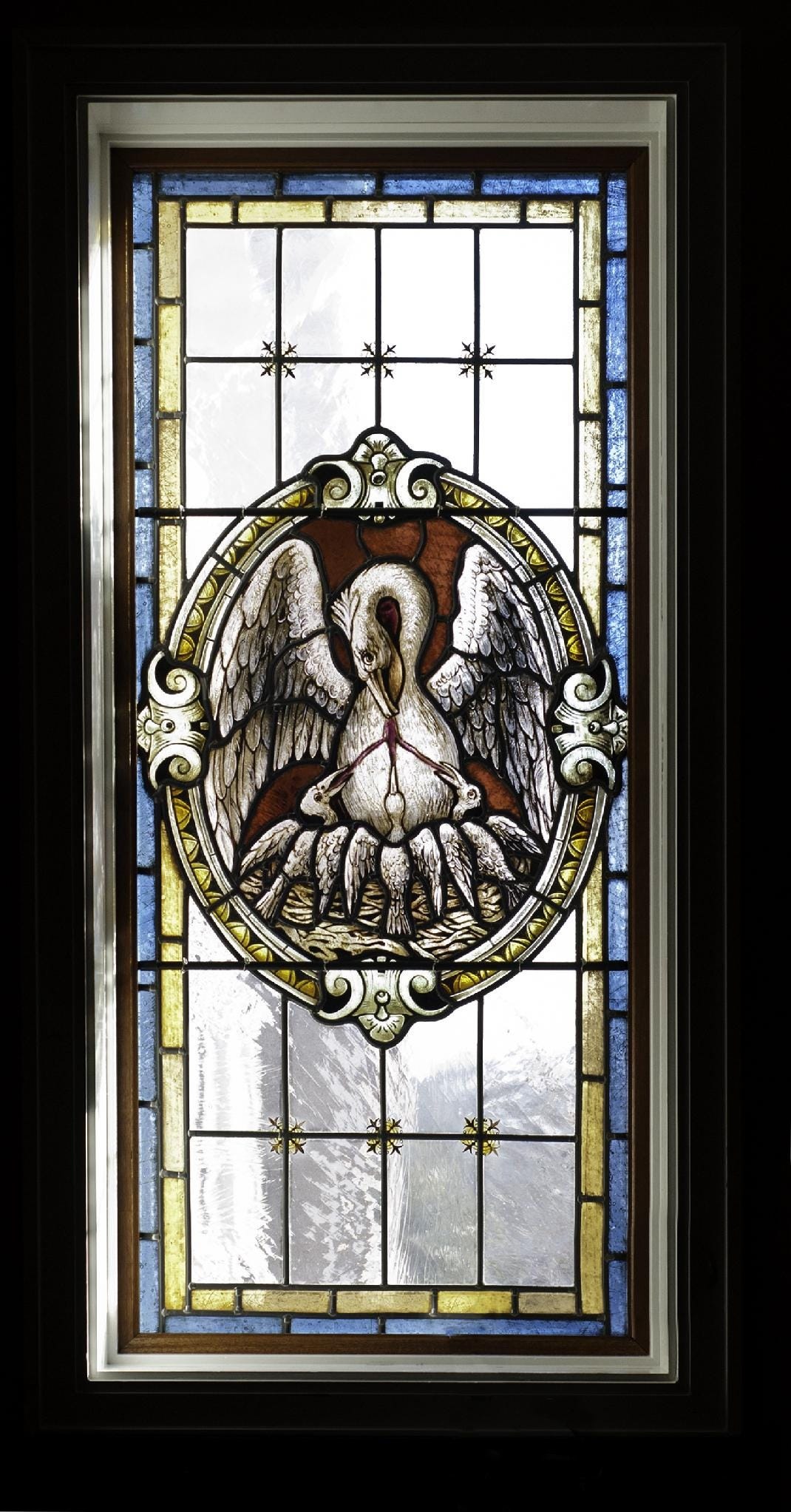
The image of a pelican is commonplace in sacristies around the world. The self-sacrificial love of the pelican as she feeds her young is clearly symbolic of the self-sacrificial love of Christ as he feeds his Church through the gift of the Eucharist. As the pelican sustains her young with her own blood, so too does Christ.
On the night before he died, Jesus took bread, blessed it, broke it, gave it to his disciples and said, “This is my Body, given for you” (Luke 22:19). By instituting this eucharistic sacrifice, Jesus was entrusting to his beloved bride, the Church, not just a memorial of his death and resurrection, but also a way of remaining with us res et sacramentum through his Real Presence. He was giving us the inexpressible gift of himself, so that, through this wondrous exchange, he may in turn fashion us for himself as an eternal gift to the Father.
It belongs to friendship to want to communicate oneself to one’s friend. When speaking on the topic of the Last Supper, St. Thomas Aquinas commented that: “Last words, chiefly such as are spoken by departing friends, are committed most deeply to memory; since then especially affection for friends is more enkindled, and the things which affect us most are impressed the deepest in the soul” (ST III, q.73, a.5). Simply put, we have a tendency to remember the words spoken by the people we love. Most especially when these words are spoken during an emotional farewell. It is unsurprising, then, that the disciples were able to recall the lengthy words spoken by Christ during his Last Supper discourse, “I have called you friends, because all things that I have heard from My Father I have made known to you.” (John 15:15) But to what extent can we truly claim friendship with God?
St. Thomas believes that for friendship to exist, there needs to be some measure of equality between the friends. Are we equal to God in anyway? Certainly not by nature. But in the totality of his great love for us, God has made us partakers in his divine nature in his Son. The original friendship that had been lost through disobedience has now been restored to us through the Blood of Christ. When commenting on the Gospel of John, in Homily 86, St. Augustine says: “Friendship is born between equals, or makes them so.” In this regard, it is through the instrumentality of Christ’s sacred humanity, and the grace that flows from it, that we become capable of friendship with God.
When describing the Eucharist, St. Thomas calls it “the sacrament of charity, the bond of perfection” (ST III, q.73, a.3). Through this sacrament of charity, the soul is united to Christ in love and brought to perfection through the gift of his divine grace. Just as love begets union, charity transforms the lover into the beloved. What does this mean for us? That through the reception of this sacrament our minds and hearts become slowly transformed by Christ’s grace; we begin to see as he sees, to think as he thinks, and to love as he loves. Through this great sacrament, our lives become patterned after that of Jesus Christ, so that, like him, we may learn to have an interior disposition toward the Father that is always ready to say: “Thy will be done.” Through our union with Christ, mankind’s relationship with God is radically transformed into one of friendship. Thus, each time we receive the Eucharist, we enter into an ever-deepening friendship with God through charity, in which He shares His very self with us through grace.
In the mystery of the Eucharist, mankind enters into the mysterious marriage covenant wrought between Christ and his Church on the wood of the cross. This marriage covenant, once believed by the Israelites to mean a simple standing in God’s presence, is now actuated by a sacramental union through which Christ shares his very Body with us in total self-gift. By the nature of this wonderous exchange, mankind is elevated to a level hitherto inconceivable; for grace alone makes us capable of receiving Christ’s perfect self-offering and of offering ourselves to him in return. As St. Thomas Aquinas penned in his famous Eucharistic hymn: O salutáris Hóstia, quae caeli pandis óstium. Christ came so that we might have life and have it more abundantly (John 10:10).
Are there social implications to this exchange? Indeed. In Deus Caritas Est, Pope Benedict XVI reminds us that “union with Christ is also union with all those to whom his gives himself” (DCE 14). Thus, from our one intimate friendship with Christ flows a multitude of friendships with all he calls friend. From this one friendship ripples a sea of friendships effectuated by and sustained in the eucharistic communion of charity. Pope Benedict goes onto say: “Eucharistic communion includes the reality both of being loved and of loving others in turn. A Eucharist which does not pass over into the concrete practice of love is intrinsically fragmented.” We see this fragmentation perhaps most clearly in social relationships that are not grounded in true charity. Charity is, by its very nature, a unifying force that fosters bonds of authentic communion and has the ability to order rightly all lesser loves according to the pattern of Christ’s sacrificial love that we see so clearly from the cross.
Christ left us this example, so that we could follow in his footsteps. How is authentic friendship to be rightly understood then? Well, perhaps it involves not just willing the good of the other, but also a willingness to be vulnerable before the other. It involves a willingness to be seen in truth by the other, and to trust that you will be accepted despite your brokenness. When Christ instituted his eucharistic friendship with us, he did so not only in the glorified state of his resurrected body, but also in the wounded state of his sacred humanity. He was willing to be vulnerable and exposed on the wood of the cross, so that, by gazing upon the one whom we had pierced, we might come to know that no obstacle was so insurmountable, no sin of ours so great, so as to separate us from his invitation to friendship.
The reality of this great invitation to friendship holds true when we gaze upon his Eucharistic Presence in the monstrance. By gazing upon the one whom we have pierced, we see reflected back at us a love that is stronger than death. It is no great wonder then that, when speaking on the Eucharist, St. Thomas chose to include a quote from the Song of Songs: “Eat, O friends, and drink, and be inebriated, my dearly beloved” (ST III, q.79, a.1, ad.2). We see, exposed for us on the altar, the heart of one who was willing to be poured out and emptied of all strength and pretence to become a perfect receptacle for divine love. It is said that love abolished the chasm that separated the Creator from the creature, since the characteristic of love is to lower oneself. For this reason, Christ became poor for our sake, so that we might become rich by his poverty. During Eucharistic Adoration, we are met by the gaze of one who is not scandalized by our weakness, but who has been equally tempted in every way, yet without sin. We are met by the gaze of one who looks at us in the brokenness of our humanity and sees not problems to be fixed but persons to be loved, for charity is the best healer and grace the best medicine. And the healing balm of this grace, channelled to us through the sacramental economy, is sweeter than any medicine for, by it, Christ is able to unite those parts of our hearts that have been ruptured by sin. Through his eucharistic friendship, we are bathed in the sweetness of his grace and strengthened in our journey toward the heavenly realities foreshadowed therein (see Roman Missal, Preface for Corpus Christi).
When writing to one another, my religious sisters will often end their letters by saying: “See you in the Eucharist.” This is not a throw away comment, but the remembrance of a sacramental reality. A reality that, although we are scattered throughout the world, we are bound together by the noble bonds of charity, united in Christ by our common “yes” to Him. On this great Solemnity of Corpus Christi, may our collective “yes” as a Church continue to draw us into an ever-deeper friendship with the One we all call Friend.
By Sister Isabelle Marie
Sr Isabelle Marie part of the Dominican Sisters of St Cecilia whose Mother House is in Nashville but with a significant (and much loved) outpost in Elgin in the Diocese of Aberdeen. They run the Ogilvie Centre with a ministry toward young people, evangelisation and catechesis.