
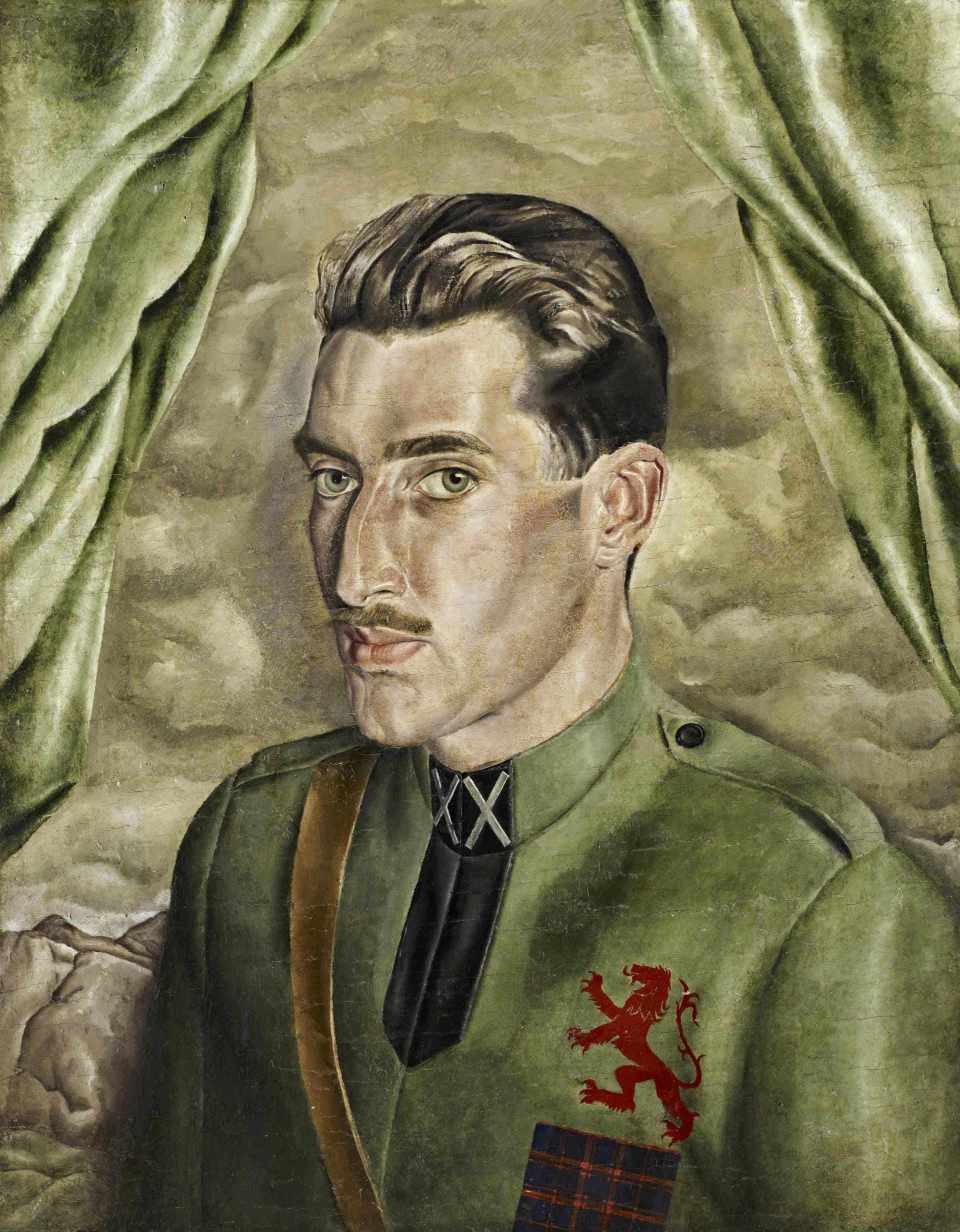
Often compared to Neil Gunn for his novels set in the Highlands and to George Mackay Brown for his conversion to Catholicism, Fionn Mac Colla is now an almost entirely forgotten writer. None of his books are reprinted, and when his work is discussed, the focus is usually exclusively on his Gaelic and Scottish nationalism or his polemics against the Reformation, which he considered a national disaster. The poet David Morrison edits the only noteworthy monograph on him, Essays on Fionn Mac Colla (1973); otherwise, one can find only a few articles, a handful of university theses, and, at most, brief references in volumes on Scottish literature.
Yet in the 1930s, Mac Colla was a young author who seemed destined for success. Among his most famous supporters was Hugh MacDiarmid, who even called him “a radical genius,” and Edwin Muir, Compton Mackenzie, and others also praised him. In addition to his novels, his journalistic work also contributes significantly to understanding Scottish nationalism and early twentieth-century politics.
Mac Colla’s current neglect is likely due to his aggressive, controversial style and his repeated accusations of provincialism, linked to his passion for Gaelic. Nor should it be forgotten that his output was rather limited: during his lifetime, he published only two novels, The Albannach (1932) and And the Cock Crew (1945), a short story, Scottish Noël (1958), and a polemical essay with a political and cultural slant entitled At the Sign of the Clenched Fist (1967). After his death, his autobiography, Too Long in This Condition (1975), was published—more a history of the evolution of his thought than a chronicle of his life—and the novels The Ministers (1979) and Move Up, John (1994), extensively revised and edited by John Herdman, his wife, and editor Ruth McQuillan. More oriented toward religious debate, these latter works contain autobiographical insights that testify to the intellectual’s struggle to be heard, resulting in misunderstanding, ostracization, and isolation.
Fionn Mac Colla, the pen name of Thomas Douglas MacDonald, was born in Montrose on March 4, 1906. The surname Douglas was that of his mother’s family, originally from the northeast, while that of his father, a shoemaker and adherent to the evangelical Plymouth Brethren movement, came from Easter Ross, a part of the Highlands where Gaelic was still spoken. Mac Colla was proud to be Scottish—”my roots in the soil of Alba,” proclaims the protagonist of The Albannach—and, as he recounts in his autobiography, he firmly believed that all the good he had achieved as a writer and polemicist was due to the families from which he descended.
During his years at Montrose Academy, where he clearly perceived how the entire school system was designed to indoctrinate students, transforming them into loyal subjects of the empire, his nationalism and his passion for the Gaelic language and culture developed. It was no coincidence that, after graduating with honours from the Teacher Training College in Aberdeen, in 1926 he decided on a position as headmaster in the northwest, more precisely in Laide, in the Gairloch district. However, the bitter realization that the school was systematically Anglicizing students soon dampened his enthusiasm. He then moved to Palestine for three years as a teacher-cum-missionary at the United Free Church of Scotland’s College in Safed. Upon returning home, he joined the newly formed National Party of Scotland, annoyed by the hypocrisy of the Independent Labour Party, which paid lip service to social justice and Scottish self-government but in reality revealed itself to be a gang of careerists and profiteers.
Meanwhile, he had begun writing, adopting a nom de plume that left no doubt about the identitarian and pugnacious direction his prose would take: Fionn Mac Colla is, in fact, the Scottish Gaelic translation of Fionn MacCool, the Celtic hero of the Fenian cycle, but is also a reference to the legendary 17th-century Catholic Highland warrior Alasdair Mac Colla Chiotaich Mac Dhòmhnaill.
Between 1932 and 1933, he contributed to the nationalist periodical The Free Man, edited by Robin Black and MacDiarmid. His articles, some of which were signed with the pseudonym Ludovic Grant, focused primarily on the benefits of independence, but also explored history, society, and language, often comparing Scotland with other European nations. Mac Colla’s contributions, like those of the other Free Man authors, were instrumental in providing a solid political and cultural ground for the Scottish National Party, founded in 1934.
The following year, in Dundee, he was received into the Catholic Church and in 1936 married Mary Doyle, originally from Islay, whom he had met during his brief stint at the New University Society. For twenty years, from 1941 to 1961, Mac Colla and his wife lived in the Western Isles, where he served as headmaster in Benbecula and then Barra. He spent the last years of his life in Edinburgh, where he died on July 20, 1975. His remains rest at Mount Vernon Cemetery.
Despite his vigorous defence of Gaelic, almost all of Mac Colla’s writing is in English. In all likelihood, although he knew the language, he did not feel proficient enough to use it to write a novel or, in general, long, complex texts. Yet Gaelic, central to his nationalist discourse, embodied for him a vision of Scotland’s political and cultural independence that went far beyond the purely linguistic phenomenon: “Gaelic gave the nation its unity, despite later incursions of Northern English, it continued to be the national language in almost every part of the country,” he wrote in At the Sign of the Clenched Fist. Over time, Mac Colla came to equate the Gaelic question with the religious one, arguing that the decline of Gaelic was largely attributable to the penetration of Calvinism in Scotland. In his view, the Presbyterian Church had betrayed the people’s culture by removing the vital link between Catholicism and the nation-state that still existed in Ireland. Like other authors of the so-called “Scottish Renaissance,” he also launched a fierce polemic against Knox and the other reformers, advocates of an anti-communitarian individualism that England had easily exploited for its own gain, going so far as to declare that “Reformation Protestantism was not Christianity, or even a form of Christianity, but its almost complete antithesis.”
Similar ideas find their way into Mac Colla’s articles and essays, but also into his novels, the best of which, many consider, are the two he published during his lifetime.
The protagonist of The Albannach is Murdo Anderson, in some ways a predecessor of the many “angry young men” of later literature. Forced to abandon his studies in the city due to the death of his parents, he returns to his Highland community but struggles to reintegrate. He then becomes trapped in a loveless marriage and begins drinking, a vice that causes the death of his son. Alone, desperate, and determined to kill himself, Murdo is ultimately saved spiritually and socially by the rediscovery of his Gaelic heritage. The novel, at times stark in its realism, establishes a fascinating connection between places, people, and identities that embodies an invitation to hold fast to one’s roots, the only certainty in a hypocritical and constantly changing world.
Also And the Cock Crew addresses the theme of Gaelic culture and the deadly interference of Calvinism, but the tone is darker, and the characters acquire a more complex psychology. Furthermore, the story, influenced by Maritain’s philosophy, gradually distances itself from its historical significance to take on a universal meaning. The book explores the conflict between Highland traditions and nascent capitalism during the Highland Clearances – the evictions of a significant number of tenants in the Highlands and Islands – while Minister Sachairi experiences a wrenching struggle between his religious devotion and social injustice. The assimilation of the Gaelic world into the empire, the defeat of Jacobitism, and the forced expulsion of families from their homes are the chronicle of a tragedy marked by injustice, of a Scotland forced into silence.
In 1932, the artist Edward Baird, also a native of Montrose, completed his famous portrait of Mac Colla entitled Portrait of a Young Scotsman. The painting, lost for over seventy years, was fortuitously rediscovered in 2010 and is currently on display at the National Portrait Gallery in Edinburgh. Mac Colla, dressed in a uniform similar to that of the Irish Republican Army emblazoned with a rampant red lion, in his sharp profile and gaze reveal the courage of a man who never bowed to any compromise, relentlessly pursuing his identity-based battle for freedom. Duncan Glen wrote of him as a “literary nationalist,” and perhaps there is no better definition for an author who truly deserves to be rediscovered and appreciated for his impetuous prose, but also for the love of his fellow men and of God that pervades every one of his books.
By Luca Fumagalli