
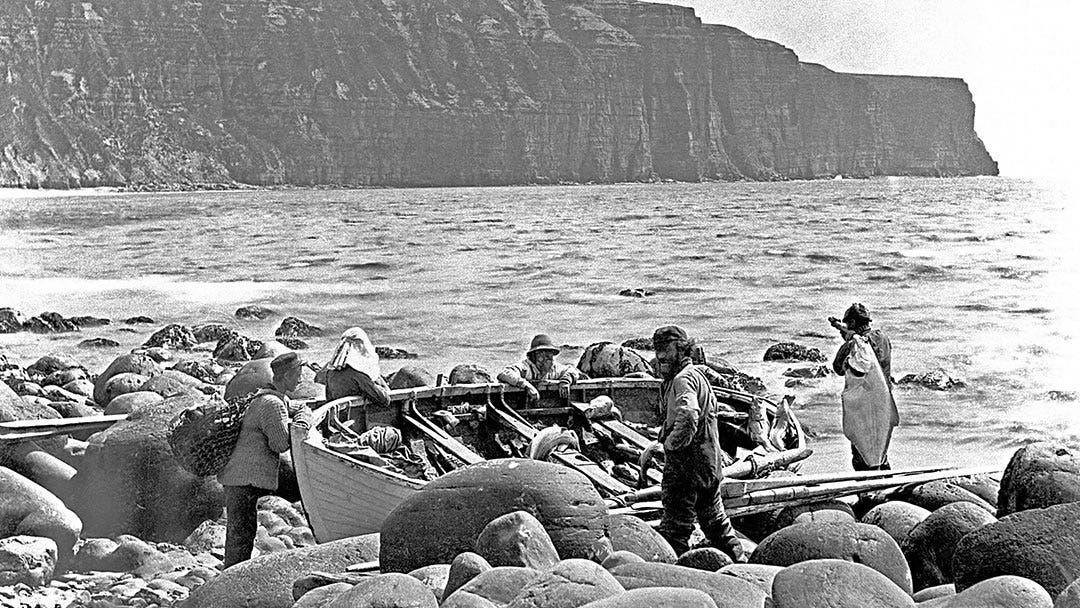
Rackwick Bay, one of the most important and recurring places in George Mackay Brown’s work, is a splendid valley located in the north-western part of Hoy, the second largest island of the Orkney. Brown visited it for the first time with some friends in the summer of 1946, during a particularly bleak period in his life, marked by semi-debilitating tuberculosis and days that followed each other with a sense of aimless monotony. He was captivated by it, and no other place would ever have such an intimate impact on him. From that moment on, the bay represented for him a sort of “Tir-nan-Og,” an earthly paradise, an inexhaustible source of inspiration, and a haven of peace and security. His friend, composer Peter Maxwell Davies, also fell in love with Rackwick, even wanting to move there, to a small farmhouse he had renovated.
However, even a wonderful place like that concealed its shadows, of which Brown was perfectly aware: in the mid-19th century, Rackwick had a population of about 150 inhabitants working small crofts, but at the time of his visit, only a handful of them remained, almost completely isolated from the rest of the world (twenty-five years later, there would be only one resident farmer). After all, life in the bay was far from easy, and it was capricious nature that dictated the law. Sometimes there could be unexpected strokes of luck, such as when, before the advent of coastal lighthouses, ships were wrecked, leaving their precious cargo on the beach, but these were still rare occurrences. Even the inhabitants could be the cause of their own misfortunes, as evidenced by the sad story of Betty Corrigall, who committed suicide around 1770 after being impregnated and abandoned by a sailor.
Aside from this, Brown sensed something positive underlying the existential rhythm of the valley’s farmer-fishermen, marked by an endless cycle of “birth, love, labour, death” that had remained unchanged for generations. Moreover, it was by meditating on Rackwick’s tragic fate that he came to develop the idea that it is “Progress” that leads to worsening things, severing the essential bonds that exist between people, the earth, and Heaven. Electric light, improved transportation, and mechanization are therefore, according to Brown, some of the manifestations of that new materialist faith that does nothing but drain the lifeblood from human beings, filling them with comforts and offering them the illusion of inexhaustible happiness. Rackwick has emptied precisely because young people have been driven elsewhere by the opportunities offered by an ever-expanding world, seeking less demanding employment than that of their ancestors. Hence the belief that the artist’s ultimate goal is to constantly remind people of their roots.
The bay appears in several of Brown’s works. For example, a chapter of An Orkney Tapestry (1969) is dedicated to it, and it is the setting for the events described in The Golden Bird (1987). The work that showcases it most, nonetheless, making it in a certain sense the protagonist, is the poetic cycle Fishermen with Ploughs (1971), whose title takes from a line from “Rackwick,” one of the poems of The Storm (1954).
Brown had been working on a series of poems that would tell the story of the valley, between glory and decadence, since the spring of 1965. It was a long and not always easy task, but he was rewarded by the positive response from the public and critics, so much so that a reviewer described him as “one of the consummate masters of poetry in Britain today.” Brown, generally highly self-critical, admitted in his autobiography that Fishermen with Ploughs contained some of his best poems, although in hindsight, the final section left him unsatisfied.
The cycle, dedicated to his friends Ian and Jean MacInnes, is divided into six parts based on interdependent poems that give the story a sequential form rather than a continuous narrative; Brown’s fixation with numbers also plays an important role. The poems, several of which had already been published previously, are characterized by an extraordinary metrical variety, and there are also prose passages. Each of them gains contextual strength from the overall concept thought they still retain a considerable measure of autonomy. Fishermen with Ploughs is also interesting for Brown’s bringing together the long-standing influence of Hopkins, his preoccupations with saga style, and linguistic experiments of the day.
The story begins in the 9th century, when a tribe of fishermen leaves the coast of Norway on a ship to start a new life in Rackwick. Their land is threatened by some evil, simply called “the Dragon,” a term that alludes to famine, pestilence, and war. The first section, “Dragon and Dove,” opens with the poem “Building the Ship,” which describes the construction of the vessel Dove, whose name alludes to the hope of lasting peace: “The bird would unlock the horizon westwards.” The subsequent lyrics recount the desperate struggle of the tribal chief Thorkeld against the Dragon and his inevitable death. His son, Njal, who is destined to abandon fishing for agriculture and to make Gudrun, his wife, “a mother of harvesters”, succeeds him (”The Blind Helmsman to Njal Thorkeldson the New Chief”). The fertile soil of Rackwick is ready to welcome the seed of the new inhabitants, just as the woman is ready to welcome her husband’s seed (women, who generally have a less superficial gaze than men in Brown’s work, are very often allied with reproduction).
The alliterative manner of Old English poetry gives way, in the second part, “Our Lady,” to a greater stylistic variation. The community has found stability, and its inhabitants’ days, though laborious, are made meaningful and happy by faith. In “Station of the Cross,” which Brown himself considers one of the key poems for understanding his writings, a comparison is made between the life of Christ and that of the peasants, while in “The Statue in the Hills,” people recite litanies to the Madonna to invoke her protection. The islanders are closely in tune with the Mother of God, a unifying force in medieval society.
“Hall and Kirk,” the third section, is characterized by concise and cryptic language. It summarises three centuries of history, from the 16th to the 19th, in which the first shadows of “Progress” gather over Rackwick, constituted by Calvinist fanaticism that condemns innocent old women to the stake (“Witch”) and by the arrogance of the powerful who demand increasingly expensive rents (“Taxman”) and services (“Grave Stone”). Brown’s polemic against Protestantism, the religion of the book that has reduced faith to a mere abstraction, forever severing the bond between the people and Christ truly present in the Eucharist, is combined here with his annoyance at all those who disturb the peace of the community, including those who seek to forcibly conscript people to fight wars that have nothing to do with them (”Buonaparte, the Laird, and the Volunteers”).
In the fourth and fifth parts, entitled “Foldings” and “The Stone Hawk” respectively, Rackwick’s decline between the 19th and 20th centuries appears unstoppable, and even the local nobleman laments the onset of poverty (”The Laird”). Work has become too arduous, with the result that the inhabitants eventually “will leave this keening valley” (”Crofter’s Death”). Life spent between land and sea now holds little promise (”Fiddlers at the Wedding”), and a sense of tragedy lingers everywhere (”Twins,” “A Warped Boat,” and “Funeral”). In “Homage to Heddle,” a once-vigorous man is forced by old age to sit and read the Bible, and solidarity among the community seems to have disappeared: “A fish-brimming corn-crammed house / But a hard door” (“Ikey’s Day”). Only “The Scarecrow in the Schoolmaster’s Oats” remains to watch over the fields, almost as if in parody of the crucifixion; tourists with a passion for ornithology overrun the bay (“A Child’s Calendar”), and the ancient religion has been replaced by the modern one of shops and technology (“Roads,” “Butter,” and “The Coward”). As the quality of life improves, depopulation sets in, and in the summer of 1952, following the tragic deaths of two children (“The Drowning Brothers”), its last remaining residents abandon Rackwick. The final poem of the section, “Dead Fires,” offers an image of utter desolation: “The poor and the good fires are all quenched. / Now, cold angel, keep the Valley / From the bedlam and cinders of a Black Pentecost.”
The concluding part, “Return of the Women,” written almost entirely in prose, witnesses the return to Rackwick by boat – called Truelove – of a group of survivors, composed of seven women and six men, after modern civilization has been destroyed by “The Black Flame,” presumably a nuclear holocaust. Technology has been swept away, and the valley’s new inhabitants, led by Saul the Skipper, settle in abandoned crofts, returning to traditional farming methods (there is even a reference to Edwin Muir’s poem “The Horses” when an old, rusty tractor is mentioned). Everything seems to be proceeding smoothly, although the death of a child and the indifference shown to the discovery of the old statue of Our Lady insinuate themselves into the story like sinister omens. Indeed, it won’t be long before Saul, tainted by “Progress,” reveals himself to be a brutal leader, and the others realize, with bitterness, that the land is not bearing fruit. They must therefore devote themselves to fishing, the opposite of what the Norwegian tribe in the first section did eleven centuries earlier.
Fishermen with Ploughs thus has an enigmatic ending: will the people surrender to Saul or rebel and go their own way? The story, as a whole, conveys hope for improvement, recovery at all levels, as a new cycle of ruin and regeneration begins. However, a melancholic atmosphere remains, and the final sentence states that the survivors have “returned, uncaring, into the keeping of the Dragon”.
By Luca Fumagalli