
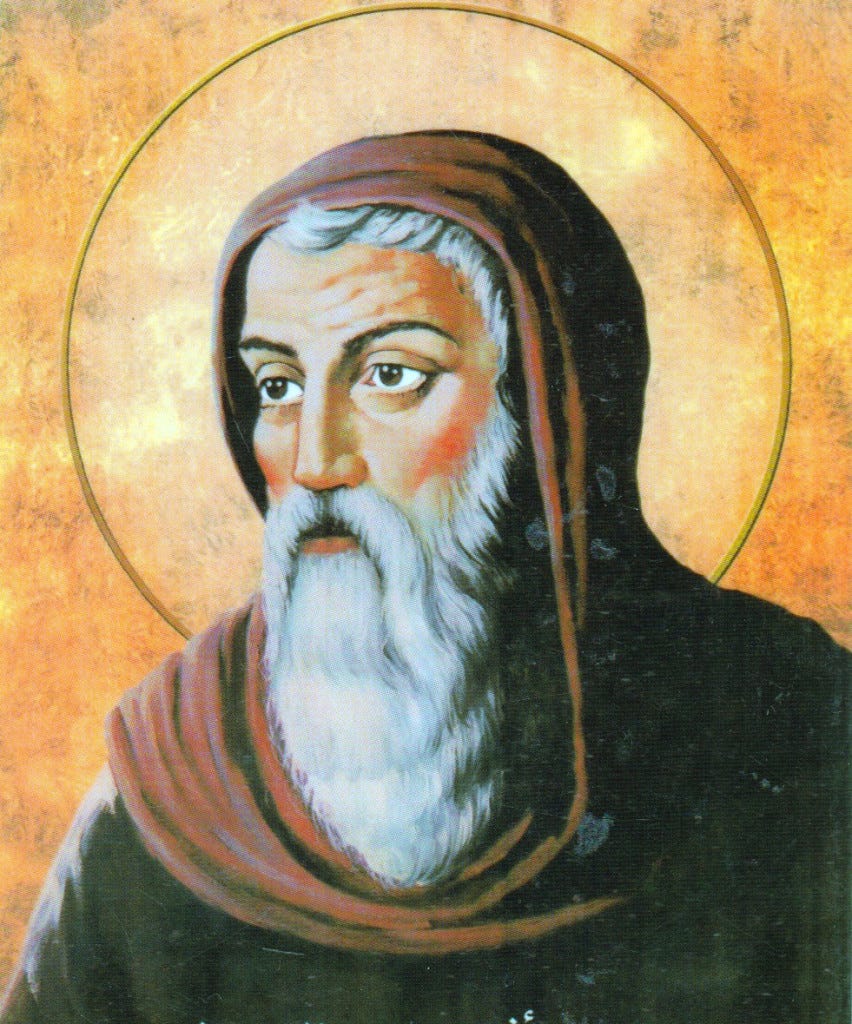
St Athanasius
God became man, so that man might become God.
This is the famous line stated by the Church Father St. Athanasius in response to Arius and his heretical claims (Arianism) that Jesus was not a Divine being, nor was he co-eternal. Arius believed Jesus was caused to exist by the Father. The first part of Athanasius’ statement might not raise a considerable number of eyebrows, but the second part “…so that man might become God” would make the reader pause and ask “how could that be?” It sounds almost like a polytheistic or pantheistic statement from Athanasius.
Fellow Church Father Augustine provides indirectly clarifies this statement in his exposition on Psalm 50:
“It is evident then, that He has called men gods, that are deified of His Grace, not born of His Substance. For He does justify, who is just through His own self, and not of another; and He does deify who is God through Himself, not by the partaking of another. But He that justifies does Himself deify, in that by justifying He does make sons of God. For He has given them power to become the sons of God.”
Augustine writes this in reaction to the heresy of Pelagianism, which asserted humans did not need grace to reach perfection. In this passage, the word “deify” appears a few times. Augustine identifies this deifying presence as God’s grace. Nowadays, like with Athanasius’ quote, this may come across as polytheistic. However, deification (theosis in the Eastern tradition) is very different from that of the likes of Roman Emperors – the context in which deification is largely understood today.
To understand the concept of deification in the Christian tradition, anthropological context must be provided. Aristotle noted that creation was made up of forms and accidents. Forms being continuous, unchanging and enduring, while accidents are changeable and made up of composites. Thomas Aquinas applies this Aristotelian viewpoint to the human person. He defines the soul as immaterial and incorruptible (a form). Once it is created, it immediately unites to a human body, which is material and corruptible (an accident). This leads Aquinas to the definition that the soul is the form of the body and the fundamental source of life for a man. This is appropriate, because God is unchangeable and immutable, and he primarily co-operates with us by acting within our unchanging souls to affect the changeable body. When we die, the soul endures for all eternity. While we live, we are a body-soul composite. Aquinas – and many other theologians – also assert that what comes along with the soul are the interior faculties of the intellect and will. These are the higher faculties. The intellect grants the ability for a rational judgement of what is right and wrong, which affects the will to act accordingly to that judgement.
However, the human soul is tied to original sin at the beginning of its existence. Adam and Eve forfeited the perfection of the image of God (Imago Dei) by falling into temptation and pride. Since the fall of man, the intellect and will have become finite and limited in their judgement of right and wrong. This finitude – inherited by all humans ever since – can only be erased through baptism. In baptism, we are not only formally baptised into the church, but we in turn are granted sanctifying grace. Paragraph 1266 of the Catechism affirms this, in that our souls are illuminated with the sanctifying grace of God for the first time. After this initial bestowal, it is up to the individual person to maintain this “state of grace” within the soul through the sacraments of Communion and Confession. When a soul commits mortal sin, it loses the state of grace which God granted. In contrast to venial sin - which harms charity but does not remove grace - mortal sin does removes grace and jeopardises the soul’s salvation. The soul must confess the mortal sin to a priest confession to have grace replenished.
Now that we have anthropological context, we can turn to the matter of how grace deifies us, by looking at John 1:12-14:
But as many as received him, he [the Word] gave them power to be made the sons of God, to them that believe in his name. Who are born, not of blood, nor of the will of the flesh, nor of the will of man, but of God. And the Word was made flesh and dwelt among us.
I read this at a Christmas Carol service last December and remember being struck at the Johannine terminology. It perfectly explains the function of sanctifying grace – which is necessary for a soul’s salvation. First, it is what makes a soul pleasing to God. I would like to highlight John’s assertion that when the Word, Jesus gives us power to become Sons of God, he says we are not born through blood, flesh or the will of man. It is important to highlight that “Sons of God” does not mean man can become a Son of God through direct divine filiation – that is only reserved to the Son. Instead, we are made adoptive Sons of God (Rom 8:15-17). When a soul has sanctifying grace from God, God adopts us. Like a family who adopts a child agrees to share the inheritance with the adoptee, so too does the grace of God grant us the right to inherit what God possesses: eternal life, intimacy with him through the Church. A family’s adopted child becomes the heir to the inheritance of eternal life, so too we become heirs of God, and subsequently, coheirs with Christ. St. Augustine puts it beautifully. If we – like Christ – call the Father of Christ “Father”, then what shall we say to Christ other than brother? Like Jesus Christ, the Incarnate Word, was born and sent from the Father through divine filiation, we can in turn be born of the Father through adoptive filiation which grace provides. This grace communicates to us a participation in the life of Christ, to be one with him, as he is with the Father.
However, the specific reason why I chose this verse is the final part. “The Word became flesh and dwelt among us.” To understand the verse from a perspective of grace, we have to go back to Exodus 33:11 where Moses speaks to the Lord face to face, as one speaks to a friend. The Lord pitched his Tent of Meeting and dwelt among the Israelites in the tabernacle (a Greek word meaning “to dwell” or “dwelling place.”) The same occurs in our souls via grace. We become friends of God. When we receive Jesus Christ in Holy Communion, we do not just consume Christ, the properties of the Eucharist also contain sanctifying grace. Like a warm house is pleasing to its owner who dwells within, God sees a dwelling place, filled with the warmth of sanctifying grace. He pitches his Tent in our souls. Therefore, the flesh of the Word physically dwells among us, but his spirit also dwells among us too. Aquinas says that sanctifying grace manifest the “invisible missions” of the Son and the Holy Spirit. Christ is sent into our soul by the Father, and both send the Holy Spirit into our souls, prompting our intellect and will to understand, and obey the will of God.
So, when man “becomes God” It does not mean that our whole bodies are deified. Nor does it pertain to the polytheist or pantheist assertions of different Gods or that our nature is God. Instead, our souls are deified. The body is changeable – an accident. The soul is immaterial – a form. Because God by his nature is unchangeable and immutable, he acts within the immaterial soul, and dwells within it. He bestows upon us the grace required for us to unify our soul and our will with his. To paraphrase the Council of Trent, grace does not just remit sins but sanctifies man from an enemy to a friend.
By Cormac O’Hara
On the last paragraph, I don't think we can say that the body is an accident, not in the final sense. We can't forget that the finality of the human person is to be found only at the General Resurrection. As N.T. Wright has said, if bodily death is our own existential horizon in this world, the existential horizon of the Saints (Mary is somewhat exempt from this) is the General Resurrection.
The soul is not made to be disincarnate, it waits with longing for its union with the perfected and transfigured body, risen according to the pattern of Christ. This takes us to the heart of Christian hope, when in the "New Heavens and the New Earth", we might enjoy the Beatific Vision in our risen flesh.
In this sense, it is the full human person which is divinised, not just the soul. Of course, all of this only according to the divinised humanity of Christ. The Divinity itself, in the Most Holy Trinity, remains forever transcendant. We can only participate in that Divinity to the extent that our perfected humanity allows.