
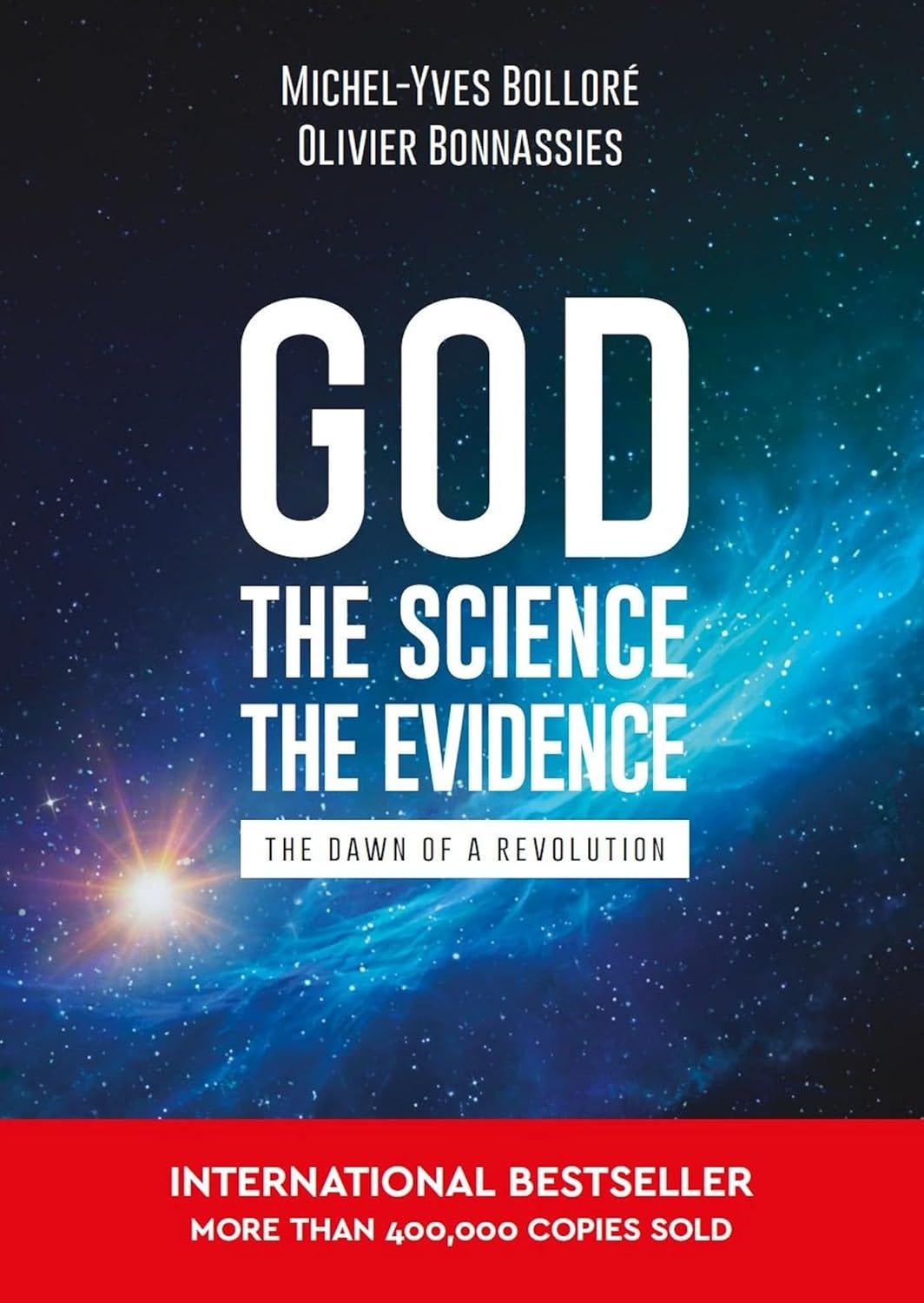
This book provides a helpful and highly readable road map to some key areas where, in particular, modern science may provide evidence for the existence of God. Due to the complex nature of many of the fields explored, it can’t do more than point to possibilities which, at best, better support the existence of God than a purely materialist perspective. It’s unlikely to convince hardline atheists but it does offer the prospect of starting interesting conversations with those who are more open-minded. Overall, it suggests at least the reasonableness of a theistic approach given current knowledge.
The work is essentially divided into two parts. The first, longer part deals with evidence within science; and the second (which I thought less satisfactory) deals with evidence from outside science, touching on traditional metaphysical arguments for the existence of God, as well as, amongst other things, the reliability of the Bible, the apparent chosenness of the Jewish people and the miracle of Fátima. Its main strength is not in the detailed treatment of the various issues, but as an overview. The proper response to such a work is therefore less a triumphant waving of a completed investigation in the way that some atheists treated Dawkins’ The God Delusion as the final word on religion, but rather as an introduction to some of the questions and an invitation to consider them further. The failure to approach it in this way can have at least two unfortunate consequences. For those inclined to atheism, the inadequate detail of some of the arguments gives them an excuse to reject the book out of hand. But for those inclined or fully committed to a theistic viewpoint, there is also the danger of a sort of cultish quickness which leaps from the current acceptance of, say, the Big Bang as the absolute beginning of space and time to an assertion that science has demonstrated the existence of God. Catholicism ought not to be too enamoured of God as logos or reason to allow that sort of cheap discussion. We may know that our Redeemer liveth, but we ought to be honest, particularly with ourselves, about difficulties in reconciling that with our other reasonable but non-religious beliefs. The authors are sometimes explicit about the limitations of their work, but the general breeziness of the tone does rather obscure those acknowledgments.
Much of the publicity surrounding the work focuses on its drawing on new findings of modern science which are claimed to support the existence of God: ‘Science is now God’s ally’ as the cover blurb puts it. As the book goes on to argue:
Today, three implications of the claim that God does not exist are challenged by science: the idea that the universe had no beginning, that the fine tuning of the universe is nothing more than chance, and that the emergence of life from inert matter is a natural, comprehensible, and replicable phenomenon. But science has contested all three of these ideas. Therefore the thesis they flow from no longer seems tenable.
Now there is probably an appropriateness if, given a theistic view of the world, we should then discover that science gives evidence for at least three direct interventions in the universe: at its beginning with a Big Bang; in ensuring that the Big Bang occurs in such a way that, some ten billion years afterwards, life could develop; and, finally, in the actual development of life from non-living materials. Such obvious interventions would fit in nicely with our theism. But none of them appear absolutely essential to theistic belief in general or even specifically to Catholicism. The scientific discoveries that the universe did not come into existence in 4004 BC, and that the genus Homo to which modern human beings belong evolved around 2.8–2.5 million years ago in Africa have not fundamentally undermined Catholicism, even if it might have been neater had a more literal Biblical narrative been demonstrated. The essential theological point is that human beings and indeed the universe as a whole are completely dependent on God for their existence; and the metaphysical proofs of the existence of God most famously summarised in Aquinas’ Five Ways express aspects of that necessary connection, even if the precise ways in which that fundamental dependence is manifested require patient scientific investigation.
In passing, note the precise wording of that quote: ‘But science has contested all three of these ideas. Therefore the thesis they flow from no longer seems tenable.’ It is a logical error to assert that the conclusion that God does not exist, even if it did depend on these three ideas, would be overturned simply by their being contested: the ideas would have to be disproved, for the thesis that God does not exist to be no longer ‘tenable’. This kind of excitable inexactness is not unique in the book and is not helpful to its overall case.
Lying behind a lot of discussion between science and religion is what I’m tempted to call an existential choice between two attitudes. I take a truly Catholic approach to be one which welcomes any scientific investigation of how God created the world: knowledge is based in wonder, and the details of, say, human evolution or the development of the universe are indeed fascinating and wonderful. Part of that wonder rests on the exploratory and tentative nature of rational exploration: scientific conjectures come and go under the tests of refutation and confirmation and that is part of the excitement of discovery. There is good historical reason to believe that it was only Christianity which allowed the full development of modern natural science: for example, only if you believe that the universe is created by a rational mind does it become credible that human rationality can successfully explore it. But that exploration is only possible if one doesn’t reach too quickly for the simple explanation that God did it. You cannot explore and wonder at the contents of God’s mind if you are satisfied simply to credit God’s action without any further attempted exploration as to how he did it. So the Catholic attitude of mind is: ‘I know God created everything and that’s wonderful! Let’s patiently explore this wonder in the spirit of gratitude and respect!’
That’s pretty much how science was conducted until recently. But an alternative approach, more characteristic of modern materialism is along the lines of: ‘I don’t think God exists. Let’s see how far I can get in exploring the world without mentioning him.’ Both approaches will, at some points, have to say: ‘I don’t know why this happened. I will keep trying to come up with a scientific solution but it’s possible (due to weakness of human wit) that I may not be able to do so.’ That, I’m sure, is precisely what most atheistically inclined readers of this book will quickly conclude and find no reason in this failure to believe in God. Theists may say the same thing. But for the sort of Catholic reasons that are not really covered in this work (e.g. confidence in the essential rationality of creation; a trust in the sacredness of the human mind and reason; a view of human nature which prioritises the sort of epistemic virtues such as humility and trustworthiness which allow co-operative scientific endeavour) they will confidently push on to see what else may emerge in the task of rejoicing in the wonder of creation. At the very least, Catholicism might be thought to provide a stronger motivation for this sort of fundamental theoretical research than atheistic materialism.
Catholicism, unlike many other forms of theism, tries to do justice to both reason and revelation by patient exploration of both. It has survived many paradigm shifts in what is taken to be scientific truth and it will doubtless survive many more. As a thought experiment, it’s worth asking yourself how much of the science in this book will be likely to survive, say, one thousand years into the future. It is much more plausible I suggest that Catholicism will still be around and recognisable than that the science put forward here as supportive of it will be fundamentally unchanged. So, while we should welcome this work as suggestive of the current relationship between science and theism, particularly Catholicism, we should also be careful not to place undue reliance on a popular account of what inevitably will look very different in that future.
By Stephen Watt