
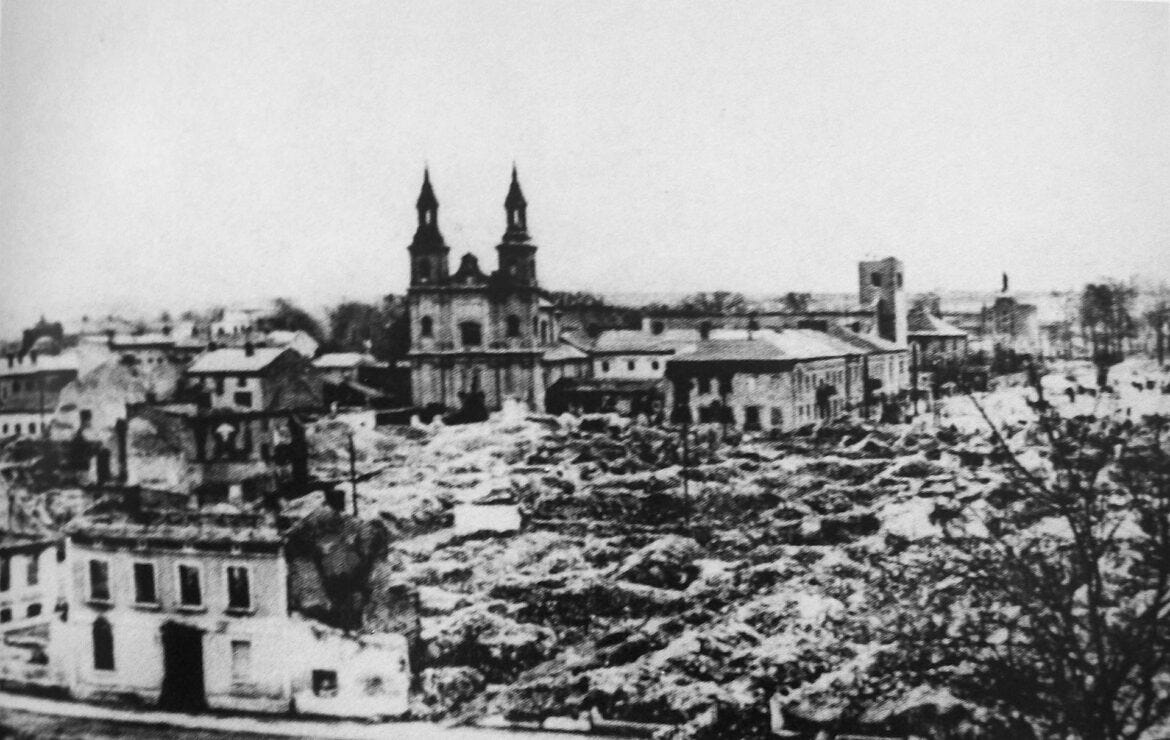
The month of September has an association which sits deeply in my nervous system. The war began brutally, almost in an instant. At around 4.40 in the morning the Luftwaffe was already bombing Wieluń, a small provincial town, minutes later Westerplatte was under fire, and by the middle of the day the German attack was unfolding on a vast scale from several directions. It was a new kind of warfare — Blitzkrieg, lightning war: speed, aircraft, tanks, whole frontiers collapsing with frightening rapidity.
I was a late child of older parents, and my grandparents lived almost to a hundred. The world of the 1940s and 1950s was therefore not simply something I encountered in history lessons. It was part of the actual lived experience of people who cared for me, who raised me, with whom I sat at the table and whom I watched — their habits, their ways of doing things, what they remembered and how they remembered it.
There are fewer and fewer people now who remember that world from within. Those people could be rather dry and severe by our present standards. We have become terribly psychological creatures. We analyse our feelings, our reactions, our wounds, our relationships, sometimes almost without end. That generation generally did not. They could appear harsh, and perhaps sometimes they were. But there was also a peculiar inner strength in them, and often a great warmth concealed behind the severity.
They loved in a rather practical way
I think, for example, of my aunt Walburga, with whom I used to spend a few days during the summer. She had lost her husband very young during the war. He died in Stutthof concentration camp, essentially for being in the wrong place at the wrong time, and she was left alone with three little sons.
She had to keep them fed, and so she worked. She did sewing work, but during the war that was not enough. She became involved in the illegal trade in alcohol, producing and supplying strong drink — apparently even to some of the German officers themselves. After the war there was no sudden ease. She simply went on working, tirelessly, raising the boys and holding the family together on her own. She was resourceful, immensely hardworking and prayerful in that simple but profoundly mature way which belongs to people whose faith has been tested against actual life.
On the wall of her kitchen hung an old-looking picture of the Holy Face of Jesus, the face impressed upon Veronica’s veil. She cherished it deeply. Every so often she would pronounce some piece of wisdom about life, joys or sorrows, and God, and you knew that the matter had become serious when she nodded towards the Holy Face. Sadly, I cannot remember any of those sayings now. I only remember knowing, as a child, that they were good and weighty and somehow true. Perhaps that was enough. It formed in me a very solid association between life, God, the Church: that these things belonged together, and that, despite everything, there was something deeply lovable about them.
There was, of course, something profoundly inhuman about the Nazi occupation of Eastern Europe, but also something terribly human about the means by which it operated. It was chillingly thoughtful.
I can still see myself sitting in her kitchen, sometime in the very early 1990s. Aunt Walburga must already have been about eighty, which to me then seemed an almost unimaginably great age. There was the table covered in oilcloth, and she was pitting very red, very sour cherries to stock the family supplies of compote for winter, while I attempted, with doubtful usefulness, to assist her. I remember her as tall, very thin, and rather severe-looking, with an intense gaze, but there was nothing judgemental, angry or bitter in it. It conveyed something much more practical, as if she was constantly scanning the environment with this thought in mind: right, what is the next thing that needs doing, because we had better get on with it before ‘’they’’ come. And into that wonderfully versatile they one could insert, depending on the year and circumstances: Germans, Gestapo, Soviets, Russians, Communists, the secret police, the Militia, boys coming home from school or work, guests who would need feeding, or indeed sheltering if the wrong type of them were after your relatives, friends or simply neighbours.
It was around that kitchen table, over those sour red cherries, that she once told me how Soviet soldiers had come after her. She ran from them and, finding no other escape, jumped into a cesspit full of human waste. It worked. And although she never used the word rape, I somehow knew that she was running from something perhaps far worse than just death.
For indeed, when the Soviets advanced westwards, driving the Germans away, they brought their own terror: and what a terror it was! Burning, murder, rape and sacrilege. And in some places, in a peculiar but very real sense, the Soviet presence was experienced as worse than the Nazi one.
There was, of course, something profoundly inhuman about the Nazi occupation of Eastern Europe, but also something terribly human about the means by which it operated. It was chillingly thoughtful. It was deliberately planned down to the smallest detail. There was even an ominous charm in its aesthetics — architecture, staged parades and speeches, uniforms, discipline, meticulousness, efficiency... all this in the service of a monstrous idea of what a human being was and who had the right to remain one. There was method in it — a twisted and horrifying method, but method nevertheless. And to develop a method is a human thing.
The Soviet regime was certainly capable of similarly cold organisation of evil: gulags, prisons, deportations, executions, systematic persecution and ideological narratives belonged very much to its world. But the violence which accompanied the Red Army’s advances could open another hell-gate altogether. Drunkenness, looting, gang rape, torture, casual killing and deliberate sacrilege were sometimes unleashed with an almost elemental savagery. Their evil did not need neatly prepared schedules and tables.
There are, it seems, different gates into hell: one may be opened by intellect severed from conscience; another by passion freed from every restraint.
The Only Face that Matters
The Church remembers such things too. Among many others, there are Blessed Maria Krzysztofa Klomfass and her fourteen companions, Sisters of St Catherine, women who remained with the sick, the old and the vulnerable as the front moved towards them, and who suffered terribly at the hands of Soviet soldiers. The details are well documented and so horrifying that they need not be repeated here. Beating, rape, hours of torture, murder and deliberate sacrilege were all part of that story.
These are not stories one tells in order to cultivate old divisions of Europe or hatred of Russians, Germans or anyone else. Aunt Walburga certainly did not tell me her story that way. That is important. The extraordinary thing about that generation was precisely that people who had seen such things could still pit cherries, make fruit compote, feed whoever arrived at the door, go to church, nod towards the Holy Face and get on with whatever had to be done next.
Perhaps that is why the Holy Face on her wall matters so much in retrospect. My aunt knew well what the human face could become. And she had spent a lifetime looking at The Only Face that can rescue ours.
Walburga was not unique in this. Or perhaps she was unique, as every human being is, but the world she inhabited was not. As a child I still knew quite a few people formed by those years. They were simply the adults around the table. Only somewhat now I realise that I had been growing up among the last witnesses of a world which is now pretty much gone.
My grandmother in Kraków belonged to it too. German occupied Kraków, 1943. There were die Menschenjagd — random street round-ups. A tram could simply be stopped, the Gestapo would appear, lorries would arrive and people would be taken away. Often to forced labour, sometimes to Auschwitz.
My grandmother happened to be in one such suddenly stopped trams on Diettla Str in Krakow.
She was pregnant with my mother. She was taken out with the others and lined up in the street, waiting to be loaded onto the lorries. At some point she caught the eye of one of the Germans.
And she kept looking straight into that eye.
I have often thought about that look. What did it actually look like, and what must it have meant for them both? There must have been fear in it, but perhaps also sorrow, perhaps a kind of gentle reproach, a pleading — something gracious in it nevertheless. And in the eye of the anonymous officer — compassion? Conscience? Frustration? Fear? No words. Just the gaze of one human being meeting another in circumstances in which almost everything human had lost its meaning. Something passed between them. Something was communicated…
For good or for ill, our lives travel further than we think.
He aggressively charged towards her and, taking the opportunity of the overall commotion and chaos of the moment, took her firmly by the arm as if in anger but, instead of towards the lorry, led her towards a side street and whispered: “Go.” And she went.
I sometimes think about that German. If not for him, my mother might never have been born, and consequently neither would I. And Dingwall would now have a different parish priest, which is quite a considerable consequence of a few seconds on a Kraków street in 1943.
I know nothing about that man apart that he was a small part of evil machinery of Nazi occupation. But I also know that then, in that instant, he chose mercy. And so I pray for the happy repose of his soul. Blessed are the merciful, for they shall obtain mercy.
As I grow older, simple things become more ominous, while the grand questions and affairs of this world somehow lose their appeal. I see with increasing clarity that it is often the small, barely noticed actions which carry the greatest weight. Most of what we do feels instantaneous, almost insignificant. We rarely know what will follow from it.
One act of kindness, one moment of courage, one refusal to do what everybody else is doing may have consequences reaching far beyond anything we can see. And perhaps that is what is fascinating in family stories. Something done in Kraków in 1943 affects Dingwall parish in 2026.
Or, on a considerably less heroic level, a friend walking along a pavement in Warsaw telephones me to tell me about his marital troubles. I listen while making an apple pie. I become distracted. The proportions go wrong. The pastry crumbles rather more vigorously than intended. And on Sunday afternoon a group of prisoners in Inverness find themselves being served what can only generously be described as apple pie, the pie having by then become largely indistinguishable from apple mash inside its packaging. From a pavement in Warsaw to a prison in Inverness! You really never know how far the consequences of your actions — or inactions — may travel.
Omissions are perhaps the more frightening of the two, because they are so easy to overlook. We notice what we have done wrong. We may feel embarrassment or shame — and, contrary to what many seem to think nowadays, there can be mercy even in such feelings, for they may move us towards contrition, repentance, change and growth. For those who love God, everything can work for the good.
Perhaps this is why Our Lord said that the tax collectors and prostitutes — in other words, those whose sins are laid bare and exposed — enter the Kingdom of Heaven before those who think themselves righteous. Self-contentment can be dangerous. It is often simply a fruit of self-delusion.
It is usually much harder to see the good we might have done and simply did not do: the kindness withheld, the truth not defended, the telephone call not made, the small act of courage quietly avoided.
Think of that when beating your breast at the Confiteor on Sunday: in what I have done and in what I have failed to do… mea culpa, mea culpa, mea maxima culpa..
For good or for ill, our lives travel further than we think.
By Fr Andrej Niski
*Taken with permission from an excerpt of Fr Andrej’s monthly gazette*
Fr Niski is Parish Priest of St Lawrence’s in Dingwall and St Peter’s and St Boniface’s in Fortrose which is in the Diocese of Aberdeen. He also is the local Prison chaplain and Priest to the Highland Deanery Polish Community.
Picture: The bombing of Wieluń, Poland.