
One of the major branches of Theology is that which is concerned with the goal of human striving – theological anthropology. In contrast to social anthropology, which takes a horizontal approach to human existence, theological anthropology looks at human existence with both a horizontal and vertical approach. It seeks to account for the role of sin, how it affects human experience, and how we, created in the Image of God (Imago Dei) are called to overcome sin in every aspect of our lives.
Theological anthropological paradigms began with the deification anthropologies of the Church Fathers, particularly St. Irenaeus, who spoke of the soul going through a spiritual “maturation” on its journey to Heaven. However, there is only one way how humans can reach this maturation. By living like Christ and sharing in his life. What this article aims to articulate is how we can look towards the nature of Jesus Christ’s distinct but inseparable divine and human natures as a guide for how to fully live of the Christian life.
The Council of Chalcedon (451 A.D.) decreed that Jesus possessed two natures that were utterly distinct, but inseparable from each other. A divine nature and a human nature – Dyophysitism. Later, the Third Council of Constantinople (680-81 A.D.), defined Jesus as also possessing a divine and human will that were also distinct but inseparable – Dyothelitism. The theological name for this union of the two natures and wills is called “The Hypostatic Union” and this term will be used from here on. Utilising the hypostatic union forms a foundation for an anthropological outlook pertaining to it. However, what must also be explained is the nature of human existence, and why that analogously pertains to the hypostatic union.
Joseph Ratzinger in his Book Jesus of Nazareth provides commentary on the High Priestly prayer of Christ in John chapter 17. More specifically, the nature of the “consecrations” that Jesus speaks of. First Ratzinger writes about how the man Jesus Christ in virtue of his divinity is consecrated to the Father. His mission as redeemer of all is set apart solely for the Father, but his mission is for the good of the whole of humanity. Second, Ratzinger converses about how Christ understands he himself is consecrated and set apart, in virtue of first, the Paternal consecration which was mentioned above, and secondly, that his divinity causes his humanity to become sacred. Then, third, Ratzinger commentates on Christ’s prayer to the Father to consecrate his disciples “in truth”, so that they may have a share in his priesthood, and become priests of God, and “baptise all the nations.” What is notable here is that Ratzinger emphasises the consecrations and the missions are inseparable, but distinct from one another. This is very similar to the Hypostatic Union of Christ, who’s divinity is inseparable but distinct from his humanity.
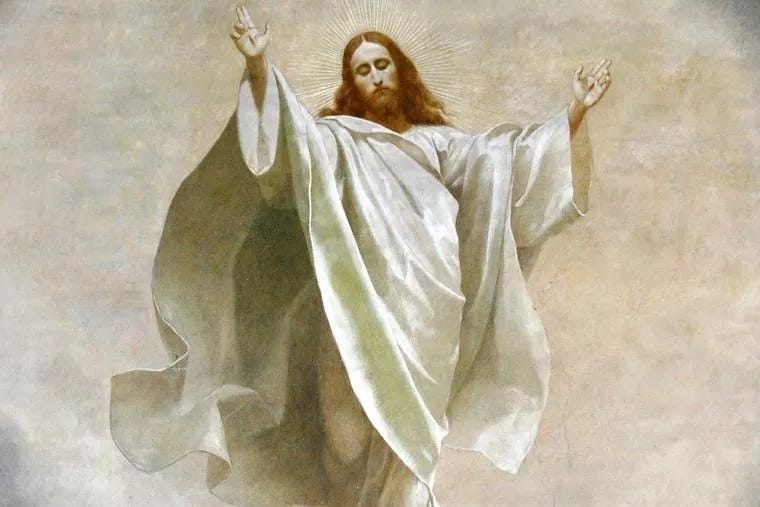
However, the incarnational analogy gets even more profound when investigating the nature of the consecrated Christian missions. In his book The Spirit of the Liturgy, Joseph Ratzinger looks at the notion of an exitus and a reditus (a coming from and returning to) a principle as undergirding created reality. In this case, God. When Jesus was on Earth, he had undergone a creation, and an exitus, descending to Earth in the hypostatic union. This mission culminated in a reditus – this would be the Ascension into Heaven. Fittingly, his reditus to the Father occurs immediately after he consecrates the missions of the Apostles. “Go and baptise all nations…” (the Apostles’ exitus) “…in the name of the Father, and of the Son and of the Holy Spirit” (the Apostles’ reditus). Jesus Christ, as the consecrated Godman for the World, consecrates the missions of the Apostles for the World.
How does this incarnational anthropology apply to us today? For this, we look to the sacraments which are essential to human existence. Joseph Ratzinger (now as Pope Benedict XVI) in Verbum Domini likened the revelation of the Incarnation to the sacraments. How can Jesus Christ be likened to a sacrament? For this, we bring in Thomas Aquinas. Aquinas defines a sacrament as a “sign of a holy thing which makes men holy.” The sacraments are sacred signs which constitute a unity of matter and form. That is, the form consecrates the matter and makes it holy. For example, in the Eucharist, the bread and wine are matter. However, when the priest utters the words of consecration “Take this, all of you…” the words don’t in and of themselves possess any power to transubstantiate, but through God using these words as an instrument, they become the form which sanctifies the matter to create the sacramental sign of God’s grace and makes men holy. Jesus Christ in his hypostatic union possesses an analogous nature to the sacraments. His human nature, the matter, unifies with the form that is his divinity. The Son’s hidden divinity then sanctifies the human actions of Jesus Christ.
This may seem at first a bit confusing. However, the whole argument comes together when we look at the Catechism’s assertion: “The Eucharist is the source and the summit of the Christian life.” The consecrated man, Jesus Christ had a divine mission of an exitus and reditus, which he fulfilled in the matter and form of his hypostatic union, and part of this was instituting the source and summit, the exitus and reditus of the Christian life – the Eucharist. The Eucharist is a visible sign of the unity of material matter and the divine form, which is essential for a valid sacrament. When the Christian comes to the mass, he greets Christ “face-to-face”, which is a common characteristic of friendship with the Divine (cf. Ex. 33:11; 1 Cor 13:12). Through the consecrated Eucharist, their life and mission in turn is also consecrated. This is their source (their exitus). They “go forth” after Mass to carry out their mission, consecrated solely to God, but for the World’s sake – just like Christ’s nature and mission. Through the prompting of grace within the soul, the human nature is elevated. Co-operation with grace means missions arrive at their reditus, their summit, which is also in the Eucharist. By carrying out their Eucharistic missions in a state of grace, the soul fulfils the model of incarnational anthropology. Their interior becomes deified; they become heirs to God’s Kingdom and coheirs with Christ.
Every person is created because God has a mission for them – just like Christ had a mission. However, upon closer analysis, we can see that each essential component of human existence involves an aspect of hypostatic union. Our missions (the matter) are consecrated by Christ (the form) and always entail an exitus and reditus in relation to God like Christ’s mission. However, to live out this incarnational anthropology, and to have our missions consecrated, we must consult the consecrated man himself – Christ. In his human existence on Earth, he had an analogous matter and form, which is fully present in the Sacrament of the Eucharist, the source and the summit, the exitus and reditus. If we treat the Eucharist as our exitus and reditus, we attain the spiritual maturation that Irenaeus spoke of, we achieve friendship with God, completing our reditus. In the next life, we share eternal beatitude with our ultimate source and summit – we share in God’s life.
By Cormac O’Hara