
After many years of religiosity being on the decrease, it seems that interest in church attendance has piqued among young adults. But what exactly does this revival look like, and is it specifically a Catholic one?
In 2006, there was a piece of academic literature that suggested from the 1960s onward, Christianity was falling in numbers. But not just Christianity – complete dissatisfaction with religion, regardless of its origin, deity or convictions. The future was looking bleak and atheist, and that was the prospective future that Scotland was facing.[1]
The same written work produced an assessment of the census figures for 2001, which highlighted the low number of religious affiliations across the country, and made the original sentiment from the 60s look like a prediction: the country was, indeed, moving away from God – but not completely by this point. 45% of the country still held a Church of Scotland membership and 17% followed the Roman Catholic Church.[2] These numbers from 2001 imply that both the national church body and Catholicism to be the two major, religious sects across Scotland, and there were little numbers pertaining to church attendance across other Christian denominations and alternative religions alike.
According to an official government statistic, in 2011, there were 841,053 Roman Catholics across the country, and approximately 1,717,871 Church of Scotland followers.[3] In the 15 years that have passed since then, the ecclesial framework of the Scottish Kirk has been in the throes of financial strain, budgeting struggles and a whopping 35% decrease in church membership.[4] With these numbers in mind, it’s easy to worry about the presence of the Catholic Church in Scotland.
The Church introduced an impressive 549 people to the Sacraments during Easter Vigil Masses across the country (Archdiocese of St. Andrews & Edinburgh, 2026). This number is staggering because it is 224 more Confirmations than the Church welcomed in 2023. [5]
According to an article by the Catholic Herald in March 2026, the university town of St. Andrews is becoming its own hub of Catholicism among the young people, too.[6]
In an article for EWTN, Archbishop John Wilson based in Southwark stated that there was a big resurgence in Catholicity among people in their twenties and thirties. EWTN made the point of saying in this article that both Southwark and Westminster were receiving a wholly unprecedented number of people into the church, with the former up to 450 individuals and the latter 500. Westminster had seen a 25% increase in their numbers, which was unlike anything they’d ever seen before in modern times.[7]
The online Catholic news website, Aleteia, called it a “convert boom” that the Roman Church was witnessing in 2026. The author of the written piece states that it was unknown what effect Pope Leo XIV’s ascension to the papal office might have on the Catholic Church in the USA, but now it’s understood that it’s been received very well. A University of Illinois student recorded 120 Confirmations – the largest in her four years studying on the campus.[8] It could be suggested that having an American pope has reignited this interest in Catholicism across the States – though this is conjecture.
These examples show that Scotland isn’t the only country witnessing a large amount of people enter the Church. What is happening here is happening internationally. But why, exactly?
Saint Carlo Acutis and Saint Pier Giorgio Frassati
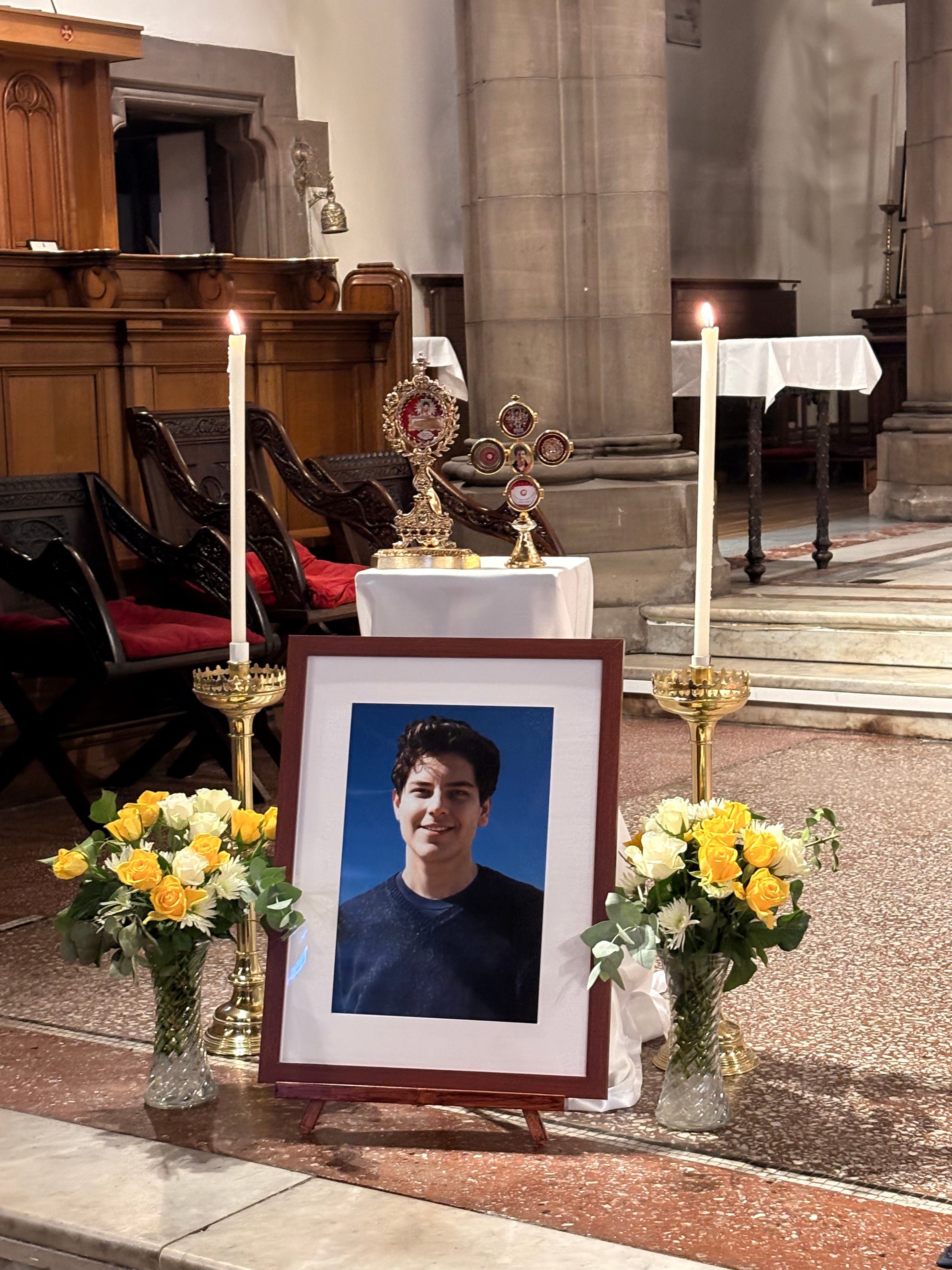
The city of Edinburgh was blessed in September 2025, as the relics of the recently canonised Saint Carlo Acutis made their way to the city.[9] These included a fragment of his pericardium, and a few strands of his hair. Here, there was veneration for the young boy who passed away at fifteen-years-old. Scots from all over the country came to visit the Archdiocese across the two days when Masses were being held for him, and there were a lot of numbers attending.
Side note: I was received into the Church on Sunday, September 7th last year, the same day that then-Blessed Carlo Acutis became canonised and made a recognised Saint of the Catholic Church. I chose him as my Patron Saint.
I attended the three Masses held in his name at St Mary’s Cathedral, and it was incredible the amount of people my age (in their twenties), below and above were there. People of all generations chose to come and honour the young man. It is no lie that the younger generations are inspired by Saint Carlo Acutis, but why exactly?
The young Carlo Acutis was into computer games and using the internet to raise awareness of Eucharist miracles. The use of his computer was his main way of evangelising, and the playing of games made him a child of his time. Naturally, that is quite the juxtaposition, because “how could the internet ever be used for good?” society has asked for years, and “what good do videogames bring?” is a classic. But a young Carlo realised how to find the good in both worlds in the early 2000s.[10]
In his tomb in Assisi, Italy, St Carlo is wearing his blue jeans, a sweatshirt and his sneakers. These are all representative of the fact that he was still a very young boy when he was called from his earthly life. But not only that, his clothes are a key reminder of the generation he was from. Carlo Acutis was born in 1991, meaning he would be classed as a “Millennial”.[11] It is because of his Millennial-ness that people of the generation after him, “Generation Z”, find him to be so inspiring – he was close to us in age, had similar interests and most of all, was a fantastic ambassador of the faith while still a child.
At Saint Carlo Acutis’ final relic display at the Mass on Sunday, 15th September at St Mary’s Cathedral in Edinburgh, there was a large amount of pupils from one of the local Roman Catholic high schools in the city. The Mass and homily were being led by both His Grace Archbishop Leo Cushley and Monsignor Anthony Figueiredo, who is the guardian of St Carlo’s relics. One thing that was of note was the attention paid to the reflection on St Carlo’s life growing up. It inspired all the young folk in the cathedral that afternoon. They were eagerly awaiting to meet face-to-face with the relics in a state of veneration.
On the same day in September 2025, Italian Catholic Pier Giorgio Frassati was canonised. He was a 24-year-old who died a hundred years before he was officially recognised in the Church as a Saint. This man inspires a lot of young Catholics today, too, through his popular adages like “joy through suffering”, which was quoted to be one of his responses to life and its many hardships.[12] Naturally, because he was a member of the Third Order of Saint Dominic, that joy was found in a relationship with Jesus Christ in his life. The world that Gen Z was born into has experienced warfare, economical crises, the rise of social media and a lot more that can impact how we value our lives and where God sits in them – but Frassati offers a way forward. Joy through suffering – these powerful three words that can challenge the pessimistic mindsets we know all too well. Pope Saint John Paul II highlighted his own reason for being inspired by the example led by Frassati – he was steadfast and unwavering in his Catholic witness.[13]
With these two Saints being recently canonised in the Catholic Church, and given their ages at their times of death, the “revival”, so to speak, can be attributed a lot to their models of faith. We’ve already seen that throughout the United Kingdom and the United States that interest in Catholicism has been on the up for quite some time, and it should come as no coincidence that it is happening around the same time as these two Saints have gained traction in the media. People are interested in them, investigating why they chose to consecrate themselves to a life of following the Lord in His Church and it is sparking conversation.
An article from 2016 looked at trends across the country pertaining to religiosity. The Church of Scotland was dwindling significantly in membership, and 2016 marked the year where membership was at 24% of the population – while Catholicism was sitting at 14%. The vision here was that, in the eight years after these figures were released, Catholicism with its statistical stagnancy may still manage to overtake the national Church of Scotland. The year 2024 was projected to be the year that this would come to fruition, and how remarkable is it that in 2026, the Church has managed to receive its highest ever number of Confirmations in the modern day?
After all is said and done, “the harvest is plenty” and the future is looking bright for the Catholic Church in not only the world, but specifically in Scotland.
By Dhylan Livani
The number of people entering the Church is notable, but few ever note that the number that leave exceeds those who join or return. We must be honest and show both sides to get the real picture.