
Since Vatican 2 in the 1960s, the Church has labelled the six months or so from Whitsunday to the beginning of Advent ‘Ordinary Time.’ I find that a bit uninspiring. To me all time feels sacred and I want to take this first half of August to show you what I mean.
The 1st August is the start of autumn in the Celtic calendar. It’s called Lughnasadh in Gaelic and Lammas in English. It was originally the feast of Lugh, a god associated with the light and sun, and people used to climb hills at this season. That still happens at Croagh Patrick in Ireland. It has a cone-shaped summit of white quartzite which glitters in the sun. St Patrick is said to have fasted there for 40 days and since the fifth century there has been a church at the top. Pilgrims still climb to it, some barefoot, in the weeks leading up to the feast of the Assumption on 15th August.
Lammas comes from ‘Loaf Mass’ when a loaf, baked from the first grain harvested that summer, was offered in thanksgiving in the church. Some Anglican churches have revived the custom. The word for autumn in German is ‘Herbst’ which is close to ‘Hairst’ in Scots, and both words also mean harvest.
To me this fits: some time in late July/ early August there’s usually a break in the weather and after the rain or wind the full heat of high summer has gone. The light subtly changes too which I noticed this year when I first stepped out into the garden on the morning of 23rd July and looked up at the sky.
I think this has something to do with being halfway between the summer solstice on 21st June and the autumn equinox on 21st September. The exact midpoint is either the 6th or 7th August. The 6th is the Feast of the Transfiguration, when, according to the Gospel of Matthew, ‘Jesus took with him Peter and James, and John his brother, and led them up a high mountain by themselves. And he was transfigured before them, and his face shone like the sun, and his clothes became white as light.’ So let’s look at the 15th August.
It’s the greatest feast of Mary, Mother of God, which Catholics call the Assumption and the Orthodox the Dormition, when it is believed she died and her body was taken up to heaven rather than being left to decay on earth. It was only in 1950 that Pope Pius XII made belief in the Assumption obligatory for Catholics, which attracted a lot of criticism at the time- but it is a fact that no one has ever claimed to have bodily relics of Mary, and the feast has been celebrated by the Church since the fourth century. The Italians call it ‘Ferragosto’ meaning ‘the feast of August’., in a month with several other big feasts. It’s a time often marked by thunderstorms and high summer turns into late summer. It’s around now that I usually notice the swifts all suddenly disappear as they start their journey back to Africa. It has always been a sad moment because, for me, their high-pitched screams are the sound of summer. But this year I haven’t seen any in Portobello, although I did hear some one evening early. Perhaps this weekend, if I’m lucky, I’ll hear some passing through.
The first reading at the Mass for the Assumption is taken from the Book of Revelation: ‘A great sign appeared in heaven: a woman clothed with the sun, with the moon beneath her feet, and a crown of twelve stars on her head. She was with child and about to give birth, crying aloud in the anguish of her labour.’
From at least the second century, this woman has been identified with Mary, and in medieval art Mary is often surrounded by the rays of the sun, standing on a crescent moon and with the stars round her head as in a painting I saw in Hexham Abbey while on holiday in Northumberland a fortnight ago. Sun and light again. Seeing it helped me persevere with this reflection when I couldn’t get my ideas to gel.
I’m going to finish with a Gaelic poem or prayer for the Assumption collected by Alexander Carmichael (1832-1912) in the Western Isles, and published in the first volume of his Carmina Gadelica, in 1900. This is a slightly modified version of his translation, made with the help of my friend, Déirdre Ní Mhathúna, a great Gaelic scholar:
THE FEAST OF MARY
The feast day of sweet Mary,
Mother of Shepherd of the flocks,
I cut a handful of the new grain,
I dried it gently in the sun,
I rubbed it sharply from the husk
In my own palms.
On Friday I ground it in a quern,
I baked it on the sheepfold,
I toasted it on a platter of rowan,
And I shared it among my people.
I went sunwise round my dwelling,
In the name of (our) Mother Mary,
Who promised to preserve me,
Who did preserve me,
And who will preserve me
in peace, in all deeds,
In truthfulness of heart,
In labour, in love,
In wisdom, in kindliness,
For the sake of Your Passion.
O, Christ of grace
Who until the day of my death
Will never forsake me!
Oh, until the day of my death
Will never forsake me!
CLOSING PRAYER
Let us pray that God will help us recognize as sacred all creation in both time and space. Amen
Ian Campbell
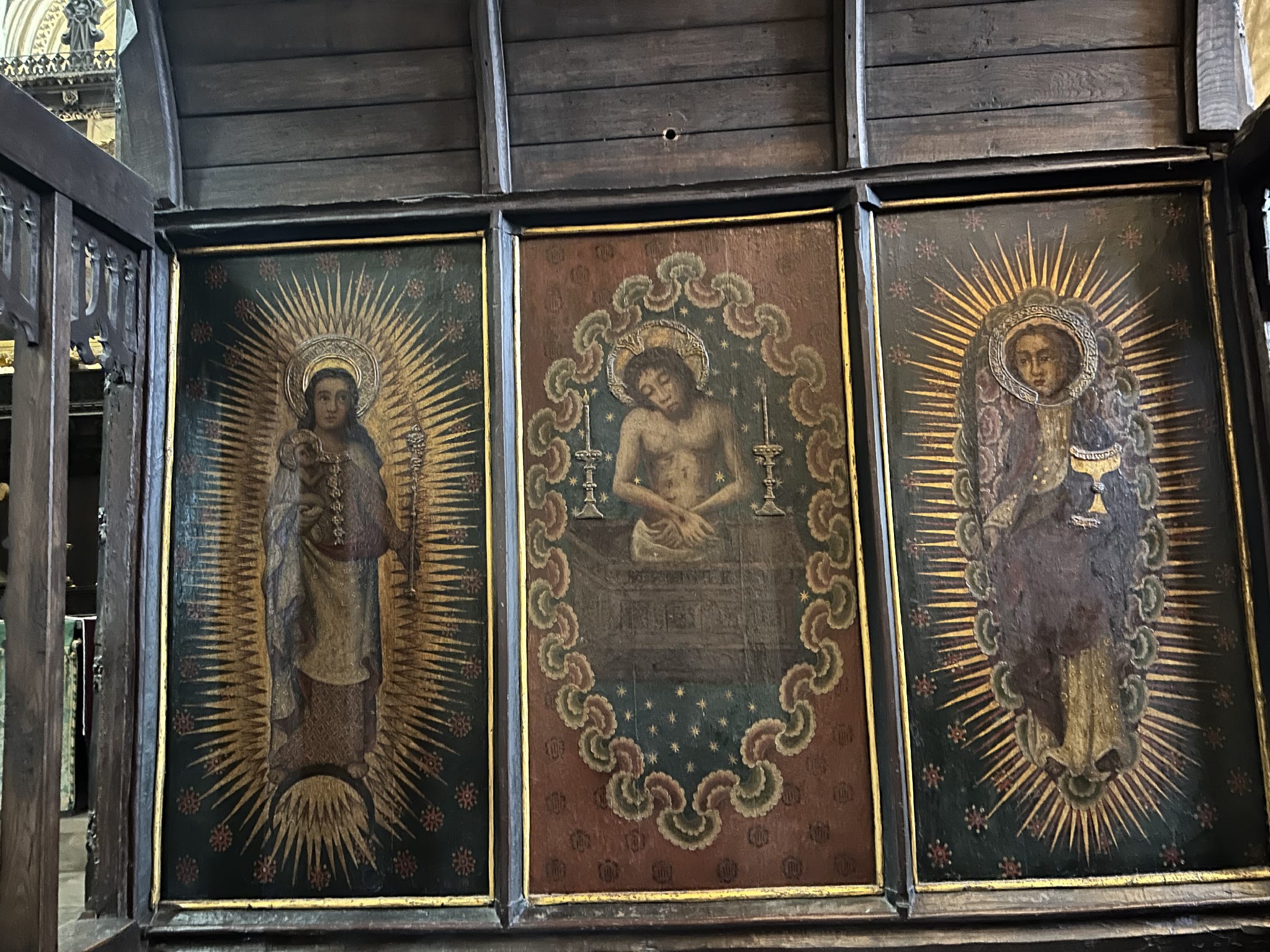
Hexham Abbey, Ogle Chantry, early 15th century