
Part 2: Trees
We’re diving into part two of our “Language of the Bible” series. The first part discussed how we can be confident that the modern Bible is an accurate translation, and this part will shift focus to the specific language used in the Bible itself, particularly with trees.
Though it may come as a bit of a surprise, trees are fundamental to the spiritual teachings of the Bible. Beyond God and humans, trees are the most mentioned living things in the Bible (The Bible Project). And while they may not naturally come to mind, today I hope to show how the core teachings, overall narrative arc, and methods of emphasis used in the Bible are very often centrally tied to trees. Much of the inspiration for this article comes from the Bible Project and their podcast on the Tree of Life—I recommend checking it out if you want to learn more.
Humans as Trees
Throughout the Bible, and especially in the Old Testament, trees are used as a mirror into humanity. Most often, linguistic and physical traits are shared between humans and trees, drawing a connection between human bodies and botanical structures—both humans and trees possess zera ‘seed’ (a deliberate connection to children and descendants) and both produce peri ‘fruit’ (the outcomes of their actions and life). The Bible also uses words such as ‘branches’, ‘shoots’, and ‘roots’—all obviously building a shared anatomy between trees and humans.
But the linguistic choice in these cases isn’t merely to build a visual bridge between us and trees, but to construct an anchor in which to extrapolate teachings for a righteous and virtuous life.
Take Psalm 1, for example, where a righteous person “is like a tree planted by streams of water, which yields its fruit in season and whose leaf does not wither—whatever they do prospers. Not so the wicked! They are like chaff that the wind blows away.”
Similarly, Jeremiah 17 discusses how “blessed is the one who trusts in the Lord, whose confidence is in him. They will be like a tree planted by the water that sends out its roots by the stream. It does not fear when heat comes; its leaves are always green. It has no worries in a year of drought and never fails to bear fruit.”
But so too, like trees, are we fragile. Without the Lord, we will wither and even be chopped down when we are wicked, living without his water. The prophet Ezekiel (31) describes how “because the great cedar towered over the thick foliage, and because it was proud of its height, I gave it into the hands of the ruler of the nations, for him to deal with according to its wickedness. I cast it aside, and the most ruthless of foreign nations cut it down and left it. Its boughs fell on the mountains and in all the valleys; its branches lay broken in all the ravines of the land. All the nations of the earth came out from under its shade and left it… Therefore no other trees by the waters are ever to tower proudly on high, lifting their tops above the thick foliage. No other trees so well-watered are ever to reach such a height; they are all destined for death, for the earth below, among mortals who go down to the realm of the dead.”
The line of King David, we are told, is dead. Isaiah 11 describes the seed of Jesse as a dead, chopped-down stump, but promises “a shoot will come up from the stump of Jesse; from his roots a Branch will bear fruit.” So, yet again, where out of death comes the hope of new life, and trees are at the centre of that message.
Sacred Spaces as Trees
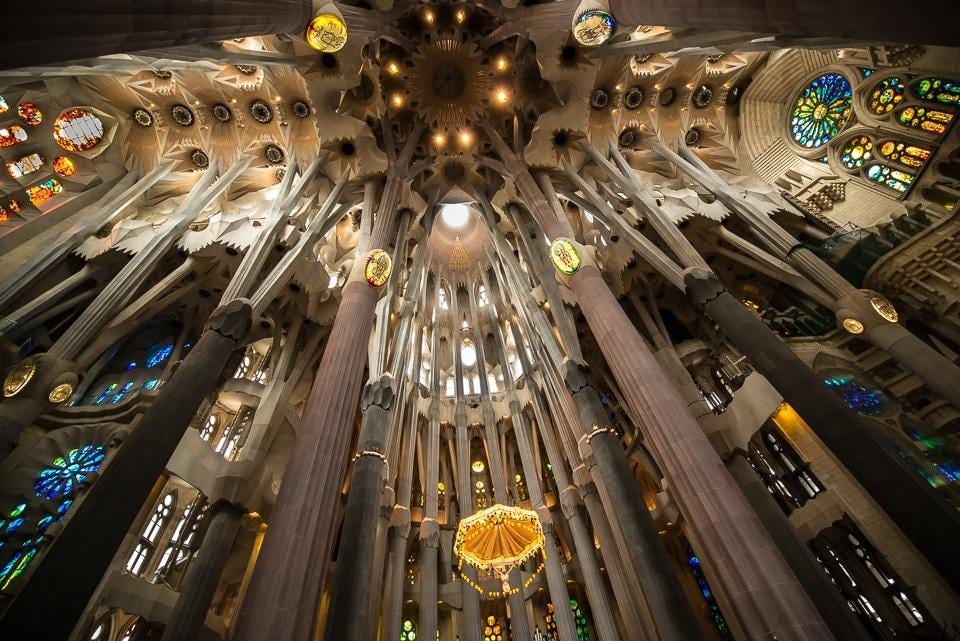
Beyond humans, we find trees to be central to a sense of a “holy place”. The common theme of trees representing a holy temple may very well begin with the Garden of Eden, where the Tree of Life sat in the Holy of Holies at its center. There, of course, also grew the Tree of the Knowledge of Good and Evil. The former represents eternal life and access to God’s direct presence, whereas the latter is heavily representative of God’s gift of freewill to humanity. Together, these trees symbolize a proximity to God and his divine blessing, which humanity lost access to with the fall of Adam and Eve.
With that core narrative in mind, it’s often found that temple and church architecture often feature tree imagery in tribute to that lost Paradise. One that comes to mind after a recent talk at St. Mary’s Cathedral in Edinburgh is the Sagrada Familia, aimed to be completed by the 2030s in Barcelona. The interior is heavily inspired by nature (and trees more specifically), which, among other artistic reasons, is used to symbolize our desire to return to that blessed place.
Points of Emphasis in Scripture
Trees are also found at almost every major crisis, test, or encounter with God, usually also at a high place (mountain, hill, etc.). These moments of trees and high places often come at a crossroad between God and human decision-making. The Garden of Eden, where humanity chooses between trusting God’s wisdom (Tree of Life) or seeking to define good and bad on their own terms (Tree of the Knowledge of Good and Evil), is of course an early example. Also in Genesis, Abraham builds an altar to Yahweh under the great trees of Mamre—here God (accompanied by two angels) visits him and prophesizes that Sarah would in time bear a son; it is also here that Abraham pleads to God to spare the righteous in the cities of Sodom and Gomorrah. A further example is in Exodus; God reveals himself to Moses through a burning bush (which uses the Hebrew word seneh, meaning a bramble bush or tree).
All these encounters and more leads to the most important point of a tree on a high place, namely Jesus’ death on the cross.
Jesus and His Death Upon a Tree
The narrative of the Bible culminates on Jesus’s death on the cross at Calvary. Evidence implies that this place must have been a hill or high place, including from the Aramaic name of Golgotha ‘The Place of the Skull”, elevation implied in Mark 15:40 (can be seen from a distance), archaeological findings of a rocky outcropping outside ancient Jerusalem’s walls, and the Roman practice of preferring raised, highly visible areas for public execution. And while one may not initially connect the crucifixion with a tree, the New Testament authors purposefully refer to the cross as a “tree” using terms like xylon in Greek, which can literally translate to ‘wood’, ‘timber’, or ‘a living tree’.
Acts 5:30: “The God of our ancestors raised Jesus from the dead—whom you killed by hanging him on a tree.”
Acts 10:39: “We are witnesses of everything he did... They killed him by hanging him on a tree.”
Acts 13:29: “When they had carried out all that was written about him, they took him down from the tree and laid him in a tomb.”
Galatians 3:13: “Christ redeemed us from the curse of the law by becoming a curse for us, for it is written: ‘Cursed is everyone who is hung on a tree.’”
1 Peter 2:24: “He himself bore our sins in his body on the tree...”
Deuteronomy 21:22 discusses how a person, who commits a crime worthy of death, is executed and hung on a tree. The New Testament authors are directly referencing this, indicating how Jesus died and took on the curse of human sin. Of course, this circles back to how the fall of humanity first began at a tree in the Garden of Eden; our redemption was also achieved upon a tree, but at Calvary. The crucifix—once a symbol of execution and death—has transformed into the new symbol for the Tree of Life.
The Ultimate Bookend
Finally, trees provide the backdrop to the wonderfully bookended story of creation. The Bible opens with the Garden of Eden narrative, and the Tree of Life and the Tree of the Knowledge of Good and Evil are absolutely central to the message and narrative elements. At the end of the Bible, in Revelation 22, the world is reconciled and Eden is restored—there, at the centre of a Garden-city, is a tree, also described with the same Greek word xylon. The tree and the fruit that it bears is to heal the nations; through this, Christ’s suffering upon the xylon of Calvary is bound to the redemption of humanity and our return to eternal life. The tree shows that history is not circling aimlessly with no end; on the contrary, it shows that we are growing for the ultimate and beautiful fruit of a restored and enhanced Eden. There we will sink our roots into rich earth and be nourished with living water; we will never again be thirsty.
“I am the vine; you are the branches. If you remain in me and I in you, you will bear much fruit; apart from me you can do nothing.” John 15:5
Amen.
By Jack Heitman
It might also be worth noting the use of the Cedars of Lebanon in the construction of the Solomonic Temple. Just as we might sometimes be referred to as "living stones" building up the Kingdom of God, upon the Cornerstone who is Christ, perhaps our likeness to trees also has some significance here. Timber, borne only from the death of the trees that produce it, contributes to the same work of building up the Kingdom. In other words, the image of the felled Cedars building up the First Temple alludes to the continued significance of our mortal lives in the Heavenly Temple, defining who we are within its structure. This is before we consider what the fruits that we have borne mean for the Kingdom.
The same imagery seems to apply to the Cross, properly termed in our liturgy as the Holy and Vivifying Cross. It is a dead tree, but one which defines the entire Heavenly economy, and which therefore continues to give life. Christ's death on that tree allows it to have this peculiar power, His Blood seeping into its dead wood. Perhaps insofar as our own dead timber is collected up and placed in relationship to this Cross, in the Heavenly Temple, it becomes revivified by that same Blood of Christ. This could be the transition from Temple to Paradise, in which nothing is inanimate, but the walls, floors, ceilings and columns are all alive.