

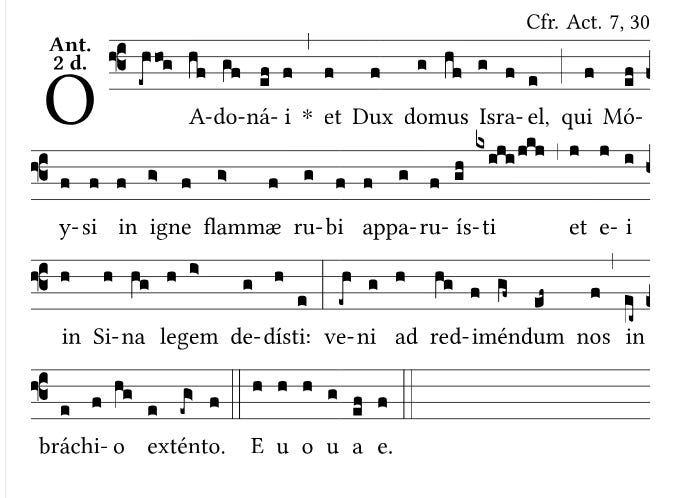
“O Adonai” is the second in the series of “O” Antiphons sung at the Magnificat of Vespers in the last days of Advent. We sing it therefore on 18th December, even if that should fall on a Sunday. Our text reads in translation:
“O Adonai and Leader of the House of Israel, who appeared to Moses in a fire of flame in a bush, and on Mount Sinai gave him the Law: come to redeem us with outstretched arm.”
There is tremendous theology involved in all this!
To begin with the Title: “O Adonai” – “O my Lord God”. This word specifically emphasises the exalted Lordship or supreme Sovereignty of God. It’s a term of the utmost respect, reverence, submission. So, for example, we find it in Isaiah Chapter 6. “In the year that King Uzziah died I saw Adonai sitting upon a throne, high and lifted up…”
The Solesmes editors of our Antiphon, as shown above, point us towards a text in the Acts of the Apostles. This is a verse from the long speech, recorded by St. Luke, given before the Sanhedrin by St. Stephen the Deacon. Stephen here recounts the history of Israel, showing how it all led up to, and was fulfilled in Jesus Christ. In Acts 7:30 Stephen directly quotes Exodus Chapter 3, where Moses encountered the burning bush, heard the voice of God, and had revealed to him God’s Name. This Name, written by the four Hebrew consonants YHWH, is already combined in this Exodus text with the parallel name “Adonai”, or “Lord”. Hebrew tradition came to regard the divine Name YHWH as too holy to be pronounced aloud, so the more generic word “Adonai” would always be substituted for it. This parallel or alternative name for God occurs in the Old Testament over 400 times.
And here is the thing! The un-mentionable divine Name, the Name of the all-holy, all-transcendent God; the Name of the God who made heaven and earth; of the God of Abraham and Isaac and Jacob; of the God whom no man can see and live (Exodus 33:20): this Name is here applied to the man, Jesus Christ our Lord. In particular, it’s applied to this unborn baby, whose appearance in human flesh the Church will celebrate in a few days’ time at Christmas.
Such a bold transfer of the divine title might almost have been designed to shock. Nevertheless, it’s a legitimate and inevitable consequence of the full Catholic doctrine of the Incarnation. So: “Lord God” we cry with this Antiphon, “Come! Come quickly! Come to us in human form! Come to redeem us, come to transform us, come to give us life, come to share with us your own divine and eternal life! And – with outstretched arm – come now in all your majestic power!”
The text that follows is simply a catena of scriptural quotation or allusion. “Leader of the House of Israel” (see, for example, 1 Samuel 9:16; 2 Samuel 12:8; Matthew 15:24); “gave the law on Sinai” (e.g. Exodus 19-20; Leviticus 27:34); “redeem us with outstretched arm” (Exodus 6:6, Deuteronomy 4:34 etc.) All of this reflects a typically Patristic view of the Old Testament. For: the promised Messiah, the One who appeared to Moses in the burning bush, the One who led Israel out of Egypt, and who dictated the law on Sinai: he is Christ Jesus our Lord!
To comment now briefly on the music.
Those of us who live the Gregorian liturgy find this melody triggers all sorts of associations! That is: although the music for the “O” Antiphons is entirely formulaic – the same for each one, adapted to fit the words as necessary – nevertheless it’s unique in the repertoire. We hear these notes, then, as it were, with a thrill. They immediately evoke for us the final days of Advent; the rotation of Monastery Officials who get to intone them, in cope and with incense; the sense of ever-hastening count-down towards Christmas. They evoke also, inevitably, dark winter nights; log fires in the calefactory; the mince pies and mulled wine which venerable monastic tradition decrees for the evening of “O Sapientia”!
The Antiphon is set in the second mode. The second mode is often associated with Chants for Our Lady. Structured around the minor third interval between “Re” and “Fa”, it’s normally rather restrained and modest in scope. But we start our invocation - “O” - with a fourth leap: “Do” to “Fa”. That bold musical statement is replicated (for each “O” Antiphon) at the turning point of the text, with the word “Veni” – “Come!” And each of these two words expresses the cry of our prayer to Christ. Come to us! Come soon!
We pray this, even as we celebrate the fact that he has come, while expressing our faith that he will come again; also that he does come, in the present, through grace. All this gains special force as we prepare for the great Feast (only a week away now!) when with three Masses we will at last celebrate his appearance in the flesh for our sake.
Between these two words of invocation, we have, somewhat in the manner of a Collect, a fuller description of the One we are addressing. “O Lord: you who…” At the mid-point of the Antiphon the music reaches its high point. This is prepared with the interchange of Mi-Re (in igne flammae rubi appar-), here four times! We naturally sing this with some crescendo and even accelerando, until we arrive at the tremendous musical ornament on the final syllable of “apparuisti”. This reaches the interval of a 7th above our starting note, or a 9th above the lowest note of the piece, in its final phrase.
Pluscarden Abbey has recorded a CD of Advent Chants, which can be purchased from our shop, for example via our web site. Or you can listen to it on line, and down-load individual tracks, if desired. Of course it has a recording of the “O Sapientia” Antiphon, sung here with just the first representative verses of the Magnificat (solemn tone). It’s quite recommendable!
By Dom Benedict Hardy OSB, monk of Pluscarden
I love how moved and enthused Fr Benedict is by the chant. X