O Virgin of Virgins, how shall this be?
For neither before thee was there any like thee,
nor shall there be after. —
Daughters of Jerusalem, why marvel ye at me?
The thing that ye behold is a divine mystery.
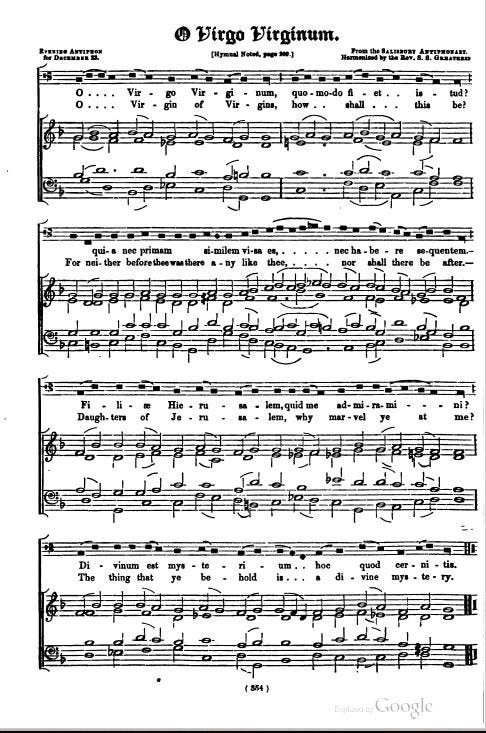
Musical Score to "O Virgo Virginum" from Helmore, Accompanying Harmonies (1852), p. 354.
The 9th century Frankish Liturgist Amalarius was said to have penned O Virgo Virginum which appears in the Sarum on the 23rd December, although is in Dom Prosper Gueranger’s Volume 01, The Liturgical Year: Advent, 2nd Ed., 1870 for the 18th December for the Feast of the Expectation of the Blessed Virgin Mary.
It starts breathlessly with O Virgin of Virgins, how shall this be? Transcribed from the words of Our Lady herself whom you would imagine from the visitation of an Angel with such momentous news it would surely leave you. The next line echoes the Angels words in implication - ‘For neither before thee was there any like thee,
nor shall there be after’…And the angel being come in, said unto her: Hail, full of grace, the Lord is with thee: blessed art thou among women (LK 1:28).
For this was not just a title but a description and what God was doing was new. There had been old women who conceived - Sara and Elizabeth. or infertile women - Hannah, but never a Virgin, only in prophecy would it be spoken of. Our Lady even surpassed Eve, who would not receive the Word of the Lord in Garden, and alongside Adam would choose defiance and unbelief - whereas Mary’s fiat would bring forth the Messiah. In another ancient poem - composed by a monk of Iona in 700 AD - Cu Chuimne - Cantemus in Omni Die to be sung by a monastic community:
Gabriel first brought the word for the Father’s bosom, which was conceived and received in the mothers womb… who by faith did not draw back but stood forth firmly.
These poetic lines reverberate with her final response ‘And the angel being come in, said unto her: Hail, full of grace, the Lord is with thee: blessed art thou among women’.(LK1:38).
As Clancy noted in the time of Cu Chuimne activity the Mary of sorrows was not so emphasised but Mary as theotokos - the God bearer was in the poetry of the age.
Mary, amazing mother, gave birth to her Father, through whom the whole wide world, washed by water, has believed.
Further underlining this thought our Monks would sing:
Truly, truly, we implore, by the merits of the Child-bearer, that the flame of the dread fire be not able to ensnare us.
Like her illustrious female ancestors (and ours in faith) child-bearing would be a blessing and a signal of God moving for His people. Sara would become the mother of Israel, Hannah would give her only son to the Temple and he would become one of Israel’s greatest prophets - Samuel. Samuel would anoint the grandson of Ruth, a foreigner who embraced the God of Israel and become the mother of Jesse - the father of David. Which returns us to our Virgin.
Isaiah would prophesy in chapter 7: ‘Therefore the Lord himself shall give you a sign. Behold a virgin shall conceive, and bear a son, and his name shall be called Emmanuel’. The context of this promise is a time when Israel was yet again under threat from powerful neighbours, and King Ahab was clearly needing reassurance. Isaiah is duly dispatched to provide it - and then adds an extra promise to show that He will really protect the people: ‘Ask the Lord your God for a sign, whether in the deepest depths or in the highest heights.’. Ahab’s response, refusing to ask for one, appears to show a level of unfaithfulness, or even disregard that God would deliver them. This, angering God, would make a promise anyway - that Emmanuel would come among them from a Virgin as a sign that the enemies of Israel would be destroyed. God here, as ever, showing us that what is impossible for humans is possible for God.
But as ever in the Old Testament, it was pointing toward the New in the covenant Jesus would bring, this time as St Paul would write saving all of creation, not just our souls. Cu Chuimne would say something similar in relation to Mary and begin the long meditation on Mary’s role in salvation:
By a woman and a tree the world first perished; by the power of a woman it has returned to salvation.
Of course Our Virgin does not save us in her own power but is the outworking of Christ, whose power this Christmas will come first in the throne of a Manager but is now and ever shall be Our King who had mercy on us. As our Ionan monk would affirm at the end of the Cantemus in Omni Die:
Let us call on the name of Christ,
below the angel witnesses,
that we may delight and be inscribed
in letters in the heavens.
By Eric Hanna
Sources:
Chapter Title: Cantemus in omni die, Book Title: Iona, Book Subtitle: The Earliest Poetry of a Celtic Monastery
Book Author(s): THOMAS OWEN CLANCY and GILBERT MÁRKUS
Published by: Edinburgh University Press. (1995)
Translation of Cantemus in Omni Die by Thomas Clancy
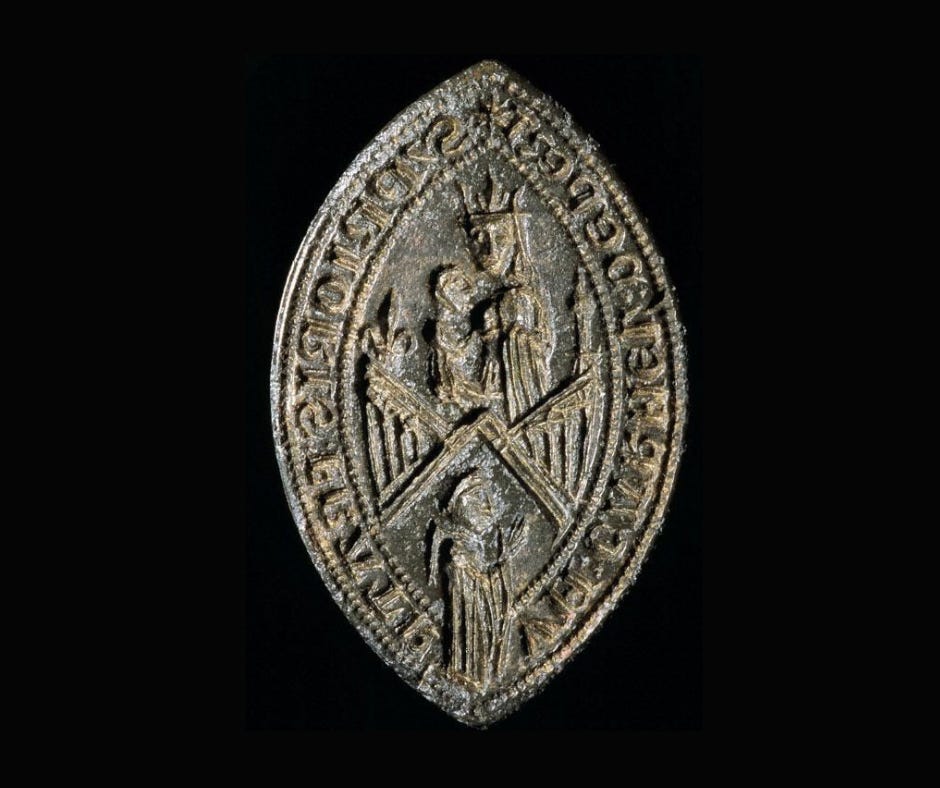
Image: Seal matrix of the Prior of the Perth Carmelites showing the Madonna and Child currently held in Perth Museum and Art Gallery.