
Scottish Catholicism is at its heart reflected in the lives of those who make it incarnate, the “living stones” of the Scottish Church. As a Church with Apostolic origins, we are never short of inspirational examples of what it means to be Catholic in Scotland. The Coracle has published on the Saints associated with this land, who often lived many centuries ago, but it has also given room for some lesser-known models of Holiness, from more recent times. There are already two articles dedicated to Priests who worked in the Outer Hebrides, most notably in South Uist: Fr. George Rigg and Fr. Allan McDonald.
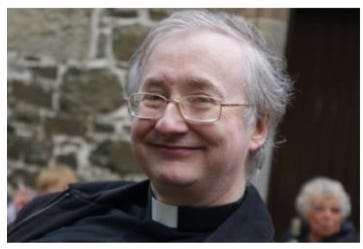
This brief article is dedicated to another Priest, one who served with the Diocese of Paisley, and who was another son of the Hebrides, Fr. Douglas Macmillan. He was born on the 1st August 1953, to an Irish Catholic mother and a Presbyterian father from Harris. His father was tragically lost at sea, while Douglas was still a young child. He and his brother were then raised by their mother in the south side of Glasgow, and it was a Catholic upbringing. Fr. Douglas recalled his Confirmation, in which he chose the patronage of St. Joseph, a Saint to whom he remained devoted. He studied at St. Aloysius’, and upon terminating his studies, he entered the banking sector to make his living.
Beginning initially at Victoria Road in Glasgow, his work ultimately took him to Fort William and to Oban, and he enjoyed living in the Highlands of Scotland. In this vein, he also recalled holidays to Ireland and to the Isle of Harris, stating that he felt quite at home in these places where he had roots. In any case, he succeeded in his work and attained to the position of bank manager. Always having a strong sense of humour, Fr. Douglas mentioned some of the characters who would ask for loans at the bank. On one occasion, a particularly passionate individual was attempting to convince the bank to finance his projects, and the response was clear: “While we recognise the great enthusiasm which you have for this enterprise, it is an enthusiasm which we do not share!”
During this time, his faith continued to deepen, and the Priesthood began to seem more attractive. In his own words, it was once Fr. Douglas began to make pilgrimages that the calling became clearer. He recalled fondly his studies at the Seminary (Scotus College, Bearsden) and had many anecdotes about those years. To quote just one of them, he confided that he took inspiration from Winston Churchill’s speeches to develop his own style of public speaking, an admission that wasn’t to be shared with everyone! Like Churchill, he also enjoyed cigars, albeit on rare occasions, and his preferred brand was King Edward Imperial.
Fr. Douglas was already in the category of a “late vocation”, and was Ordained on the 17th April 1999, at the age of 45. His wasn’t the only religious vocation in the family, as two of his aunts were nuns. His priestly life was served in a few Parishes, beginning with the role of Assistant Priest in St. John the Evangelist, before serving at St. Mirin’s Cathedral. His first appointment as Parish Priest was to the Parish of the Holy Family in Port Glasgow. His second and final Parish was St. Bridget’s in Eaglesham, one of the oldest Parishes in the Diocese. It was here where I first came to know him, and his ministry of some nine years there was very fruitful. These years included the trauma of a fire which devastated the Church, followed by refurbishment, and a providential fraternity developed with the neighbouring Church of Scotland, who had given us the use of their buildings for weekly Mass during this time. All the while, Fr. Douglas shepherded the community, and made every effort to encourage people to become more involved in the Parish.
The strength of this ministry came from several defining characteristics and went beyond Fr. Douglas’ role as Parish Priest. In the first instance, it was clear that he had a great devotion to Our Lady, and he had made St. Louis Marie de Montfort’s Consecration to Her on a number of occasions, renewing it each year. Accompanying this devotion was a real passion for the Divine Mercy, and he never ceased to preach on this subject, weaving it into homilies, and promoting a prayer group devoted to it. Everyone in St. Bridget’s knew something of St. Faustina and her Diary by the end of his ministry there.
These devotions were also expressed in his continued commitment to pilgrimage. Speaking personally, one of the fondest memories I have of Fr. Douglas was a shared journey to Craig Lodge, where we joined a group of diverse pilgrims and spent a weekend in reflection. He never tired of visiting Medjugorje and may well have been one of its most committed Scottish Priests! He likewise retained an active interest in the supposed apparitions at Garabandal until the end of his life.
His faith was one that was ever open to the supernatural, and he would relish the opportunity to talk about miracles (sometimes even Catholic ghost stories) over a dram in the Parish house. At the same time, this same faith was centred on Jesus Christ, and on Salvation being assured in Him. This imparted a certain optimism to his perspective, one of his favourite phrases being “Praise the Lord!”
Besides his role in the Parishes he served, Fr. Douglas was actively involved in the RCIA, and offered spiritual direction to people across the Diocese. He was committed to Charismatic Renewal, and he was open-minded to the gift of “speaking in tongues”. As readers might surmise, his ministry was varied, and focussed on God. It was entirely given over to Him.
From his thirties, Fr. Douglas had began developing a progressive paraplegia (HSP), which gradually limited his physical capacities. When he first came to St. Bridget’s, he was already using two walking sticks, and preparing for Sunday Mass could be a challenge, not least because of a flight of stairs from his house to the chapel. His commitment to the Priesthood was exemplary, and many noted his extraordinary courage in the face of his physical suffering.
The Parish house (Mayfield) in Eaglesham was always well-ordered and it was graced with bookshelves holding hundreds of volumes. There was even a space dedicated to several first-class Relics, which were always in view. Often, Fr. Douglas would host people for several hours, and discussion would turn to theological debate, not least because one of his closest friends was a “die-hard atheist”. One point that is clear in retrospect is the generosity he made of his time: nothing at all was rushed, from the Holy Mass and Confessions, to the time spent with others. He was available at all hours, even on early morning emergency calls. Indeed, we might say that he really didn’t waste any time – either he would be in prayer, he would be celebrating the liturgy, or he would be engaged in pastoral work. His illness had forced him to slow-down, and he simply adapted with an intensity of commitment that is rarely seen.
After breaking his leg in the Parish house, his mobility declined further, and he was forced into retirement in 2019. His final years were spent in a wheelchair. He was based first at St. Laurence’s, Greenock and finally at St. Joseph’s, Bow Road. This period was significantly challenging for him, as he was effectively confined to his living room, and required carers to visit throughout the day. For some two years, being unable to access the nearby Church without help, he celebrated daily Mass on his dinner tray, with all due solemnity. It was a privilege to have been present at well over a dozen of these Masses. They were always followed by a pizza, on the house, which was always a treat.
He celebrated his Silver Jubilee of Ordination on the 17th April 2024, and this was Fr. Douglas’ last major celebration, a gathering of his closest friends and family. His passing on the 6th February 2025 was sudden, but not entirely unexpected. He had received the Last Rites, and the funeral was organised at St. Joseph’s, Clarkston. An impressive number of people attended, and he was buried with his mother at St. Conval’s. At the committal, a handmade St. Bridget’s Cross was placed in the grave, in a final gesture, highlighting a life marked with devotion, profound care for his flock, and a lively faith.
By Anthony MacIsaac