
The very first appearance of Christianity in Scotland may have been during Roman Britain, although there is little concrete evidence. A more successful mission of Christianity was brought to Scotland around the year 563 A.D., on a boat, by the Irish Saint Columba and his twelve followers. They established a religious community on the Isle of Iona, which became one of the main centres of Christianity on the British Isles.
Over the next 1000 years, Scotland underwent various struggles for independence, often subdued by her more powerful neighbour, England. Inevitably, therefore, when Catholic England fell victim to the Reformation under Henry VIII in the 16th century, Scotland did not delay for long in submitting to a similar fate.
Those living in Scotland today must make a conscious effort to find evidence of Scotland’s rich Catholic history. Iconoclastic efforts by reformers have removed all outward signs of our faith – dismissed as superstitious and idolatrous. But whether or not it is evident to the unsearching eye, it ought to be a consolation and source of great hope to the contemporary Scottish Catholic that in fact many of our forefathers gave their lives to God in this land.
State of the Church in Scotland Pre-Reformation
While it can be admitted that the Church in Scotland was corrupt and had many flaws in the 15th and 16th centuries, it is also true that it had many positive aspects, such as the structure it provided to society. In his book A Church History of Scotland, J.H.S. Burleigh writes that “It represented a universal, ordered and in many ways efficient system of law and administration in glaring contrast to the feudal disorder which too often prevailed in Scotland.”[1] The ordered hierarchy of the Church, unlike the feudal system, was generally not one of contempt and uneasy, volatile power, but rather one of respect, obedience, and service. However, there were exceptions to this, also noted by Burleigh, where he states that there was often a power struggle between the monarch and the Pope[2], a phenomenon which is not exclusive to Scottish history.[3] A general patriotism in Scotland at times led to a greater loyalty to the King than to the Pope. The Church in Scotland at this time had become rather powerful and well-organised. The dioceses had been established, feast days were observed and many, if not most, Scots were devout Christians.
Causes of the Reformation in Scotland
Indubitably, the example of England’s Reformation played a role, as well as the influence of Luther and Calvin in Europe. However, Scotland did have its own issues which were being met with growing discontent in the 16th century.
In 1192, Scotland was named a “special daughter” of the Roman See. This may have increased the power struggle between monarch and Pope at times, as it meant that Scotland was answerable only to the Pope, not necessarily to the King. It also led to some practical tensions. Firstly, the question of taxation – the people were required to pay tithes of around one-tenth of their income to the Church and simultaneously the landowners were required to pay taxes to the crown. Understandably, there were disgruntled people who perceived that the Church was growing wealthier, with the priests and bishops living kingly lives, whilst the poor became poorer. The Church also owned a large amount of land in Scotland. Many nobles wished to obtain that land for themselves, and shrewdly realised that a break with Rome would allow for this.
Simultaneously, a new philosophy was spreading throughout Europe - that of nominalism. William of Ockham, the main proponent of nominalism, shed the old ideas of unity, universals, and community, instead preferring to emphasise the individual and particular. Morality, according to Ockham, is a conforming of the “individual to God’s law, external to us and arbitrarily laid down by him.”[4]. Therefore, according to Ockham, man is not following a moral law in compliance with his nature, but rather a random law imposed by God simply because He decided to impose it. Many of the minds behind the Reformation thought this way, placing a great emphasis on the personal relationship with Jesus and personal subjective interpretation of the Scriptures, foregoing the necessity of following the teaching provided by the Magisterium and the Pope. Thus, it can be said that this shift in philosophy was a clear reason which set in motion the idea of the individual, leading man to believe that he is capable himself of leading himself, and does not need a Pope or ecclesiastical hierarchy at all.
The third, and perhaps most influential, reason leading up to the Reformation in Scotland is religious. At this time, the Church was being accused of various different corruptions including simony, claims of episcopal concubinages, and a growing suspicion surrounding many of the material practices of the Church – they were viewed as superstitions. The influence of iconoclasm infiltrated quite significantly, increasing the growing animosity towards the traditions such as veneration of relics and statues.[5] The poor example of the clerics who lived with concubines further served to reduce the respect for the Church hierarchy, causing the people to question the infallibility of the Church. However, with the Council of Trent beginning in 1545, many of these issues were addressed and resolved. Thus, although there were significant changes necessary, perhaps the reformers failed to recognise that such issues were merely a result of malpractice and lack of education rather than a true reflection of Church teaching.
Reformers
It must be noted that Scotland was not alone in falling victim to Protestant reforms in the 16th century. Many other reforms were taking place at the same time across Europe and the British Isles. In 1517, Martin Luther wrote his 95 Theses mainly attacking the corrupt Catholic practice of selling indulgences and created a wave of criticism that spread throughout Europe. Henry VIII declared himself the supreme head of the Church of England in November 1534 in order to divorce his wife. French theologian and Protestant reformer John Calvin influenced the Protestant movement worldwide from Geneva.
In Scotland, however, the Reformation was led mainly by one man: John Knox. Inspired by Calvinist theology and by George Wishart, he began preaching in St Andrews in 1547, was exiled to France, released in 1549, was appointed chaplain to King Edward VI - Henry VIII’s son - in 1551, a role which evidently increased his profile throughout the world. Meanwhile, the state of the English Crown was rather tumultuous. The death of the childless Edward VI at age of fifteen led to a dispute over who was the rightful heir. Knox, at this time, fled Scotland for Europe, where he hoped to discover a more established Protestant setting from which he could learn. It was while he was in Geneva in 1554 that Knox met Calvin, studied his theology, and was very much influenced by him. Over the next two years, Knox would spend time in Geneva and Frankfurt preaching, learning, and pastoring those whom he found there. When he returned in 1556 to Scotland, he brought with him not only a wife, but a master plan to bring much of Calvin’s teachings to Scotland, and to convert the country to his newly reformed religion.
Knox published several works, including the Scots Confession, in which he outlines the pillars of belief in his new Church. These highlight aspects rather similar to the famous ‘solas’ provided by Martin Luther: emphasising the importance of a personal relationship with Jesus Christ, the authority of Holy Scripture, while disregarding all forms of earthly ecclesiastical authority, especially the Pope.
Knox strongly attacked the so-called ‘superstitious’ traditions of Catholics, believing that they were merely a distraction and thus warped the true meaning of the sacraments. In the 22nd chapter of the Scots Confession, Knox writes “The addition of oil, salt, spittle, and such like in baptism, are merely human additions.” [6] He ventured so far as to say that the Catholic practices regarding the Eucharist were “sacrilege”[7].
A new and devastating iconoclasm occurred at this time, in 1561, as Knox’s new criticisms of Catholic practices spread. He did not act alone, but now with accomplices, which allowed him to implement his new creed further throughout the nation. Visibly, the churches throughout Scotland were stripped of their art, statues and valuable objects, whitewashed, and any other religious imagery – including exterior crosses – was removed. It was believed that these were a distraction from the true God, and prevented people from worshipping Him truly.
Thus today, we find many of our churches rather bare, bereft of the beauty which once rightly adorned them. The legacy of the Reformation continues its influence in church architecture in Scotland; we are yet to regain our desire for beautiful churches.
Although this sad history of the Reformation and the ensuing widespread persecution of Catholicism throughout Scotland may tempt today’s Scottish Catholics to despair, we must take courage from the many Saints and martyrs who precede us.
Holy Martyrs and Saints of Scotland, pray for us!
[1]J.H.S. Burleigh, A Church History of Scotland, (London, Oxford University Press, 1960), pg. 91
[2]Ibid., pg. 91
[3]Before the dogma of Papal Infallibility (Vatican I), it was the case that many Catholic countries were more loyal to their monarch than the Pope, resulting in so-called national Churches which believed the monarchs held temporal earthly power while the Pope held more limited authority over Church affairs. See Gallicanism.
[4]Cf. John Vidamar, The Catholic Church through the Ages, pg. 194
[5]Cf. John Vidamar, The Catholic Church through the Ages pg. 187
[6]John Knox, Scots Confession, Ch 22 https://www.apuritansmind.com/creeds-and-confessions/the-scottish-confession-by-john-knox/
[7]John Knox, Scots Confession, Ch 22 https://www.apuritansmind.com/creeds-and-confessions/the-scottish-confession-by-john-knox/
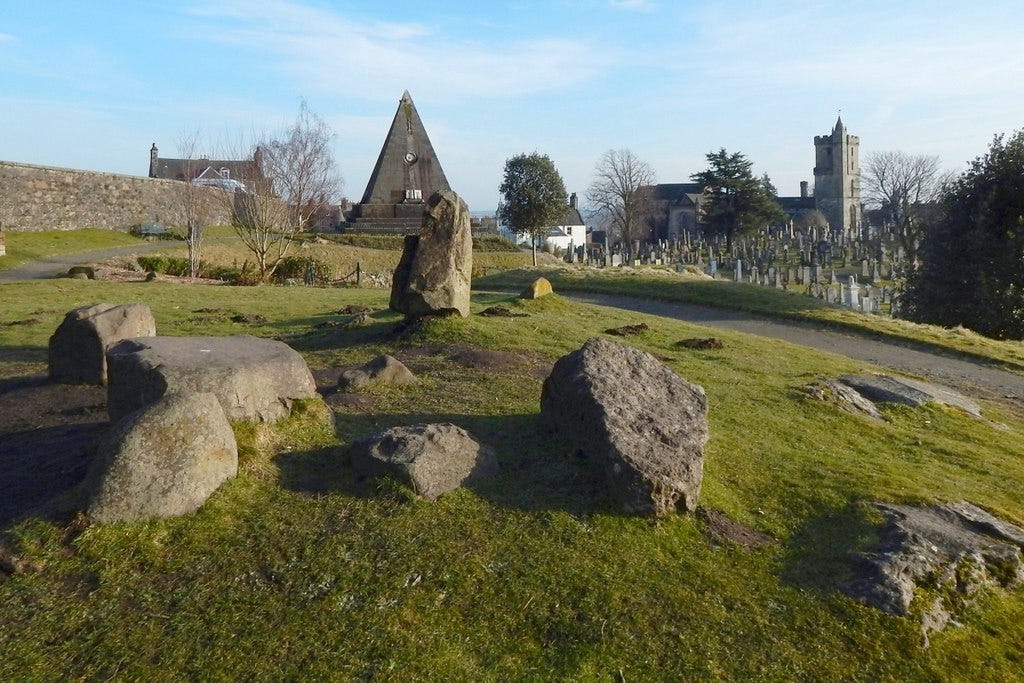
Image: Drummond Pleasure Ground Stirling: Created by nurseryman William Drummond in 1857, which intended to be a place where people could contemplate biblical scenes alongside the major Reformation figures. Its centre piece is a pyramid which contained a copy of the Confession of faith and the Bible.