
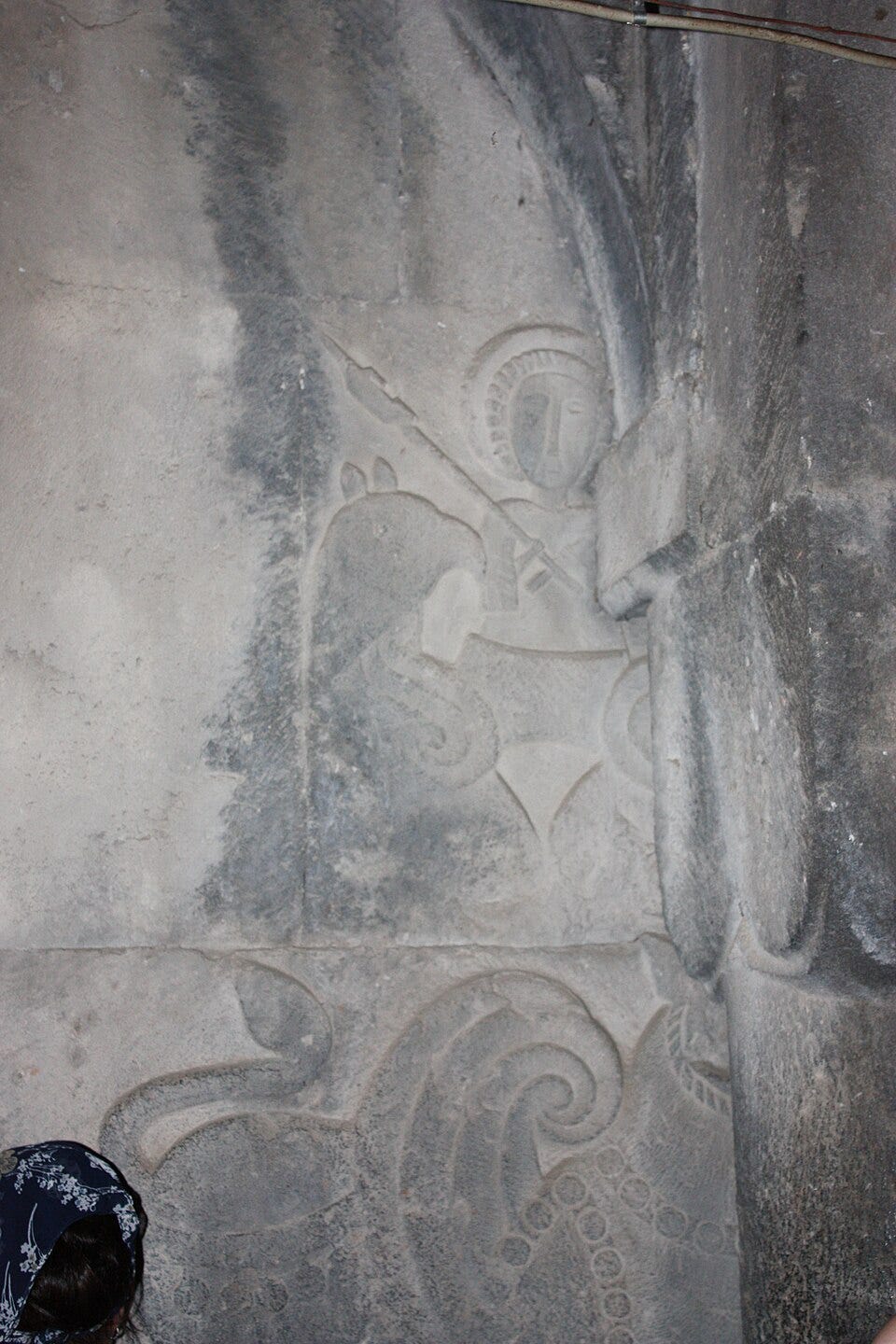
Alexander the Great - Khakhuli Monastery in Georgia - main church is now a Mosque. Please see the postscript below for a little extra. )
By some measures, one of the most consequential figures of human history, both despised and revered, is Alexander of Macedon. The son of Philip II of Macedon, his military conquests, and impact on subsequent history, earned him renown as Alexander the Great.
Alexander stands at the junction between the ancient world – the world of Egypt, of Babylon, of ancient Israel – and the world of Imperial Rome. The latter came to define most subsequent Western history. The Caesars considered Alexander with some awe, and his imprint on Scottish history is found in the names of three of our kings – Alexander the Fierce, Alexander II, and the ill-fated Alexander III.
Holy Scripture has little to say of Alexander, but the 1st Book of Maccabees acknowledges his rise to power, and the gravitas that this power entailed:
“He advanced to the ends of the earth, and plundered many nations. When the earth became quiet before him, he was exalted, and his heart was lifted up.” (1 Maccabees 1:4)
His reception isn’t necessarily a positive one, and the text is hostile towards the successors he appointed in his stead, dividing up his empire:
“They all put on crowns after his death, and so did their descendants after them for many years; and they caused many evils on the earth.” (1 Maccabees 1:9)
It is true that Alexander’s conquests allowed for the spread of Greek culture throughout the world of the Mediterranean. The entire branch of Hellenistic Judaism, with proponents like Philo of Alexandria, and even the translation of the Scriptures into the Septuagint, are indebted to his career. This latter point, the translation of the Tanakh into Greek, was considered a prophetic act, and the Septuagint remains normative for most of the Apostolic Churches.
In the centuries after his death, Alexander’s life became the subject of legendary narrations, most of them collectively known as the Alexander Romance. This work exists in varied recensions. The material of the Alexander Romance appears to have influenced the later Arthurian cycles of British legend. It also influenced popular religious belief.
The Talmud presents Alexander as visiting Paradise, in unison with these legends, and in this Jewish tradition he succeeds in reaching its fountain of immortality. The import of this tradition isn’t immediately clear, fascinating as it is. For rabbinical Judaism, it would appear that Alexander’s career isn’t quite over, and that he has at least some of God’s favour.
Islamic theology develops his religious role to a further extent and has long regarded Alexander as a figure associated with the eschatological battle with Gog and Magog. While this isn’t unanimous in Islamic teaching, he is often identified as the Dhu al-Qarnayn, the “Two-Horned One”. In this sense, his place is decisive, and he is considered one of God’s chosen, even as one of his Prophets.
In his Christian reception, we find traces of an Icon depicting Alexander, suggesting that he was Canonised a Saint, at least in the Churches occupying early medieval Georgia. The 10th century carving shows him ascending into the heavens, and with a halo around his head. It seems entirely plausible that Alexander was venerated for his historical significance, but only within the framework of the Resurrection and Glorification of Christ. This is a transformation of Alexander’s mortal image into something timeless.
Having said all of this, we must also mention the Zoroastrian traditions, which are the most reminiscent of the violence that Alexander brought to Persia. They are relatively unambiguous on his legacy. For Zoroastrianism, Alexander was an instrument of the Evil Spirit, fully opposed to the Divine will. It is worth taking pause here. Before we might conclude with a positive view of Alexander, we ought to take stock of violence worked in his name. The massacres and pillaging, which formed such an essential part of his military campaign, make it very difficult to have personal sympathy for the man.
Later Christian traditions portray him in a less glorified manner, as we see in the famous Icon showing St. Sisoes the Great visiting his fabled tomb. Alexander’s tomb, known to Antony and Cleopatra, has been lost for around 1500 years. The question of whether St. Sisoes (one of the Desert Fathers) ever found the tomb is open to interpretation.
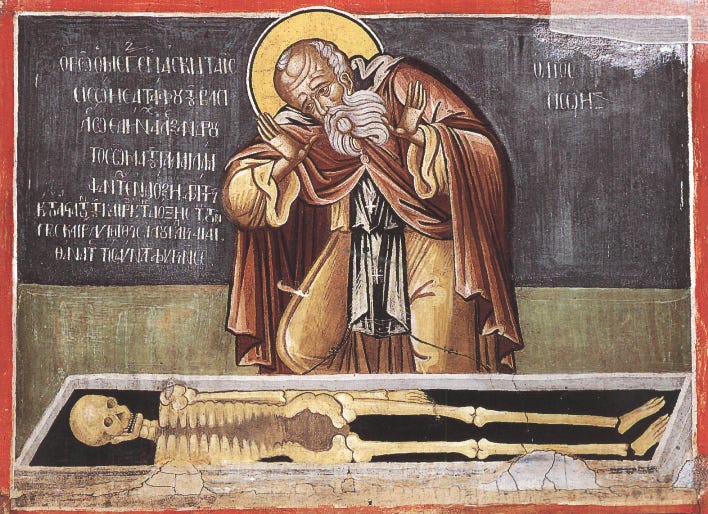
The thrust of the Icon is simply a demonstration of the futility of all worldly power. St. Sisoes regards the open sarcophagus with sadness, and perhaps with some horror. Alexander has come to the same end as all men, despite the incredible influence his career exerted on the world. His salvation seems far from assured. Of course, we may also wonder whether St. Sisoes prayed for Alexander’s soul, as he contemplated his desiccated remains, and the image is suggestive.
If his tomb was found, by St. Sisoes, or otherwise, some scholars have suggested that it now hides in plain sight. In fact, it has been thought that the mummy of St. Mark the Evangelist, taken from Alexandria to Venice, may actually constitute the remains of Alexander. If true, the irony is clear – for centuries, faithful Catholics have been venerating the Relics of the Macedonian conqueror. This only adds to the ambiguity of his place in the religious imagination.
So, is Alexander of Macedon a Saint? We have seen that his character is one of the most ambiguous in traditional religious narratives, and that three of the four monotheisms are cautiously positive about his fate. Perhaps we may see the parallel with King Solomon – the Alexander Romance is highly suggestive of this – who was recognised as a Saint only for his exclusive role in the unfolding of Divine Providence, and for his purported authorship of the Book of Wisdom. Alexander’s key historical role, which seems to earn him a place in the eschatological scenario, seems to give him some hope of redemption. Of course, any sanctity which we might attribute to Alexander must ultimately come from the Divine Mercy alone. At best, we might say that he was saved by miraculous grace, and that if he is a Saint, he would be so to remind us of that grace.
By Anthony MacIsaac
Anthony would like to thank Samra Azarnouche and Muriel Debié for the excellent seminar on Alexander the Great.
Postscript
On the image at the top of the page: It’s a legendary motif of an “Aerial Flight”, which we find in stories about Ahiqar, and also in the traditions surrounding Nimrod. Ahiqar inspired the Book of Tobit, while Nimrod is the protological conqueror, a “Mighty man on the Earth”. The Tower of Babel is a variation on the same theme, building higher and higher until an aerial invasion of Heaven becomes possible.
Solomon is placed in similar scenarios, and Jewish and Islamic legends recount that he was able to fly to the ends of the earth, and to control an army of demons, who helped him build the First Temple at Jerusalem. This tradition specifically mentions a“Ring of Power” (might this have influenced Tolkien) which were used to bind the demons to the Divine service. Hence, the tradition of Solomon as exorcist par excellence. This tradition is implicit in the words of Our Lord Jesus Christ - “There is one greater than Solomon here” - after He exorcises a demon.
So, the Alexander Romance portrays Alexander in precisely the same way as Solomon the exorcist - he enlists an army of demons by force, to fight for him, at certain junctures in his extra-historical career. This probably refers also to the eschatological scenario, in which the devil’s house is divided unto itself.