
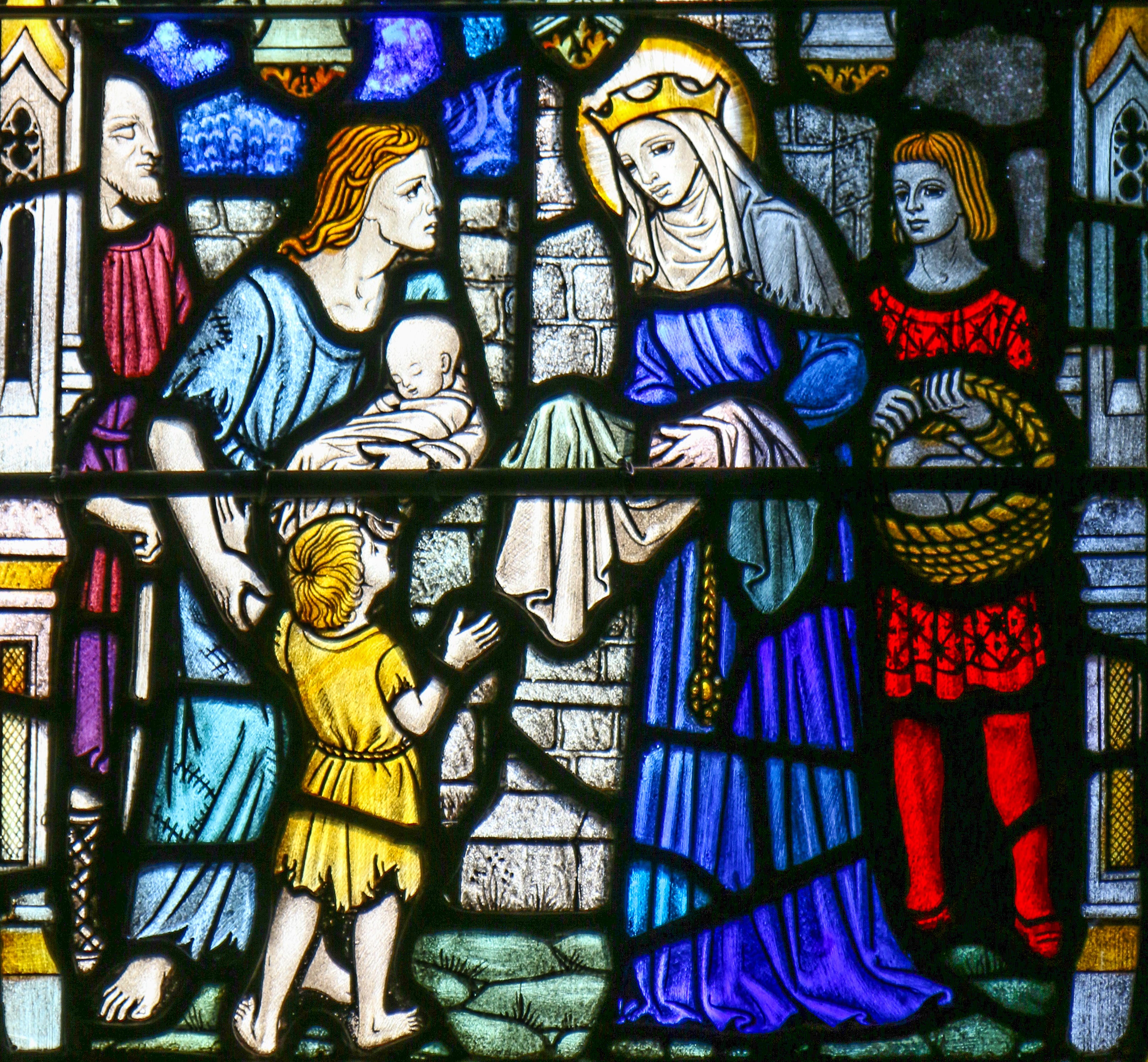
Queen Margaret of Scotland was a remarkable lady who had a profound beneficial influence on Scotland, and has left her mark on our nation in many ways, and in visible names and places.
Historians have many conflicting views and opinions on Margaret, especially as there was so little written down in the eleventh century, and what was written down has so often been destroyed or lost. However, there are many things which are not disputed.
Her father was Edward Æthling, and mother Agatha. Her grandfather was King Edmund. He did not succeed to the throne, as King Cnut (or Canute) the Danish king who ruled most of England then, had other ideas, and Edward and Agatha had to flee the country. They went to Hungary, where they had connections, and it was there, around 1045, that Margaret was born. She was baptised in a church in Mecseknadasd.
In 1057 Edward was declared heir to the throne of England. So he, Agatha, and their children Margaret, Christina, and Edgar, returned to England, ready to take over the throne. Unfortunately, Edward suddenly died just after they arrived, of natural causes, in 1057, leaving his wife and children to the care of the Court. Margaret was about 11 years old at that time. Then came 1066 and the Norman invasion. They had to flee again, moving up to Northumberland, and then as the Normans spread across England, they took to a ship to go over to the Continent again - but a storm had other ideas and they were blown into the Firth of Forth and landed at St. Margaret’s Hope, near Rosyth in Fife in 1069.
The family went to see King Malcolm III to ask for his protection and help.
Malcolm had been crowned at Scone on St Patrick’s day in 1058, and in 1059 he married Ingibiorg of the Norwegian royal family, and so gained Orkney, Shetland, Caithness and Sutherland. They had three sons, and then Ingibiorg disappears from history.
Margaret had been brought up in a very strong religious country and household, and had aspirations of entering the cloisters as a nun. However, Malcolm was a widower (or at least, “unmarried”) and there was a mutual attraction, so in 1070 or 1071, they were married in a small chapel in Dunfermline. Malcolm was about 40 and Margaret about 24 years old. On the site of this chapel was erected the Abbey. Malcolm and Margaret moved into Edinburgh Castle. They had a happy marriage for 23 years, during which time Margaret gave birth to six loons and two quines. The children went on to great things. For example, the eldest daughter, Matilda, also known as Edith or Mold, married Henry I in Westminster Abbey in November 1100 to become Queen of England.
Margaret set about dragging Scotland into the eleventh century. For a start, she insisted that, at court, people used knives and forks, rather than fingers and a dagger to cut up the meat.
Margaret found the church in Scotland, not exactly in disarray, but in need of some firm direction and encouragement. A good example of this is in Laurencekirk, previously known as Conveth. She made a pilgrimage to the Kirk of Conveth, which was dedicated to Saint Laurence of Canterbury. She gave money and endowments to the Kirk there to encourage the priests, help build a new Church, and to build a sanctuary for pilgrims to rest and recuperate. As was the custom, she appointed a man to be in charge of the sanctuary and would pay his salary. The railway station at Laurencekirk was closed under the Beeching / Conservative regime in the 1960s, but was reopened on May 17th, 2009 at a cost of £3.5 million. It has been a great success. The southbound platform had to be completely rebuilt, and on the wall is a string of murals in tessera which includes one celebrating the visit of Queen Margaret in 1080. Apparently she was not too well when she visited, and later gave birth to a daughter.
Margaret visited churches all over Scotland, encouraging them, funding them, and insisting on the observance of the rules, such as fasting, making the Sabbath Sunday instead of Saturday, rules for marriage between cousins etc., and generally elevated the level of Christianity in the country.
She was known for caring for prisoners of war, and even paying their ransom herself so that they could go home. Every day her Chamberlain had to present nine different orphans who she would personally feed, before she would eat anything herself. During Lent, she and Malcolm would wash the feet of six poor folk every day.
With her continental European connections, she encouraged trade, and foreign luxury goods began to appear in Scotland, as well as raw materials and foodstuffs.
Margaret was always encouraging pilgrimages, especially to Dunfermline and St Andrews. From Edinburgh this would involve a detour upriver of about 60 miles to be able to cross to Fife, which would take about three days, so she instigated the ferry service between South and North Queensferry. As well as the ferry (free to genuine pilgrims) she had built hospices for the pilgrims at Inverkeithing and at South Queensferry. Margaret personally appointed, and paid for, the person in charge of each of these shelters for pilgrims. The ferry operated from around 1100 to September 4th, 1964, when Her Majesty Queen Elizabeth I of Scotland opened the road bridge. The last ferry trip was made by the ship “The Queen Margaret” carrying Her Majesty back from Fife. The ferry was the world’s first diesel electric paddle ship, and started operation there in 1934. There were four ships operating a quite intensive service. The Queen Margaret and Mary Queen of Scots were scrapped at Inverkeithing in 1965, Robert The Bruce was scrapped at Bo’ness in 1965, and the Sir William Wallace was sold to Belgium. Before the railway bridge was built, railway passengers also crossed by the ferries to pick up trains again at Inverkeithing or Dalmeny. The sloping ramps are still in place.
Margaret herself used the ferries, and helped develop Dunfermline into Scotland’s most important religious centre. She invited Benedictine monks from Canterbury to come and establish a priory there, and later her youngest son King David I of Scotland made it into an Abbey in 1128, continuing his mother’s good practice giving money and endowments to ensure the growth of the Abbey.
In 1093, Margaret’s husband Malcolm III and their son Edward went on a raid of Northumberland. At Alnwick, the English army defeated the Scots, and both men were killed. At this time, Margaret was unwell and in bed. She had been weakened by too much fasting and taken ill. She took the news very badly, and died three days later, in Edinburgh Castle. Her remains were taken to Dunfermline Abbey and interred there. Margaret died on November 16th, 1093, around 47 years old.
Her shrine became a great pilgrimage destination. Miracles were attributed to her intervention, and she was made a Saint by Pope Innocent IV in 1250.
Of her six sons, three became Kings of Scotland, Edgar, Alexander I and David I. David, born 1084 and died May 24th, 1153, was probably the most effective. He reigned from 1124 to 1153. During this time, he set up the feudal system, established law and order, a legal system and a civil service. He also developed more trade with the Continent. David also introduced coins, when he captured the English Royal Mint which was in Carlisle Castle. He was responsible for building St. Margaret’s Chapel in Edinburgh Castle. When he died, he left a Scotland that was much more modern, more European.
There are a great many memories of Margaret all across Scotland. Probably the latest is the wall on Laurencekirk railway station, and the oldest is probably St. Margaret’s chapel in Edinburgh Castle. On March 13th, 1314, Robert the Bruce captured Edinburgh Castle and demolished all the buildings there apart from the Chapel — and it is the oldest part of the Castle, and the oldest building in the whole of Edinburgh. This small chapel (about 16 feet long by 10 feet wide) has undergone various changes over the centuries, including being used as a gunpowder store when the windows were filled in. Today it is open to the public, and cared for by the St Margaret’s Guild, established in 1942. The Guild has over 300 members, and all must have their first or second names “Margaret” or a derivation of it such as Meg or Daisy. The Guild maintain the chapel, and put fresh flowers in it every day. They also have some artefacts, including a large banner that is used at an annual procession in Dunfermline. There are North and South Queensferry of course, and at North Queensferry there are the remains of St James’ chapel, which was restored by local sailors in 1752. St James is the patron saint of pilgrims.
Dunfermline contains a great many places to see. There are two railway stations, Dunfermline City (renamed from Dunfermline Town when it was made a city on October 3rd, 2022, becoming Scotland’s eighth city) and the other station is Dunfermline Queen Margaret - named after the nearby hospital. To name a hospital after Margaret is most appropriate of course.
Dunfermline Abbey - or what is left of it - is wonderfully impressive. Edward I of England, the “Hammer of the Scots” sacked it in 1303, used parts as stables, and barracks, and generally left it in a sad state. In 1306 Robert the Bruce who had sent Edward home again - restored the Abbey. The Reformation was very unkind to the Abbey, it was attacked by a mob on March 29th,1560 and looted, and it fell into disrepair.
There is Queen Margaret’s stone, about eight feet high, today at the entrance to the Pitreavie Business Park. Margaret is said to have rested at this stone on her way to meet Malcolm. Some historians say it was where they first met.
Margaret also used to go to a little cave shrine to pray in peace and solitude. This became a place for pilgrimages, and was always being visited, especially after her canonisation in 1250. In 1960 the Dunfermline Council decided to fill in the wee valley and cover it all, including the cave chapel, in a car park. There were protests at this desecration, and so when the valley was filled in in 1962, the cave was spared and is still there, and can be visited, going down 87 steps.
St Margaret, Queen of Scotland, left indelible marks on Scotland, both physical and moral. There are many places and churches named after her, including (Catholic churches) in Huntly, Airdrie, Roybridge; (Church of Scotland) Aberlour, Rosyth, Lossiemouth, Braemar; and (Episcopalian) Aberdeen, Dalry, Glenrothes. In total there are around two dozen churches in Scotland named after Margaret, and many in Hungary. As I have shown there are many places to explore, especially in and around Dunfermline. Margaret was devout, and actively lived her Christianity by building up the Church, encouraging pilgrimages, and her caring for prisoners, the poor and the sick. She fairly deserves to be remembered and constantly held up as a shining example of Christianity in action.
Margaret exemplifies the parable of the farmer sowing his seed. In Margaret’s case, the seed fell on good ground, and multiplied well over one hundred times. It would have been easier for her to have stayed in Edinburgh, embellished the castle, and had a comfortable life. However, she travelled widely around Scotland by horseback on inferior roads and tracks, bringing her presence and shining example to the people.
Her feast day is November 16th, the anniversary of the day when she died, and she deserves to be celebrated on this special day.
By Ron Smith