
St Hildegard Von Bingen was born into a noble family in c.1098 in modern day Germany and her feast day is September 17th; she was a 12th Century Benedictine Abbess and Polymath who entered the monastery as a child, beatified in 1326 with Pope Benedict XVI declaring her a Doctor of the Church in 2012 and joining her contemporary St Bernard of Clairvaux with whom she exchanged letters and shared her visions. St Hildegard also exchanged letters with many other important people from Frederick Barbarossa to Pope Eugene III, many of whom sought her wisdom with which she obliged in her affectionate yet fiercely pious way. Some modern biographers try to paint St Hildegard as a disobedient proto-feminist with high ambitions who was disliked by her superiors, but despite having disagreements and being intensely passionate, she was encouraged in her spiritual work by her hierarchy and doted on by her contemporaries, for example St Bernard of Clairvaux comforted the mystic saying “We rejoice in the grace of God which is in you. And, further, we most earnestly urge and beseech you to recognize this gift as grace…” additionally Master Odo of Paris wrote in 1148: “It is said that you are raised to Heaven, that much is revealed to you, that you bring forth great writings, and discover new manners of song…”.
…the ‘feminist’ world are more interested in her sexuality and relationships with the men in her life than her actual tangible achievements such as building a convent, authoring multiple publications, developing her own language and remarkable musical compositions still performed today.
The monk known as Volmar worked by St Hildegard’s side for much of his life transcribing her visions. Her central work ‘Scivias’ is an illustrated collection of 26 visions, the original medieval manuscript was lost during WWII, but faithful copies were made throughout the centuries. As well as recording her visions, St Hildegard also wrote one of the first known morality plays, scientific texts and composed music. She is one of the first known female composers along with Byzantine abbess Kassia. Contrary to the idea that women were oppressed by the Church, it is the Church here that gave these women the freedom to write and compose and subsequently kept their work and memories alive. St Hildegard gained renewed popularity in the 20th Century mostly within the New Age movement due to her mysticism and writings about natural healing, particularly those where she describes the use of plants, metals and precious stones. This New Age interest is attributed to de-frocked Dominican friar Matthew Fox who became a New Age evangelical preacher later in life. Although it is wonderful that St Hildegard has affected so many people across centuries and world-views and continues to inspire people across many creative disciplines, it is disheartening to see her devout character moulded to fit a current agenda, many alluding to secret love interests and battles with the ‘patriarchy’, such as an opera by Sarah Kirkland Snider and a film by German film-maker Margarethe von Trotta both centred on a fictional romance fantasy between Hildegard and another Sister, which seems all the more offensive that those within the ‘feminist’ world are more interested in her sexuality and relationships with the men in her life than her actual tangible achievements such as building a convent, authoring multiple publications, developing her own language and remarkable musical compositions still performed today. ‘A feather on the breath of God’ was released in 1982 by British vocal ensemble Gothic Voices and consists of the music composed by Hildegard Von Bingen, around the same time the German early music ensemble Sequentia also released recordings of St Hildegard’s compositions, this lead to increased interest in both medieval music and St Hildegard, the music was even sampled by rave musicians and thus St Hildegard’s reputation continues among unlikely sub cultures.
St Hildegard experienced visions from childhood but only ever spoke of them later in life, from her writing it seems that she felt as if she would not be believed or that what she had to say would not be well received. She described in clear detail how her visions came to her: “...I did not perceive in dreams, or sleep, or delirium, or by the eyes of the body, or by the ears of the outer self, or in hidden places; but I received them while awake and seeing with a pure mind and the eyes and ears of the inner self…”. In a separate entry, she describes how her soul “rises up high into the vault of heaven and into changing sky and spreads itself out…” (see figure 1), she describes how she sees the things she describes as if reflecting in water. ‘Scivias’ is structured in 3 books, the first focuses on ‘The Creator and Creation’ reflecting on Hildegard’s vision of God, the Fall, the nature of the Cosmos and the choir of Angels. The second focuses on ‘The Redeemer and Redemption’ and reflects on the nature of the Trinity and the Church as the bride of Christ. The third book mostly focuses on a symbolic building which represents salvation history as well as each structural element corresponding to the virtues and doctrines of the faith.
“Oh noblest greenness, who have your roots in the sun… / you are held around by the embraces of the divine mysteries / you glow red like the dawn
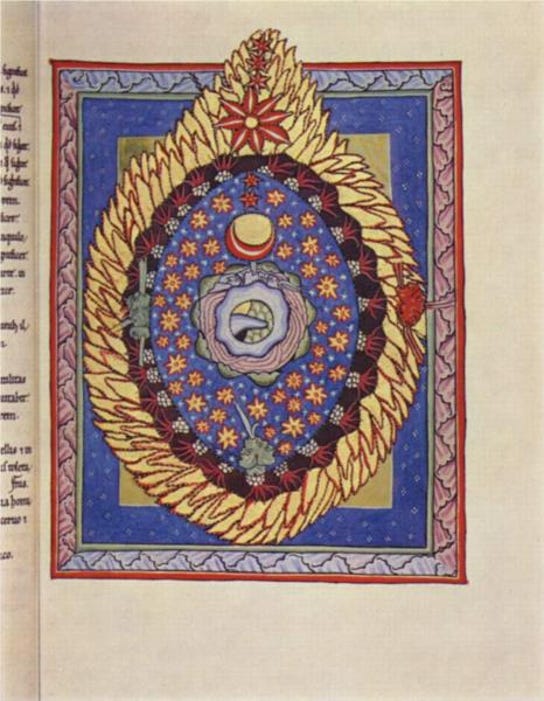
Vision of the Universe
Hildegard’s visions are not only illustrated beautifully in the artwork of ‘Scivias’ but also within the poetry of the Antiphons and Sequence’s she wrote for her compositions. In ‘O ignis Spiritus Paracliti’ we continue to see through Hildegard’s eyes: “O boldest path / penetrating into all places / oh high and on earth / and in every abyss / you fit and gather all together.” In Hildegard’s writing and her music, she often uses imagery of irrepressible, virile nature to describe God’s power, she calls this ‘Viriditas’, meaning ‘greenness’ and ‘growth’; one responsorial song ‘to the Virgins’ proclaims “Oh noblest greenness, who have your roots in the sun… / you are held around by the embraces of the divine mysteries / you glow red like the dawn…. It is akin to the language of the Canticle of the Sun by St Francis Assisi, who was born only a few years after St Hildegard’s death whereby he praises God for ‘Brother Fire’ and ‘Sister Water’.
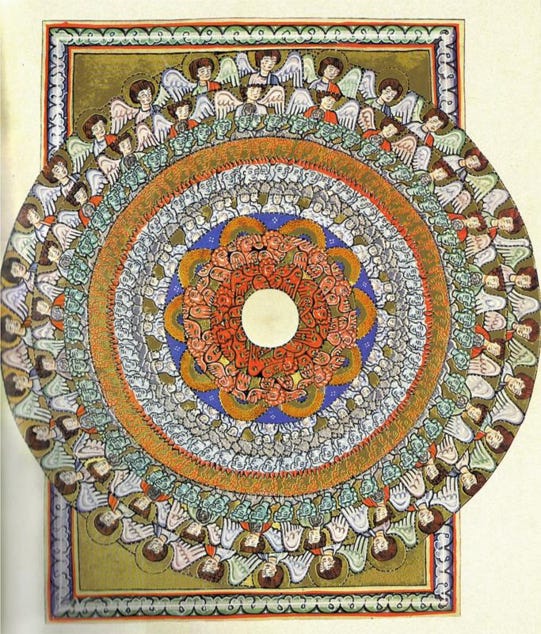
Vision of the Choir of Angels
In the introduction to Fiona Maddock’s biography of Hildegard Von Bingen she describes how in the March of 1852, a handful of people gathered around a casket in the church of Eibingen, believed to contain the remains of a woman who died nearly 700 years before. The remains had been moved around the country, including once to Cologne during the 30 Years War, had survived wars and pillaging and were now back home on the banks of the Rhine. When the casket was opened, the parish priest found nearly 60 bones within a violet silk shroud including the skull in a silk hood with a parchment with gothic lettering that read: Caput Sancte Hildegardis (Head of the blessed Hildegard). Additionally, there was a pocket sewn into a skullcap with strands of gold-grey hair, parts of a black and brown habit and the remains of mummified vital organs within boxes. These remains are now in a reliquary at Eibingen in Germany and the central destination for pilgrims.
By Lucy Fraser
Lucy also wrote about St Hildegard as part of last years Advent series on the O Antiphons- please have a look below.
O Sapientia

In the first of our O’s beginning on the 16th December as per the Sarum version we start with Wisdom.
Thank you for this write up Lucy — I recently gave a talk titled “Maidens, Mothers and Mystics: The Role of Catholic Women in the Church Through the Ages” and felt I could read from and about Hildegard all day — and still I learned a few new things from your article! I’m feeling very tempted these days to name our next daughter after her, if we are blessed with one!
You will be sorry for this post, as it will now cause more exposure to this witch, and here it is: "Hildegard’s visions violate the traditional Christian understanding of private revelation and the authority of the Church...." "her "abnormal gift" (often described by secular historians as visionary prophecy) as occultic in nature." "RJMI’s critique generally follows these points:
Rejection of Private Revelation: He maintains that the era of public revelation closed with the death of the last Apostle. He argues that any subsequent "prophetic" visions that attempt to add to or clarify doctrine—or that claim a direct, unmediated channel to the Divine—are deceptive.
The "Witchcraft" or Occult Classification: While mainstream history views Hildegard as a polymath and mystic, RJMI classifies her influence as witchcraft because he contends she operated under the power of demons, seduced others into heresy, and elevated her own subjective experiences above the objective deposit of the faith.
The Heretical Trajectory: He places her within a broader context of medieval figures whom he views as having helped corrupt the Church from within. He considers her popularity among modern readers as evidence of a "great apostasy" where individuals prioritize mystical or emotional experiences over the strict, traditional doctrine he defends.
You can find his specific arguments detailing why he labels her a witch and a deceiver in his various "True Catholic" online tracts and compiled encyclicals, where he methodically categorizes historical figures as either saints or agents of the adversary based on his strict adherence to his specific interpretation of Catholic tradition. His writings on this are typically indexed under his critiques of "false mystics" and "heretical saints." The above is from the ai helper at gab.com ai I use... More on her use of astrology, and demon possessed "rocks/stones" later when I get some time for this update....