
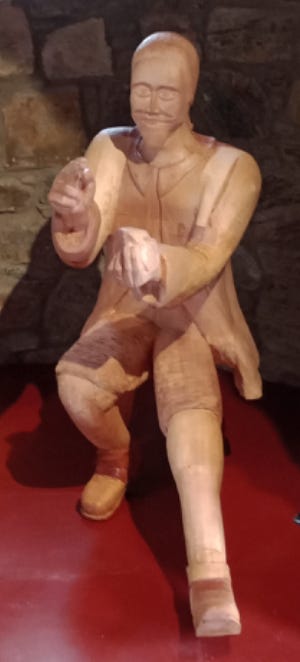
Statue of Bl Dermot Duggan in St Mary’s Bornish, blessed by Bishop Brian McGee in 2025.
Readers will find that the Coracle has published various articles on the particularities of Catholicism in the Outer Hebrides, and some also on the personalities who were involved. We previously mentioned, in the piece dedicated to Fr. Douglas Macmillan, the articles concerning such luminaries as Fr. Allan McDonald and Fr. George Rigg.
One of the only places in the British Isles to have survived the Reformation was the Isle of South Uist, alongside the smaller islands to its south. To be precise – Barra, Berneray, Vatersay, Mingulay, Pabbay, Sandray, Fuday, Hellisay, Fuiay, Gighay, and Eriskay. Since all of these islands were so isolated, they also preserved a Catholicism which was somewhat indigenous to the region. This Catholicism has been described as part of the wider phenomenon of “Celtic Christianity”, although the term is notoriously difficult to define, and is fraught with controversy.
The Reformation, and the Counter-Reformation which followed it, would likely have swept most of these traditions away. Only the isolation of the Hebrides protected their Celtic culture from such an eventuality. That being said, the Reformation did cause a chronic shortage of Priests to the region, and there were some efforts to reach these islands through time. The Catholic Faith had become dangerously fragile in this context, and whole generations of people were uncatechised.
St. Vincent de Paul (1581-1660) was notable in that he took an interest in places where the Catholic Faith was most endangered, from his flourishing Congregation of the Mission in Paris. Inspired into action and given financial aid by such figures as Marie-Madeleine de Vignerot, the niece of Cardinal Richelieu, he sent missionaries to regions as varied as Madagascar, North Africa, and the Western Highlands and Islands of Scotland.
One of these missionaries was M. Dermot Duggan CM[1], who had been born in Co. Tipperary and who knew the Gaelic language. Born in 1620, he entered the Congregation of the Mission on the 26th August 1645, after he had been Ordained a Priest. He went to Paris in 1648, before being sent to Scotland in 1651.
We see that Duggan began by converting the Chiefs in the region, including Glengarry and Clanranald. In a letter to St. Vincent de Paul, dated the 28th October 1652, Duggan writes:
“God graced us, upon our arrival in Scotland, to cooperate in the conversion of the father of M. de Glengarry. He was an old man aged 90 years, raised in heresy since his youth. We instructed him and reconciled him to the Church during a great illness, which soon led to the grave, after he had nevertheless received the Sacraments and testified a true regret for having lived so long in error, and an unspeakable joy that he would die Catholic. I reconciled also many of his domestics and some of his friends, though quite secretly.”
This initial conversion near the outset of Duggan’s mission was an extraordinary success, and refers to the son of “Old Glengarry”. Both the old Chief and this son were called Donald MacDonnell. Old Glengarry had been Chief for some 70 years, and died aged 102 in 1645. Due to advanced age, his son had missed his chance to govern, and it was therefore the grandson Aeneas MacDonnell who held power. We may notice that Donald was born in 1562, if he met Duggan in 1652, which was only two years after the Scottish Reformation. This makes his conversion to the faith in which his father had been born quite meaningful, bringing the story of the Reformation back full circle to the old Catholic Faith, all in one lifetime.
Later in the same letter, Duggan writes about his experience with Clanranald (John MacDonald, 13th Chief of Clanranald) and on the Isle of South Uist more generally:
“I travelled to the Hebridean islands, there where God, in His Merciful Omnipotence, worked wonders beyond all hope. He had so well disposed their hearts, that M. de Clanronald, lord of a good part of the Isle of Uist, converted with his wife, the young lord his son, and all their family, and all the gentlemen, their subjects and their families. I worked also with the people of this island and passed to those of Egga and Canna, where God converted eight to nine hundred people […] I found thirty or forty people aged 70, 80 or 100 years and more[2], who had not received Holy Baptism ; I instructed them and baptised them, and a little time after they were dead ; and without doubt they pray now before God for those who procured them such a great good.”
The conversion of John MacDonald was another great grace for the mission, and assured continued support from Clanranald going forward. However, his son Donald MacDonald, who became 14th Chief and who was converted by Duggan, later gained a terribly evil reputation. He came to be known as “Black Donald of the Cuckoo”, since he would shoot innocent tenants from the walls of Castle Tioram, with his gun which was named the “Cuckoo”. One of the darkest events recorded about him was his hanging of a poor old woman for stealing his snuff.
Certain stories suggest he sold his soul to the devil. Folklore thus recounts how he came to be haunted by a black toad, following him everywhere like an evil familiar, and which eventually sat near his deathbed on the Isle of Canna. As he lay dying, whistling could be heard, which seemed to herald his damnation, and a very tall figure could be seen approaching his abode. Some versions of the story recount that a brave widow’s son was in the room with Donald. When the Chief tried to get up feverishly, to meet the figure, the young man forced him back onto his sickbed. This occurred on three successive times, at which point that the tall figure was unable to physically claim Donald’s soul. All the other people nearby had since fled upon sight of this tall apparition – who was none other than the devil. Eventually, it departed towards the Isle of Rùm, walking over the sea, the widow’s son having saved the Chief. So it was that Donald finally praised God, and he died in relative peace, reconciled to the Church, in the year 1686. We might wonder whether Duggan was interceding for him, and whether the grace of the Sacraments that had been received at the Vincentian’s hands finally won him over to God at the very end, despite a life of great sin. Of course, the historical details of such stories allude us, and are unverifiable.
Perhaps the historical uncertainty, and dramatic content of the story, shouldn’t really bother us. In South Uist, and the wider region, storytelling has always been a significant part of the culture. It is through storytelling that cultural knowledge is transmitted. This can refer to historical events which affected the whole community, and which ought to be remembered. Donald’s reputation asides, it is interesting to realise that Dermot Duggan has become an undying part of the story.
Indeed, the success of Duggan’s mission continued to affect this same Clanranald lineage which would later produce, just over a century later, such figures as Flora MacDonald (1722-1790) and Alasdair mac Mhaighstir Alasdair. It would anchor the Catholic Faith that later served the Jacobites so well, and which left behind an enduring legacy, one which is still with us today. Even in the restoration of the Catholic hierarchy in 1878, many of the key leaders in that process were descendants of Clanranald: Bishop Hugh MacDonald (1699-1773), Bishop Hugh MacDonald (1841-1898), Archbishop Angus MacDonald (1844-1900), and Bishop Aeneas Chisholm (1836-1918). Even Bishop Roderick Wright (1940-2005) is a latter-day descendant! We have Dermot Duggan to thank for all of this, in a roundabout way, and it may well have been another story entirely if he hadn’t been sent by St. Vincent de Paul. We may conclude with one further extract, from Duggan’s 2nd letter to St. Vincent, dated to April 1654:
“We are infinitely obliged to without ceasing thank the Divine bounty for so many blessings that He was pleased to pour upon our little works. […] Among those who received Holy Communion, there were found five who God showed to not be in the disposition that they must have, because having stuck out their tongues to receive the Blessed Host, they could not withdraw their tongues ; there were three who remained in this state until we took back the Blessed Host […] God chose to allow these extraordinary effects to give to the other Christians of this land a greater fear […] We also saw many wonderful things operated through the virtue of Holy Water […] We baptised a great number of children and even adults of 30, 40, 60, 80 years and more, being assured that they had never been baptised, among them there were found those who, being troubled and vexed by ghosts and evil spirits, were entirely delivered, after they had received Baptism, such that they never saw these again.”
This extract highlights a miraculous side to Duggan’s missionary work and confirms that his ministry was supported by “signs and wonders”. However, he was soon worn down by it all, and he died on the 17th May 1657 in South Uist, after only a few years of very fruitful mission. He had been preparing to visit Pabbay. Although he expressed elsewhere in his letters the desire to go to North Uist, and to help evangelise the people there, this was never to be. North Uist remains Protestant to this day. St. Vincent de Paul received news of his death on the 31st October 1657, the Eve of All Saints’. We find the following extract from the writings of St. Vincent de Paul, dated to All Saint’s Day (1st November 1657):
“I read a letter yesterday, touching on our good dead M. Duiguin, through which I am informed that his death moved everyone to tears, seeing that they lost their good father (they held him to be so) ; and the old and the young, all were in tears ; he was their father, having begotten them to Jesus Christ. This can give some subject of esteem firstly to our Company, seeing this ; but what we must make of these of these intimations, is to say, as soon as we see and hear this: “To You alone, Lord, the glory! To You, my God, all the glory!””
It seems to be providential that St. Vincent received this news on the Eve of All Saints’ and wrote these words on the Feast of All Saints’ itself. Indeed, probably unknown to St. Vincent, it was only soon after his death that the people of South Uist began to venerate Dermot as a Saint. A chapel seems to have been built in his honour, in the sacred land of Howmore, where the Clanranald Chiefs were buried, and his body was plausibly transferred there from an initial burial site in Cladh Ard an Dugain. This latter site’s name simply translates as “High Graveyard of Duggan”. Fr. Michael MacDonald helped provide some of these details, and he also noted that there are some Holy Wells associated with him on the island. Short of excavating his likely burial site at Howmore, in the chapel dedicated to him, we have no Relics of the man. Original copies of Duggan’s letters were also lost in a fire that devastated the Vincentian archives. What we do have is a statue of Duggan, blessed by Bishop Brian McGee on the Feast of the Transfiguration (6th August 2025), and erected within St. Mary’s Church at Bornish. Prayer cards invoking his intercession were also produced at the time.
If he was indeed acclaimed a Saint in South Uist, and if this cultus seems to have continued for some time – traditions among those in Nova Scotia continued to remember miracles that he had wrought among their ancestors – it seems that we might take Duggan’s status quite seriously. The dedication of a Church to his name, the Holy Wells associated with him, and the recognition of his heroic virtues by the Vincentians themselves : all of this seems to attest to his likely sanctity. Since his cultus was localised to the regions where he missioned, he could only potentially be considered as a Blessed, under the current rules surrounding Canonisation.
It is, in any case, quite a thought that veneration to this early Vincentian missionary may even have preceded the death of St. Vincent de Paul. Might Bl. Dermot Duggan CM be the first Vincentian to have been venerated as a Saint? He died in 1657, and Vincent died in 1660, so it certainly seems possible.
Bl. Dermot Duggan, pray for us!
Anthony MacIsaac
[1] Vincentians were always given the title of Monsieur, rather than that of Father, as a sign of humility.
[2] As with Glengarry, it seems extraordinary that Duggan was baptising centenarians in this time period, people who would have certainly been born around a decade before the Scottish Reformation. For such people, they were likely born into some form of Catholicism (Duggan’s doubt about their Baptism is interesting) and this mission allowed them to die as Catholics.
Bibilography
Louis Abelly, La Vie du venerable serviteur de Dieu Vincent de Paul, 1. II, chap. 1, sect. XI, 1er éd., p. 202-204.
Dom Odo Blundell,The Catholic Highlands of Scotland. Vol. 2. The Western Highlands and Islands, 1917.
Angus MacLellan, Dòmhnall Dubh na Cuthaig, Recorded by Calum Iain MacLean, School of Scottish Studies Archive, SA1960.011.A3. Available at Tobar an Dualchais: tobarandualchais.co.uk [Accessed 22nd August 2026].
Authors Note
Anthony MacIsaac – the author descends from Clanranald (specifically from Allan MacDonald, the 9th Chief), his entire paternal family having deep links to South Uist and the wider Hebrides. For most of his theological studies, he was lodged with the Congregation of the Mission in Paris.
Grateful thanks to M. Jérôme Delsinne CM, who made archival materials available for the writing of this article. Thanks also to Fr. Michael MacDonald, and to Bishop Brian McGee, for their input on the same subject.
Translations from the French are the author’s own, and the particular extracts from Duggan’s letters chosen by him for the purposes of this article.
Thanks for this, I had no idea about the Catholic population in this area.