
In March just past, Bishops across the country assembled to talk about the current functioning of the Catholic Church in Scotland, and changes that can be made for its betterment.
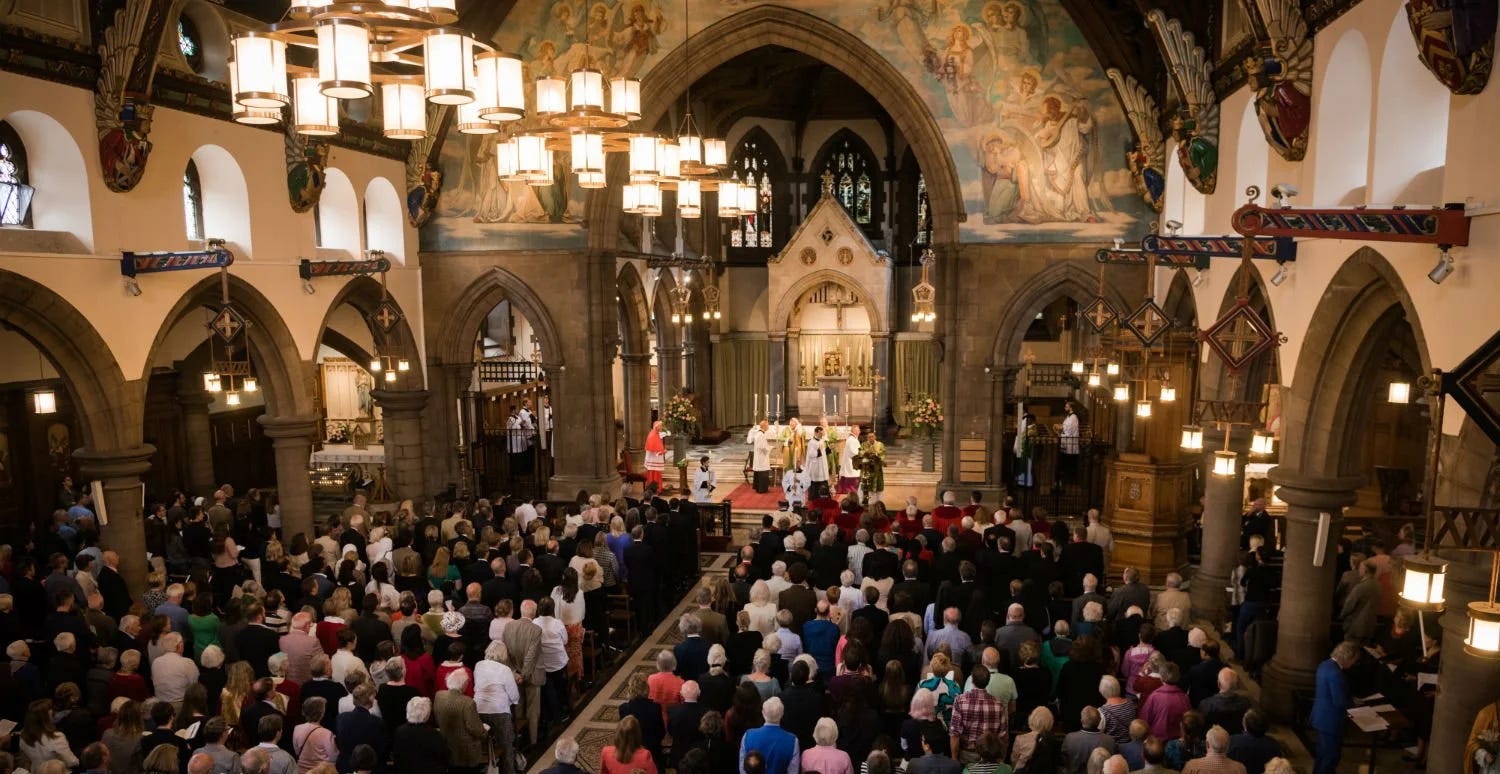
Pictured: St Mary’s Catholic Cathedral, Easter Sunday, 2026
The statement produced at the Bishops’ Conference of Scotland for 2026 addresses some stark pressures that the Church is currently facing, ranging from a lesser number of ordained priests; evolving practices; the eight dioceses across Scotland lacking in the essential requirements to function and more.
While these issues were addressed in the statement, it was also highlighted that the Holy See initiated this call for introspection among the Bishops in the country, and to determine whether it’s possible to maintain the upkeep of all these dioceses.
We spoke to Bishop John Keenan, of Paisley, to gather more information about the talks and the approach to future evangelisation:
“The process is not about rationalisation in an administrative sense. It is about how… we can be the best Catholic Church in terms of our mission of evangelisation and the involvement of the whole People of God in the life and mission of the Church.” (Bishop John Keenan, 2026)
This outlined the deep-rooted interest in evangelism in the Church, and that it is intrinsically connected to the heart of the Gospel and Jesus Christ being its drive during outreach. This echoes what is in the official Bishops’ Conference statement, which reads:
“Yet our mission remains unchanged: to proclaim the Gospel and to lead our people to Christ.” (Bishops Conference of Scotland, 2026)
While the importance is on evangelisation, there are two potential routes that have been proposed in order to ameliorate the problem of lowering resources among the dioceses of Scotland. These are drafted to ensure that the future of the Catholic Church in Scotland is a positive and fruitful one, and are important facets of the official March 2026 statement.
One of these options sees the maintenance of the current ecclesial framework of the eight dioceses of Scotland, maintaining their individual identities as separate to the other, but highlights that in order to achieve this vision, there must be shared resources. This creates space for more conversations to be held, as inter-diocesan communications are what will fuel this pathway.
The second route that was proposed sees the merging of dioceses across Scotland, as it acknowledges that resources are short, and ergo, the current ecclesial framework across Scotland will change in order to merge them.
Bishop John Keenan highlighted the importance of lay voices in these choices, and that they are valued by Bishops who are currently in the process of decision-making:
“The bishops will get together to discern among ourselves first of all, but we are keen to involve the clergy and the lay faithful of Scotland.” (Bishop John Keenan, 2026)
The symbiotic clerical/lay relationship in this process is emphasised by Bishop Keenan as he discusses the importance of the decision at hand. Either one will impact the future functioning of the Catholic Church in Scotland, and will come with its proponents and its naysayers.
Both clergy and laity are encouraged to pray during this time of discernment, and are asked to contribute in sharing their thoughts on the future of the Church body across the country.
By Dhylan Livani
Instead of asking, “Why is the ship going down and what can we do about it?” they’re going to rearrange the deck chairs.
May God have mercy on us all.