
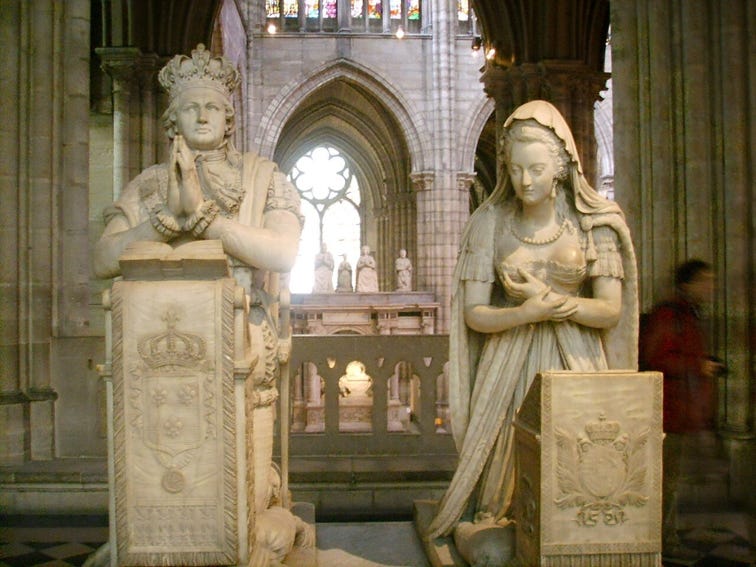
Born on the 2nd November 1755 in the Hofburg Palace in Vienna to parents Francis I, Holy Roman Emperor and Empress Maria Teresa, Marie Antoinette was to become amongst one of the members of French aristocracy most infamously associated with the French Revolution.
Despite her eminence, the historiographical discourse on her personal life is somewhat clouded. Many historians disagree as to her true intentions regarding her marriage, country, and family. While some claim that she was deceitful, adulterous, and insincere, others defend her integrity. However, much of the popular discourse surrounding Marie Antoinette is myth – backed up by little, if any, evidence.
In fact, Marie Antoinette is believed to have been a devout Catholic. This is rarely mentioned by historians, who seem to brush aside the meek and pious aspect of her character, instead choosing to dwell on the false allegations which led to her demise. Having been brought up in the religious Hapsburg family, Marie Antoinette returned with greater fervour to her faith as she aged. By the end of her life, she seems to have been very devout, caring most for her children.
Marie Antoinette (called Antonia growing up) enjoyed a carefree childhood in the Schönbrunn and Hofburg palaces, being well educated in music and the arts. She was married at the young age 14 to the French dauphin Louis, grandson of King Louis XV, as an attempt by her mother to maintain the alliance between France and Austria which had been established during the Seven Years’ War (1756-1763), following their long-subsisting rivalry since the War of Spanish Succession and War of Austrian Succession (1740-48).
The marriage was not a happy one; it was not consummated for seven years, which led to much speculation about the ability of Marie Antoinette to produce an heir. Additionally, the king was not attentive to his wife, often disregarding her. They were not a well-suited couple. The king himself was supposedly not a strong or decisive man, meaning that Marie Antoinette often bore the burden of making political decisions, despite her lack of competence in such matters.
Thus, several of the decisions made by Marie Antoinette during the swelling tide of revolution in France may not have been the most prudent or expedient. But it was not because of her political decisions that she was to be so detested. Nicknamed Madame Déficit, she was regarded as a pompous spendthrift who was single-handedly contributing to her country’s financial crisis. It did not help that she was Austrian…
“Let them eat cake!” Many people know that this quote is falsely attributed to Marie Antoinette. She is alleged to have uttered it upon being informed about the starving peasants of France. However, there is no evidence that she ever said this. Instead, it is most likely attributed to the Confessions of Rousseau, which mentions a great princess saying this. One theory of historians is that this phrase was adopted by revolutionaries and falsely attributed to Marie Antoinette due to the likeness of situation and state.
In contradiction to allegations that Marie Antoinette lacked compassion for her people, there are many cases to be found where both she and her husband took their duties of almsgiving very seriously, personally caring for the poor and needy beyond what was required of them as monarchs. Further, letters from her mother, Empress Maria Teresa, show her being scolded for not taking enough care with her appearance and appearing too shabby. Whilst it is certainly true that Marie Antoinette was sometimes rather lavish in her appearance, it is also worth noting that this was a necessary requirement for the French Queen Consort, and not merely vanity or superfluity.
The second major (false) allegation made against Marie Antoinette is that she partook in an adulterous affair with a Swedish Count Axel von Fersen. The evidence of correspondence between them suggests that they had a close friendship, but historians disagree over whether this was a physical affair or merely an intense platonic friendship.
The third and final scandal which served to darken Marie Antoinette’s name was the Affair of the Diamond Necklace (1784-5), which was a series of duplicitous actions committed in the name of Marie Antoinette as part of a scheme by Jeanne de la Motte to swindle money from a diamond necklace worth over $17.5 million today. It included the false implication of Marie having had an evening rendezvous with a certain Cardinal de Rohan. The perpetrator even went as far as hiring a prostitute to impersonate Marie Antoinette. Despite her innocence in the whole affair, this scandal furthered all feelings of mistrust and hatred towards Marie Antoinette. It served as the final blow in a long line of growing disdain, the French people seeing her as an adulterous, money-grabbing queen.
From this moment onwards, it was clear that Marie Antoinette would never regain what little popularity she had in France. The significance of one diamond necklace represented the aloof and self-absorbed mind of the Aristocracy: while her people couldn’t afford bread, Marie Antoinette was perceived as writing secret letters to a cardinal beseeching him to procure for her a diamond necklace.
On 20th June 1791, with the help of the aforementioned Swedish Count, the king and queen attempted to escape, having correctly realised that their lives were at risk. However, it was already too late. They were apprehended by Revolutionary forces and brought back to Paris. On 10th August 1792, Tuileries Palace was stormed and destroyed. The King was put to death in January of 1793. Marie Antoinette was confined, watched the heads of her friends (Princess Lamballe) be paraded on pikes, and was finally tried and guillotined on 16th October 1793. Her death is reported to have been calm and not the spectacle which the crowd expected. She even apologised for stepping on the executioner’s foot – her last words.
The life of Marie Antoinette, though lavish, was a pious and deeply misunderstood one. Her death, which can be seen as a martyrdom for what she believed to be a position instituted by God, was serene and humble.
The last words of her diary read:
“My God, have pity on me! My eyes have no more tears to cry for you
my poor children; adieu, adieu!”
By Grace Marshall