
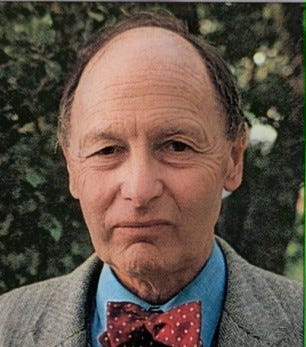
William (‘Willie’) Charlton who died on 5 September 2025 was a Catholic philosopher with strong Scottish connections. As well as teaching Latin at the University of Glasgow at the beginning of his career, he returned to Scotland to teach philosophy at the University of Edinburgh from 1988 to his retiral in 1994. Although he died a year ago, I was shocked to learn only recently of his death. I have only been able to find one obituary online celebrating his life [1] and, although I’ve no doubt there have been other tributes which I have missed, his life and work deserve to be celebrated in St Moluag’s Coracle as part of the intellectual and cultural depth in Scottish Catholicism which we exist to explore. For more personal reasons, I recall him with affection and gratitude as my PhD supervisor in the 1990s.
Willie was born in York on 23 April 1935. After Ampleforth College (open scholar, 1948-53), he attended New College, Oxford as an open scholar (1955-9: first class in Classical Moderations, 1957; first class in literae humaniores, 1959; MA, 1963). After a period of teaching Latin in the University of Glasgow, he returned to New College for a BPhil in philosophy (1961-3). He taught at Trinity College Dublin from 1963 to 1968, initially as junior lecturer, then as lecturer in mental and moral science. He was then lecturer and subsequently senior lecturer in philosophy at the University of Newcastle-upon-Tyne (1968-88). From 1988 to his retirement in 1994, he was senior lecturer in philosophy at the University of Edinburgh (Head of Humanities Planning Unit and Chairman, Department of Philosophy, 1991-4). He was visiting professor to the Universities of Bucharest and Cluj in 1991. He published many books on metaphysics, philosophy of mind, ethics, religion, and aesthetics, as well as translations of ancient Greek philosophical texts, and over eighty articles in philosophical journals.
Much of Willie’s contribution to the subject has developed from a concern with classical philosophy and, in particular, with the traditional problems of metaphysics. As he says, ‘I never open Plato without being surprised by new proofs of his originality and acuteness, and my own answers to the traditional questions were nearly all developed in efforts to make sense of the dark conclusions of Aristotle’ [2]. Perhaps the best overview of his concerns is provided in The Analytic Ambition (1991), which, although described as ‘an introduction to philosophy’, is rather an exercise in philosophy. As such, it does not rest content with a survey of possible positions, but rather advances original arguments in a number of areas: the worthwhileness of the analytical, Anglo-American tradition in philosophy is demonstrated by applying it. Arguing that the central problems of philosophy are concerned with the relationship between the dimensions of reality, language and thought, he contrasts his own position with a widely held alternative viewpoint: ‘Insofar as the aim of metaphysics were achieved it would enable us to know precisely what there is in the world’ [3]. Rejecting this position, he argues instead, ‘Different forms of expression correspond to and reflect (sometimes insincerely or deceptively) different ways in which things enter into thought; and to describe how things do enter into thought is to say how we think they enter into reality’ [4]. In providing an account of these relationships, ‘The philosopher attains truth in the way Michelangelo attains truth about the human figure, not in the way in which a spy attains truth about a country’s military preparations’ [5]. Put roughly, his is an approach which puts the emphasis on how we describe the world, rather than on what we describe.
In his later work, The Physical, the Natural and the Supernatural (1998) he develops some of these themes by arguing that the development of our way of talking about matter and mind has been infelicitous, losing the possibility of a conception of the natural which would make sense of hopes for a supernatural life. (This book also contains some interesting experiments in reviving the presentation of philosophical arguments in the form of dialogue.)
Willie’s philosophy, both in his written work and in his teaching, demonstrated his understanding of the subject as a civilised art. Bringing together the influences of classical philosophy, the emphasis on the creative power of language in modern analytical philosophy and his Catholicism, his work is valuable, not so much for the presentation of any radical theories, but for an elegant and frequently original engagement with central issues within the subject. It’s often dangerous to read off any strong connections between the ideas of academics and their lives, but my own personal experience of his supervision as his PhD student tends to reinforce for me this passing on of philosophy or perhaps more exactly a cultured wisdom as one of his main characteristics. His wide intellectual and artistic interests were coupled with both a rigorous exploration of the philosophical aspects of these areas as well as an extraordinary generosity in sharing his time with students in social settings. I frequently met with him at his homes, first in Edinburgh and then in Northumberland, sometimes on my own, but just as often with my wife and children. To pick at random one strong memory, one of my earliest meetings with him took place after a family meal at his Northumberland home, accompanied by his wife Anne, and his daughter, Tessa, where, rather than the simple praise of an utterly delightful meal, the precise strengths and weaknesses of the cooking were analysed with a forensic exactness with a view to future improvement. (I have since tried this with my own family with rather unfortunate results: it requires a combination of affection, tact and intellectual clarity that the Charltons possessed and we don’t.) Over the years, I often dined with him where he would also sing the praises of Brillat-Savarin’s, The Physiology of Taste as a philosophical work. This might sound all rather fine but all rather precious, but I never felt it to be that, even though it left me with my low tastes and almost pathological introversion rather floundering at times. Instead, I thought then and now that it was a perfect attempt to pass on a resistance to a failure within modern academic philosophy which Mary Midgley, a friend from his Newcastle University days, described thus:
None of these [great] philosophers … had any experience of living with women or children, which is, after all, quite an important aspect of human life. I wrote…drawing attention to this statistic and asking whether it might not account for a certain over-abstractness, a certain remoteness from life, in the European philosophical tradition. [6]
To see a Catholic intellectual and his family just living with the ordinary everyday things of life, and yet bringing a depth to them in that ordinary living profoundly influenced me. [7] When I told Willie that I was converting to Catholicism and that he and Anne had been an important part of that process of conversion, he was rather horrified at the thought that he might have unduly influenced me. He hadn’t, indeed, we rarely discussed religion directly, but he was one of those people I have met over the years who have modelled a way of living and thinking that manages to be both profoundly human and yet to live that humanity very deeply indeed. That was influential.
References:
[1] Frank Charlton, ‘William Charlton (1935–2025)’, Memorial minutes 2025, American Philosophical Association [available online at https://www.apaonline.org/page/memorial_minutes2025 , accessed 3 September 2026]. Apart from my personal memories of him, I have relied on this obituary by his son, together with a biographical entry which I wrote for the Dictionary of Twentieth Century British Philosophers, Thoemmes Continuum, Bloomsbury Publishing, 2005.
[2] ‘Orientations: William Charlton’, p. 108 in in Philosophical Writings, no 1 (January 1996), pp. 107-108.
[3] The Analytic Ambition, p. 15, (Oxford, 1991).
[4] The Analytic Ambition, p. 21, (Oxford, 1991).
[5] The Analytic Ambition, p. 12, (Oxford, 1991).
[6] From Midgley’s The Owl of Minerva, quoted in Ellie Robson, 2025, ‘So many unmarried men’, Aeon, [available online https://aeon.co/essays/for-mary-midgley-philosophy-must-be-entangled-in-daily-life , accessed 3 September 2026]
[7] That this ‘ordinary living’ included some profound personal tragedies can be seen in his son’s obituary referenced in [1] above. A reminder, if one were needed, that a human life, however blessed, remains one conducted in a vale of tears.
Select bibliography (focusing on works directly related to Christianity):