
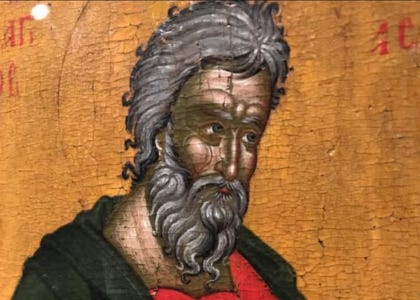
“St Andrew now in bliss above,
thy fervent prayers renew
that Scotland yet again may love
the faith, entire and true…”
Each year on 30 November, this final verse of the Hymn to St Andrew is sung in Catholic parishes across Scotland. Its plea, that Scotland yet again may love the faith entire and true, captures something profound about the role St Andrew has played in the spiritual imagination of this nation.
For centuries, Scots have appealed to Andrew not only as a patron saint but as a custodian of Scotland’s identity, a guarantor of its independence, and a bridge between Scotland and the wider Christian world. Yet, for many of our fellow citizens today, St Andrew’s Day has become a secular festival, an opportunity to celebrate music, food, poetry, and national symbols, often without reflection on the faith that first bound Scotland to this apostle of Jesus Christ.
So why does St Andrew still matter? And why should he remain especially important for Scottish Catholics?
To answer these questions, we must first understand two intertwined stories: the life of the apostle Andrew himself, and the long, complex, and sometimes contested history of how Scotland came to claim him as its patron.
The Apostle Andrew: “First-Called” and Fisher of Souls
Long before he became a national emblem or the figure behind a white cross on a blue field, Andrew was a fisherman of Galilee. According to the Gospel of John, he was originally a disciple of John the Baptist and thus stands at a hinge moment between the Baptist’s call to repentance and Christ’s proclamation of the Kingdom. Andrew is called protoklētos , “the first-called”, because he was among the very first to follow Jesus and, crucially, the one who brought his brother Simon Peter to Christ. In the Catholic tradition, this detail is not incidental. Andrew stands literally and symbolically at the threshold of apostolic succession, pointing his own brother toward the One who would declare Peter the rock upon which the Church would be built.
Andrew appears in the Gospels as practical, attentive, and quietly faithful. It is he who brings forward the boy with five loaves and two fish during the feeding of the five thousand: a characteristically modest gesture that nonetheless becomes the starting point of a miracle. His martyrdom in Patras, on an X-shaped cross, further cemented his role as a witness who refused to imitate Christ’s death identically, believing himself unworthy to die in the same manner. It is this distinctive cross, the crux decussata, that would come to dominate Scotland’s civic and ecclesiastical imagery.
From Patras to Fife: Legend, Relics, and Medieval Identity
Andrew never set foot in Scotland. His link to this country emerges from the medieval imagination, yet in ways that shaped real political and religious developments.
According to the influential medieval legend, St Rule (or St Regulus), a monk in Patras, received a vision instructing him to carry Andrew’s relics as far west as possible. He landed on the shores of Fife, establishing a shrine around which the town of St Andrews would later grow. Whether this story is historically plausible mattered less than its spiritual and political resonance.
By the twelfth century, St Andrews had become the ecclesiastical heart of Scotland, with a cathedral that was the largest in the kingdom and a pilgrimage centre of international significance. The presence of Andrew’s relics allowed Scottish kings and bishops to place their nation within the wider sacred geography of medieval Christendom.
A second tradition reinforced this bond. In the ninth century, King Óengus II supposedly saw a white cross appear in a clear blue sky before a decisive battle against the Angles. Victory followed, and Andrew was declared patron of the Picts and, eventually, of all Scotland. This legend did something powerful: it fused Andrew’s martyrdom with Scotland’s political self-understanding, embedding the Saltire in both religious devotion and national mythology.
By the Middle Ages, then, St Andrew was not merely a saint among many. He was the saint through whom Scotland articulated its belonging to the universal Catholic Church and its independence as a Christian kingdom.
St Andrew and the Declaration of Arbroath
The high point of Andrew’s political significance came in 1320 with the Declaration of Arbroath, Scotland’s most famous medieval document. Addressed to Pope John XXII, it invoked St Andrew to assert Scotland’s ancient dignity and independence. The signatories appealed to the Pope not simply as a political arbiter but as the spiritual successor to the apostle Peter, Andrew’s own brother. This familial symbolism was intentional and sophisticated: if Scotland’s patron was the brother of the first pope, then Scotland’s place within the Catholic world was not peripheral but deeply rooted.
Through Andrew, Scotland expressed both fidelity to Rome and its own sovereignty, an early articulation of what we might call a Catholic vision of nationhood.
Reformation and Rivalry: A Saint Claimed by Both Sides
The Scottish Reformation of 1559–60 transformed the religious landscape. The medieval cult of saints was rejected, relics were denounced as idolatrous, and St Andrews Cathedral was stripped and abandoned after an iconoclastic uprising prompted by a sermon from John Knox. Andrew’s relics vanished, likely destroyed or dispersed. For the new Presbyterian establishment, saints could be historical examples of faith but not mediators or intercessors. Andrew’s significance shifted from spiritual patron to a cultural symbol of political and religious independence.
Yet Catholics responded differently. The disappearance of the relics was not merely a political act but a rupture in Scotland’s sacred continuity. For recusant communities, missionary priests, and later the Scottish Catholic diaspora, Andrew remained a sign that Scotland had once been woven fully into the fabric of the Catholic world. Writers in the post-Reformation period insisted on Andrew’s apostolic authority and his connection to Peter as reminders that Scotland’s ancient faith was inseparable from Rome. Even without relics, the saint became a symbol of persistence, identity, and hope during centuries of marginalisation.
What followed was a remarkable paradox: both Protestants and Catholics claimed St Andrew as proof that their tradition represented Scotland’s authentic identity. Presbyterians emphasised Andrew as the figurehead of a non-Roman, scriptural, national Christianity. Catholics saw him as the silent witness to Scotland’s pre-Reformation past and its continued spiritual link to apostolic tradition.
The same saint legitimised two contrasting visions of Scotland. That Andrew could bear this double burden testifies to the depth of his symbolic power.
Union, Diaspora, and Modern Identity
St Andrew’s political role did not end with the Reformation. The Act of Union in 1707 carefully integrated the crosses of St George and St Andrew into the Union Flag, visually asserting a partnership between two ancient kingdoms. Scottish diaspora communities in North America established St Andrew’s societies as early as the eighteenth century, using the saint as a means of preserving culture, memory, and religious identity far from home.
In modern Scotland, St Andrew’s Day has become increasingly secular, celebrating national culture rather than religious heritage. Ceilidhs, Burns recitations, Saltire colours, and traditional food now dominate the day for many Scots.
Yet, within the Catholic Church, 30 November remains a feast marked by Masses in red vestments and, since the nineteenth and twentieth centuries, by veneration of relics of St Andrew in Edinburgh, gifts from Amalfi (1879) and Rome (1969). These relics provide a tangible connection to a tradition once thought lost.
Why St Andrew Still Matters for Scottish Catholics
In a Scotland where Christianity, let alone Catholicism, no longer commands the cultural authority it once did, why should St Andrew continue to matter?
Three reasons stand out.
1. St Andrew anchors Scottish Catholicism in apostolic faith.
Catholic identity is fundamentally apostolic. To be Catholic is to stand in continuity with the Church founded by Christ and handed down through the apostles. Andrew, as the first-called disciple and brother of Peter, reminds Scottish Catholics that their faith is not an imported tradition but one woven into the earliest fabric of the Christian story. His presence in Scotland’s medieval past is evidence that this land once saw itself as part of that universal communion.
2. St Andrew embodies a form of national identity compatible with Catholicism.
In a time when Scottish identity is often contested, politically, culturally, and constitutionally, Andrew offers a model of national belonging rooted neither in ethnic exclusivity nor political ideology. St Andrew historically unified the kingdom, crossing regional, linguistic, and even denominational lines. For Catholics, Andrew represents a way of being Scottish that is neither defensive nor assimilationist, but confident, generous, and outward-looking.
3. St Andrew challenges us to rediscover the spiritual dimension of Scottish identity.
Many Scots today know the Saltire but not the saint. Yet the symbols of a nation are impoverished when stripped of their spiritual roots. For Catholics, remembering Andrew is an invitation to re-evangelise Scotland not by nostalgia, but by witness. Andrew’s life, quiet fidelity, humble service, courage in martyrdom, offers a counter-narrative to a culture often shaped by secularism, individualism, and political polarisation.
If St Andrew could introduce Peter to Christ through a simple act of personal encounter, Scottish Catholics today might ask what equally small but transformative acts of faithful witness are possible in our own communities.
Conclusion: Recovering the Depth of a Familiar Symbol
St Andrew has been many things for Scotland: apostle, protector, national emblem, political symbol, Protestant heritage figure, Catholic memory, and modern civic brand. His meaning has shifted across centuries, but he has never been irrelevant.
For Scottish Catholics, however, the heart of Andrew’s importance remains spiritual. He links Scotland to the apostolic age; he reminds us that holiness precedes nationhood; he calls us to fidelity in times of upheaval; and he continues to ask, in the words of the traditional hymn, that “Scotland yet again may love the faith, entire and true.”
In a secular age, recovering St Andrew is not about reclaiming political ground or resisting cultural change. It is about recognising that even a familiar national symbol contains a deeper invitation, one calling Scotland back to its spiritual roots, and calling Scottish Catholics to live out the apostolic faith with the same courage and humility as the fisherman who first said “yes” to Christ.
By James Bundy
One of the many things James is involved in is A Thistle with Thorns a podcast with Murdo Fraser on Scottish history. The above article is from their show notes. If you want to listen please click the link below: