
The Language of the Bible series has shown why we can be confident that the major modern translations of the Bible faithfully convey the meaning of the original Hebrew, Aramaic, and Greek texts, as well as how elaborate themes like ‘trees’ mirror our relationship with God. In this third stop of our journey, we’re taking a deep dive into bread.
Bread, generally speaking, is an exceptionally important narrative element in both the New and Old Testament. Indeed, bread (and the Eucharist therein) is key to understanding Christ’s role in our struggle for physical and spiritual nourishment. Today I’m going to walk through the various ways in which bread is used in the Bible to reflect on human survival, thanksgiving, God’s presence, and, ultimately, eternal life. By looking back through the lens of the Lord’s Table, and specifically through the linguistic and theological weight of the Greek word eucharistia—meaning “thanksgiving”—we discover a startling reality: every loaf baked, offered, or broken in the Old and New Testaments was whispering of Christ all along.
The Bread of Survival and of Thanksgiving
The biblical narrative of bread begins following humanity’s fall from grace in the Garden of Eden. God declares to Adam the new status of the human condition: “By the sweat of your face you shall eat bread, till you return to the ground” (Genesis 3:19).
In the ancient Near East, this harsh reality was only too true. The Hebrew word for bread, lechem, often carries the broader sense of food or sustenance in general. To have bread was to possess life; to lack bread was to face immediate risk of starvation. Bread represented the anxiety of the harvest, the vulnerability to drought, and the unrelenting, cyclic toil of ploughing, planting, harvesting, and threshing. It was the physical manifestation of human frailty.
Yet, precisely because bread was synonymous with life, sharing it became the ultimate, sacred duty of hospitality. In a world defined by scarcity and tribal warfare, offering bread to a stranger was a radical act of peacemaking. When Abraham (Genesis 18:5) welcomes three mysterious divine travellers, his immediate instinct is rooted in this desert code: “let me bring a morsel of bread, that you may refresh yourselves, and after that you may pass on.” To break bread with someone often symbolized peace, friendship, and covenant relationships, extending one’s own survival to the guest.
The Eucharist takes this ancient symbol of human sweat, anxiety, and survival and radically reclaims it through the power of eucharistia. Crucially, Luke 22:19 records that Jesus took the bread, and “when he had given thanks [eucharistēsas], he broke it and gave it to them.” By offering thanksgiving over the very item that embodied the curse of Adam’s sweat, Christ flips the narrative of human struggle. In the Eucharist, the baseline survival of the ancient world is elevated into supernatural life, and, furthermore, the hospitality of sharing bread reaches its zenith: at the altar, God does not merely welcome us to His table as fragile guests; He offers His very self as the feast, binding humanity to the divine nature in an eternal covenant of peace.
From the Table to the Altar
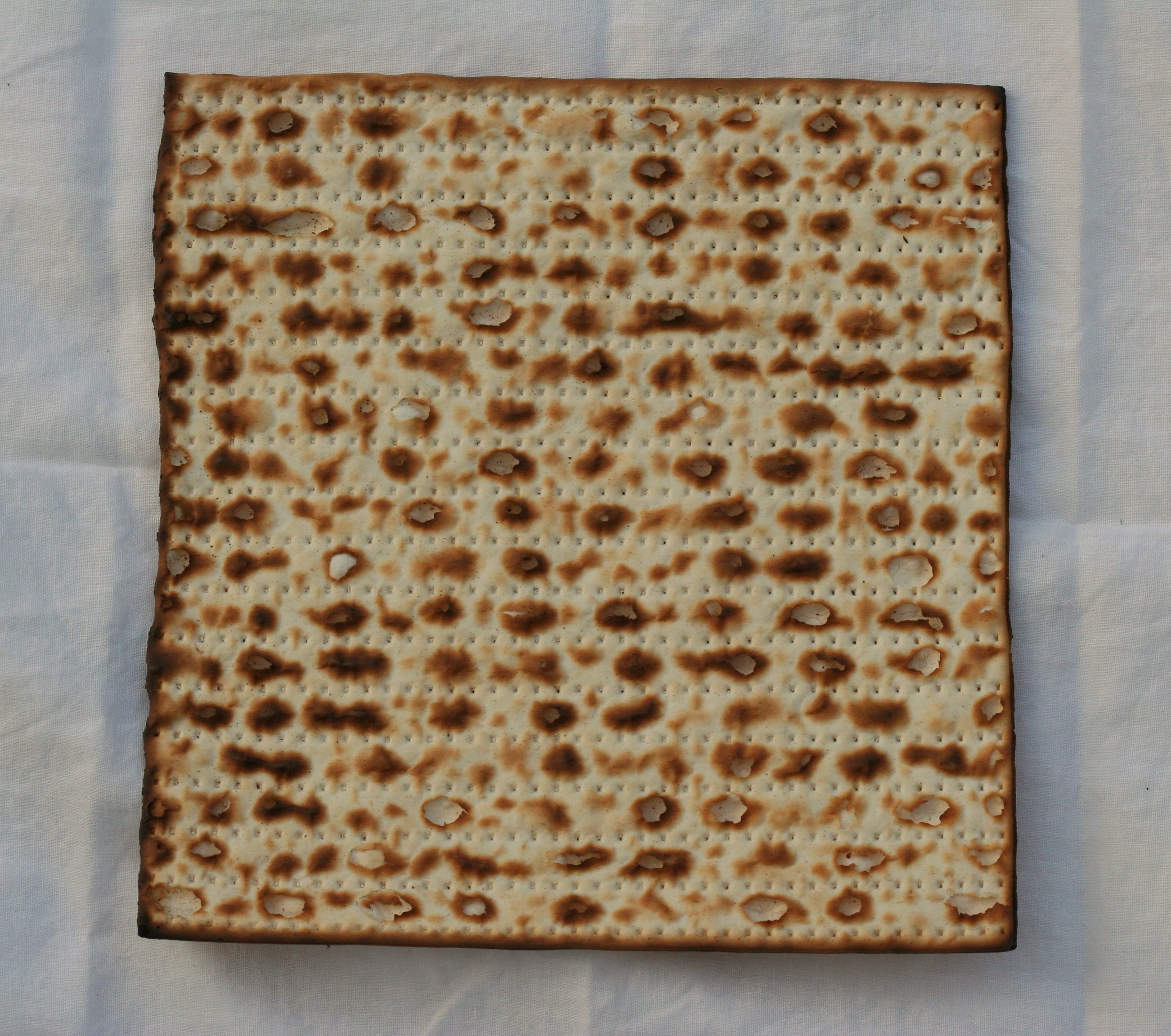
As the biblical story progresses, the transformation of bread begins in the midnight haste of the Exodus. Fleeing the bondage of Egypt, the Israelites are commanded to pack their dough before it can rise. The resulting unleavened bread, or matzah, became a key pillar in Jewish tradition, where its sustenance emphasizes haste and remembrance of the past. On the other hand, yeast, or leaven, subsequently becomes a biblical metaphor, often (though not always) symbolizing sin, corruption, or false teaching.
Once the Tabernacle is constructed in the wilderness, bread is placed before the Lord in the Holy Place. Instructed by divine decree, the priests place twelve permanent loaves of baked grain upon a table of pure gold, directly opposite the Menorah in the Holy Place. This was the Lechem haPanim, literally the “Bread of the Face,” commonly translated as the Showbread or the Bread of the Presence (Leviticus 24:5–8). Replaced every single Sabbath and consumed exclusively by the Aaronic priesthood, these twelve loaves stood as a visual anchor of God’s perpetual covenant with the twelve tribes of Israel. It was a tangible sign that God desired to dwell among His people and share a continuous, peaceful meal with them.
Without the Eucharist, these ancient liturgical rituals remain beautiful but incomplete shadows of ancient history. Just as the ancient matzah marked a definitive rescue from physical slavery, the Eucharistic bread delivers the human soul from the ultimate spiritual bondage of sin and death.
To fully understand this connection, one must look to an ancient Israelite sacrificial practice known as the Todah—the Hebrew word for “Thanksgiving Offering.” The Todah was a voluntary sacrifice offered by a person who had been miraculously delivered from mortal danger, such as illness, imprisonment, or the perils of the sea. It consisted of an animal sacrifice accompanied by an offering of both leavened and unleavened bread. The worshipper, their family, and the priest would then consume this bread and meat together in a festive meal of celebration.
When the ancient Jewish scholars translated the Hebrew Scriptures into Greek (the Septuagint), they translated this specific thanksgiving sacrifice, the Todah, frequently using the root word eucharistia. Rabbinic (Leviticus Rabbah 9:7) tradition even holds a prophetic maxim: “In the Messianic age, all sacrifices will cease, except the sacrifice of Thanksgiving (Todah), which will never cease.”
Catholics have traditionally understood that, when Christ institutes the Eucharist, He is establishing the ultimate Todah. He replaces the symbolic, static Showbread of the Temple with His literal, living flesh. The “Bread of the Face” is no longer hidden away behind a heavy sanctuary veil, restricted to a select Levitical elite. Rather, the living Presence becomes accessible to all, transforming an ancient ritual shadow into an intimate, breathing reality.
The Bread of Immortality
The climax of the biblical narrative bridges the physical and the spiritual through spectacular displays of divine provision. As the Israelites wander through the barren, unforgiving Sinai desert, they find themselves entirely devoid of agricultural options. They can no longer till the ground or eat bread by the sweat of their brow. In response to their desperation, God intervenes directly, raining down a mysterious, miraculous, flaky substance from the sky each morning. The people called it manna, a name traditionally understood to derive from their question, ‘What is it?’.
This wilderness bread carried strict divine parameters: it could not be hoarded, stored, or monetized. If an Israelite tried to stockpile it out of greed or anxiety for the future, it bred worms and rotted by nightfall. It had to be gathered fresh daily. This was a deliberate feature designed by God to radically restructure the psychological architecture of a slave mentality. As Deuteronomy 8:3 summarizes, God fed them with manna “that he might make you know that man does not live by bread alone, but man lives by every word that comes from the mouth of the Lord.” It taught humanity that true security is not found in the hoarding of earthly resources, but in daily, unwavering reliance on the faithfulness of the Creator.
Centuries later, this wilderness motif erupts back into view on the shores of Galilee. Confronted by a massive, starving crowd of thousands, Jesus echoes the divine benevolence of the Old Testament. Taking just five humble barley loaves and two fish from a young boy, He multiplies the resources to feed the multitudes, leaving twelve baskets of fragments leftover (John 6:11–12).
John’s Gospel carefully highlights the miracle through the lens of thanksgiving: “Jesus then took the loaves, and when he had given thanks [eucharistēsas], he distributed them” (John 6:11). The next day, the crowds track Jesus down, demanding more free physical food, explicitly invoking the memory of the wilderness manna. It is here that Jesus throws open the doors to the deepest spiritual reality of the universe. He explicitly contrasts Himself with the miracle of Exodus: “Your ancestors ate the manna in the wilderness, yet they died. But here is the bread that comes down from heaven, which anyone may eat and not die. I am the living bread that came down from heaven... This bread is my flesh, which I will give for the life of the world” (John 6:49–51).
The trajectory of the entire Bible nears its peak in this revelation, capped off by the words spoken at the Last Supper: “This is my body, which is given for you” (Luke 22:19). The Eucharist is the key that translates temporal, physical food into what the early Church Father Ignatius of Antioch famously called “the medicine of immortality.”
Give Us This Day Our Daily Bread
The three great historical movements of bread across the biblical canvas—the bread of earthly survival, the bread of sacrificial ritual, and the bread of miraculous heavenly provision—converge with flawless symmetry at the altar.
The bread of the earth sustains our fragile, mortal bodies; the bread of the altar shapes our holy identity as a rescued people; the bread of the Eucharist saves our eternal souls. Every single time the Church gathers to break bread and offer the eucharistia, the boundaries of time collapse. The sweat of Adam is redeemed, the Exodus is realized, and the heavenly manna falls fresh. Bread is transfigured into the real presence of the Creator of the universe, offering Himself to satisfy, once and for all, the deep and aching hunger of the human heart.
By Jack Heitman